+86 13816508465
Sep. 08, 2026
Commercial and industrial water systems often need much more than simply moving water from one point to another.
A pump installed inside a building services system may need to maintain circulation through hundreds of meters of pipe, overcome pressure losses across heat exchangers and control valves, boost water pressure to upper floors, circulate chilled water through an HVAC system or maintain hot-water flow across an entire facility.
At the same time, mechanical rooms in hotels, hospitals, office buildings, factories and commercial complexes often have limited floor space.
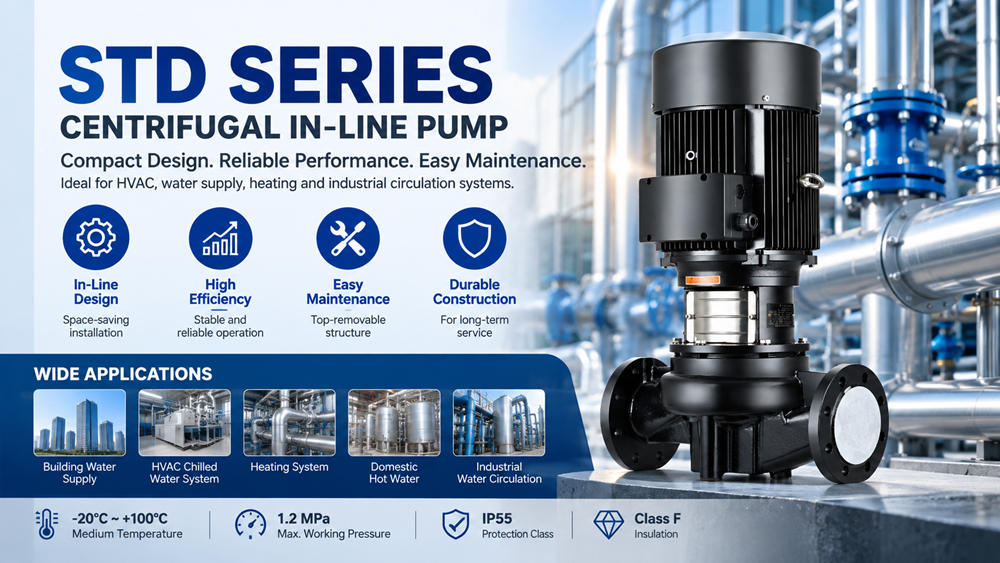
The Stream STD Centrifugal In-Line Pump is designed for these applications.
It combines a single-stage centrifugal hydraulic design with an in-line flanged configuration, allowing the suction and discharge connections to remain aligned directly with the pipeline.
This compact arrangement makes the STD particularly suitable for commercial building services, HVAC circulation, district heating, water-pressure boosting and general industrial water systems.
Its split-shaft construction, top-removable service design and cartridge-type mechanical seal also address another important concern in commercial pumping systems: maintenance without unnecessarily disturbing the surrounding pipeline.
The Stream STD is a single-stage centrifugal pipeline pump designed for commercial and industrial clean-water circulation and pressure applications.
Unlike a conventional horizontal end-suction pump, where water enters from one end and leaves through a discharge positioned at approximately 90 degrees, an in-line pump positions the suction and discharge flanges along the same pipe axis.
This means the pump can be installed directly into a straight section of piping.
The result is a compact pumping arrangement that is particularly attractive in crowded mechanical rooms and plant rooms.
The term in-line describes the arrangement of the pump connections.
The suction and discharge ports are positioned directly opposite each other so water continues through the pump along the pipeline direction.
In a typical installation, the pipe approaches the pump from one side, enters the pump casing, passes through the impeller and exits through the opposite flange.
This contrasts with many end-suction centrifugal pumps, where the discharge changes the direction of the piping arrangement.
Commercial mechanical rooms often contain boilers, chillers, heat exchangers, expansion vessels, valves, water-treatment equipment and multiple pumps.
Every additional pump base and pipe bend consumes valuable floor area.
An in-line configuration allows the pump to become part of the piping arrangement itself.
This can provide several practical advantages:
Reduced mechanical-room footprint
Simplified piping layout
Fewer unnecessary elbows
Convenient replacement in existing pipe systems
Good suitability for vertical pipe arrangements
Compact installation in retrofit projects
| Pump Type | Single-Stage Centrifugal In-Line Pump |
| Medium Temperature | -20°C to +100°C |
| Maximum Ambient Temperature | 40°C |
| Maximum Working Pressure | 1.2 MPa |
| Motor Insulation | Class F |
| Motor Protection | IP55 |
| Connection | Flanged In-Line Connection |
| Seal Type | Cartridge-Type Mechanical Seal |
The STD uses the same fundamental hydraulic principle as a conventional centrifugal pump.
Water enters the suction side and reaches the center of the rotating impeller.
As the impeller rotates, mechanical energy from the motor is transferred to the liquid.
The water moves outward toward the edge of the impeller with increased velocity.
The pump casing then converts part of this velocity energy into pressure before the water leaves through the discharge flange.
Because the STD is a single-stage pump, this energy transfer occurs through one main impeller rather than through multiple impellers arranged in series.
Both single-stage and multistage centrifugal pumps can be used for pressure boosting, but they are optimized for different hydraulic requirements.
| Feature | STD Single-Stage In-Line Pump | Vertical Multistage Pump |
|---|---|---|
| Hydraulic Stages | One | Multiple |
| Typical Strength | Large circulation flow with moderate pressure | Higher pressure from multiple stages |
| Typical Applications | HVAC, heating, circulation and pipeline boosting | High-rise boosting, process pressure and high-head water supply |
Where very high pressure is required, a multistage pump may provide a more appropriate hydraulic solution.
Where the system requires substantial circulation flow and moderate pressure increase, a single-stage in-line pump can be particularly practical.
Commercial buildings can experience pressure losses across long piping networks, valves, filters, heat exchangers and elevated floors.
A correctly selected centrifugal in-line pump can provide the additional head required to maintain adequate system pressure and flow.
Typical installations include:
Hotels
Office buildings
Shopping centers
Hospitals
Schools
Apartment complexes
Commercial facilities
One of the most important applications of in-line centrifugal pumps is commercial HVAC.
A chilled-water system normally circulates water between the chiller and air-handling or fan-coil equipment throughout the building.
The pump must overcome resistance created by:
Long pipelines
Heat exchangers
Cooling coils
Control valves
Balancing valves
Pipe fittings
The pump does not simply lift water vertically.
In a closed hydronic loop, its primary job is to overcome the friction and pressure losses created as water circulates through the system.
Pump head represents the energy the pump adds to the circulating liquid.
In a closed HVAC system, elevation differences largely balance because the water returning downward assists the water moving upward.
The pump therefore mainly needs to overcome system resistance.
This is why accurate pipe-loss calculations are critical when selecting a chilled-water or heating circulation pump.
The STD can also be used in district and central heating systems.
Hot water must circulate between boilers, heat exchangers and the parts of the building where heat is required.
The STD's specified medium-temperature range up to 100°C makes the series suitable for appropriate hot-water circulation duties within its working limits.
District or regional heating systems distribute heated water between central heat sources and multiple buildings or zones.
These networks may involve substantial pipe lengths and hydraulic resistance.
In-line centrifugal pumps can be used at suitable points in these systems to maintain circulation and overcome pressure loss.
Large hotels, hospitals, apartments and commercial buildings often use hot-water circulation loops so users do not have to wait for hot water to travel from a central heater to distant outlets.
A circulation pump keeps water moving through the hot-water network.
Correct pump selection is important because excessive flow can waste energy and increase pipe losses, while insufficient flow can result in long waiting times and unstable hot-water delivery.
Stream also specifies district or regional water-supply systems as an application for the STD.
Pipeline pumps can be used to provide additional pressure where water must move through extended distribution networks.
The pump should be selected according to the required flow and total dynamic head rather than motor power alone.
Factories and industrial facilities use water for many different purposes.
Examples include:
Equipment cooling
Process-water circulation
Washing systems
Utility water distribution
Heat exchanger circulation
Machine cooling loops
A single-stage in-line pump can provide a compact solution where the liquid conditions are compatible with the pump materials and specified operating range.
Commercial and industrial washing systems can require significant flow and stable pressure.
Water may need to circulate through spray systems, cleaning equipment or filtration loops.
The STD can be integrated into suitable water systems where its hydraulic performance matches the required operating point.
Stream also lists boiler feed water among the STD applications.
However, boiler systems vary greatly in required pressure, temperature and water-treatment conditions.
The STD should only be selected where the actual system operates within the pump's stated temperature and 1.2 MPa maximum working-pressure limits.
High-pressure steam-boiler feed systems may require a dedicated multistage boiler-feed pump instead.
Industrial and commercial pumps are commonly connected using flanges rather than small threaded connections.
A flanged connection offers:
Strong mechanical connection
Convenient pipeline alignment
Suitability for larger pipe diameters
Reliable sealing when installed correctly
Convenient removal during major maintenance
The STD uses an in-line flange arrangement that integrates directly into commercial and industrial piping.
Maintenance is one of the most important differences between a commercial pump and a small domestic water pump.
Industrial pumps may operate for thousands of hours and are often installed in systems where shutting down an entire pipeline is expensive.
The STD is designed so that major rotating components can be serviced from the top while the main pump casing remains connected to the pipeline.
This reduces the need to dismantle the surrounding pipework during routine service.
Removing a complete pump from a large flanged pipeline can involve significant work.
Technicians may need to:
Drain the system
Support heavy pipework
Remove flange bolts
Realign the piping after service
Replace flange gaskets
A serviceable top-removal arrangement can reduce some of these tasks because the main casing remains installed.
The STD uses a split-shaft design intended to simplify installation and maintenance.
This construction provides greater service flexibility than a pump where the motor and hydraulic shaft are permanently integrated into one assembly.
For commercial facilities, easier maintenance can reduce downtime and simplify replacement of wear components.
The mechanical seal prevents pumped liquid from escaping along the rotating shaft.
Because the shaft must rotate while the pump casing remains pressurized, the seal is one of the most important wear components in a centrifugal pump.
The STD uses a cartridge-type removable mechanical seal arrangement.
Stream specifies seal materials including:
Carbon
Silicon carbide
Viton
SUS304 stainless steel
The design is intended to simplify seal replacement during service.
Silicon carbide is commonly used in pump mechanical seals because of its hardness, wear resistance and dimensional stability.
In commercial circulation systems, where pumps may operate for long periods, durable seal faces can contribute to improved reliability.
The STD is equipped with a standard motor configuration.
Using a standard industrial motor format provides practical advantages for system integrators and maintenance teams because motor selection, electrical protection and replacement can follow familiar industrial practices.
The STD motor is specified with IP55 protection.
This rating is designed to provide protection against dust ingress sufficient to interfere with operation and against water jets under the applicable test conditions.
IP55 should not be interpreted as permission to submerge the motor or install it in unsuitable flooded locations.
The pump should be installed in an appropriate mechanical-room or industrial environment according to the installation instructions.
Class F motor insulation provides a thermal insulation system commonly used in industrial electric motors.
Correct ventilation and ambient conditions remain important for reliable motor operation.
Stream specifies a maximum ambient temperature of 40°C for the STD operating environment.
Both in-line and end-suction centrifugal pumps are widely used in industrial water systems.
Their main differences relate to physical layout, maintenance and installation requirements.
| Feature | STD In-Line Pump | Horizontal End-Suction Pump |
|---|---|---|
| Pipe Layout | Suction and discharge on same line | Typically 90-degree suction/discharge arrangement |
| Floor Space | Compact footprint | Usually requires more floor area and baseplate space |
| Typical Application | HVAC, commercial buildings and pipeline circulation | Industrial transfer, irrigation and high-capacity installations |
| Maintenance Access | Top-removable design on STD | Often back-pull-out depending on design |
An in-line pump is particularly attractive when:
Mechanical-room floor space is limited
The existing pipeline follows a straight route
The pump is used for HVAC circulation
A retrofit must fit into an existing pipe network
Commercial building services require a compact installation
Maintenance without removing the complete pump casing is desirable
An end-suction centrifugal pump can be more appropriate where floor space is less important and the installation prioritizes conventional horizontal maintenance access or very large hydraulic capacities.
There is no single pump layout that is best for every project.
The choice should be based on hydraulic performance, installation constraints, maintenance requirements and total lifecycle cost.
A vertical in-line single-stage pump and a vertical multistage pump can both appear in commercial water systems, but they should not be confused.
| Requirement | STD In-Line Pump | Vertical Multistage Pump |
|---|---|---|
| Large circulation flow | Well suited when correctly selected | Depends on model |
| Very high pressure | Not its primary advantage | Major strength |
| HVAC circulation | Typical application | Possible but often unnecessary |
| High-rise pressure boosting | Suitable within available head range | Often preferred for high-head requirements |
Many commercial water systems operate at variable demand.
An office building may require high cooling-water flow during the hottest part of the day but substantially less flow at night.
Running a fixed-speed pump continuously at maximum capacity can waste energy when demand is low.
Where the selected STD motor and system design are suitable, a variable frequency drive can be used to adjust motor speed according to system requirements.
For centrifugal pumps, reducing motor speed decreases both flow and head.
Pump power consumption generally decreases rapidly as speed is reduced.
This is why variable-speed control is widely used in modern HVAC systems.
Instead of wasting pressure across throttling valves, the pump can reduce its own speed when full flow is not required.
A pressure sensor and VFD can also be used in suitable commercial booster systems to maintain a target discharge pressure.
As water demand increases, pump speed increases.
As demand falls, the drive reduces speed.
The complete control system should be designed according to the required duty, sensors, electrical system and pump performance curve.
Two values are fundamental when selecting a centrifugal pump:
Flow (Q) describes how much water must be moved.
Head (H) describes how much hydraulic energy the pump must add to overcome the system resistance.
Choosing a pump only according to pipe diameter or motor power is not sufficient.
For an open water-transfer system, total dynamic head can include:
Vertical elevation difference
Pipe friction
Valve losses
Filter losses
Heat exchanger resistance
Required discharge pressure
For a closed HVAC circulation loop, the pump mainly needs to overcome friction and equipment pressure losses rather than the full building elevation.
Every STD model has its own performance curve showing the relationship between flow and head.
As flow changes, available head also changes.
The required system operating point should intersect the pump curve in a suitable operating region.
A pump should not be selected simply because its maximum flow or maximum head appears higher than the system requirement.
A centrifugal pump normally has a region where it operates most efficiently.
This is commonly associated with the Best Efficiency Point, or BEP.
Operating reasonably close to the pump's intended efficient range can help reduce:
Energy consumption
Hydraulic vibration
Bearing load
Seal wear
Long-term operating cost
A larger pump is not automatically a better pump.
An oversized pump can create excessive pressure and force operators to throttle valves in order to reduce flow.
This wastes energy because the pump creates hydraulic energy only for the valve to dissipate it.
Oversizing can also move the pump away from its preferred operating region.
An undersized pump may fail to provide the required circulation flow or system pressure.
This can lead to poor cooling, insufficient heating, low water pressure or inadequate process-water supply.
Correct hydraulic calculation is therefore essential.
| Application | What the Pump Does |
|---|---|
| Commercial Water Boosting | Adds pressure to building water systems |
| Chilled Water HVAC | Circulates cooling water through chillers and coils |
| Central Heating | Circulates heated water through building systems |
| Domestic Hot Water | Maintains circulation in hot-water networks |
| District Water Supply | Provides additional pipeline pressure |
| Industrial Cooling | Circulates cooling water through equipment and heat exchangers |
| Washing Systems | Supplies circulation flow and pressure to cleaning systems |
The pump should not be used to compensate for poorly aligned or unsupported piping.
Pipe loads can place unnecessary stress on the pump casing and flange connections.
Because the STD is designed for top service access, sufficient space should be provided above the pump for maintenance.
Isolation valves on both sides of the pump allow service without draining an entire building water network.
A check valve can prevent unwanted reverse flow when the pump stops.
Its position and suitability depend on the hydraulic system.
Air trapped inside hydronic systems can reduce circulation performance, create noise and interfere with pump operation.
Appropriate air vents or separators should be used in the complete system design.
A centrifugal water pump should not normally be allowed to operate dry.
Dry running can damage the mechanical seal and hydraulic components.
Visible leakage around the shaft area can indicate mechanical-seal wear.
Changes in noise or vibration can indicate bearing wear, hydraulic imbalance or incorrect operating conditions.
Changes in current consumption can help identify overload, hydraulic problems or motor issues.
Pressure gauges installed around the pump can help technicians evaluate whether the system is operating close to its intended duty point.
The motor requires adequate airflow for cooling.
Dust and obstructions should not block the cooling path.
Possible causes include a closed valve, blocked filter, air in the system, incorrect rotation, excessive system resistance or an unsuitable pump selection.
Noise can result from trapped air, cavitation, bearing problems, pipe vibration or operation far from the intended duty point.
Seal leakage can result from wear, dry running, incorrect installation or unsuitable liquid conditions.
Check motor load, ambient temperature, ventilation, supply voltage and hydraulic operating conditions.
The pump may be oversized, the control method may be incorrect or valves may be operating in an unsuitable position.
The STD is a commercial and industrial single-stage centrifugal in-line pump designed for water circulation, pipeline boosting, HVAC, heating and general industrial water systems.
An in-line centrifugal pump has suction and discharge connections positioned on the same pipeline axis, allowing the pump to be installed directly into the pipe run.
Yes, it can be used for suitable pipeline and commercial water-pressure boosting applications, but its application range also includes HVAC circulation, heating and general industrial water systems.
Yes. Central air-conditioning refrigeration and chilled-water circulation are among the primary application categories for in-line pumps of this type.
Yes. Stream specifies medium temperatures from -20°C to +100°C and lists heating and domestic hot-water systems among the intended applications.
The STD is specified for maximum working pressure up to 1.2 MPa.
The STD motor is specified as IP55 with Class F insulation.
Yes. The pump uses flanged suction and discharge connections for industrial and commercial piping systems.
The STD is designed with top-removable construction so major rotating components can be accessed while the main pump casing remains connected to the pipeline.
The STD uses a removable cartridge-type mechanical seal arrangement with materials including carbon, silicon carbide, Viton and SUS304 stainless steel.
Where the selected motor and electrical system are suitable, centrifugal in-line pumps can be operated with variable-frequency drives for variable-flow HVAC and pressure-control applications.
Neither configuration is universally better. In-line pumps are particularly attractive where floor space and straight-pipe installation are important, while end-suction pumps can provide advantages in other large industrial installations and maintenance arrangements.
It can be used where the required flow and total dynamic head fall within the selected STD model's performance envelope. Very high-pressure applications may require a multistage booster system.
Determine the required flow rate and total dynamic head, then select the model using its individual performance curve. Pipe diameter, liquid temperature, working pressure, electrical supply and control method should also be considered.
The Stream STD is designed for the type of water system found behind the walls and inside the mechanical rooms of modern buildings and industrial facilities.
Its single-stage centrifugal hydraulic design provides the flow and pressure required for commercial water boosting, chilled-water circulation, central heating, domestic hot-water networks, washing systems and general industrial water circulation.
The in-line flange configuration allows the pump to fit directly into the pipeline, reducing the amount of floor space and additional piping normally required around conventional pump installations.
At the same time, the STD addresses long-term maintenance through its split-shaft arrangement, top-removable construction and cartridge-type mechanical seal.
With medium temperatures from -20°C to +100°C, maximum working pressure of 1.2 MPa, Class F insulation and IP55 motor protection, the STD is engineered for a broad range of commercial and industrial water systems.
For building-service engineers, HVAC contractors, industrial facilities and water-system integrators looking for a compact centrifugal pump that combines pipeline installation with serviceable construction, the Stream STD provides a practical industrial in-line pumping solution.
Address
No.17 XeDa Jimei Ind. Park, Xiqing Economic Development Area, Tianjin, China
Telephone
+86 13816508465
QUICK LINKS