+86 13816508465
Pump Introductions
Sep. 04, 2026
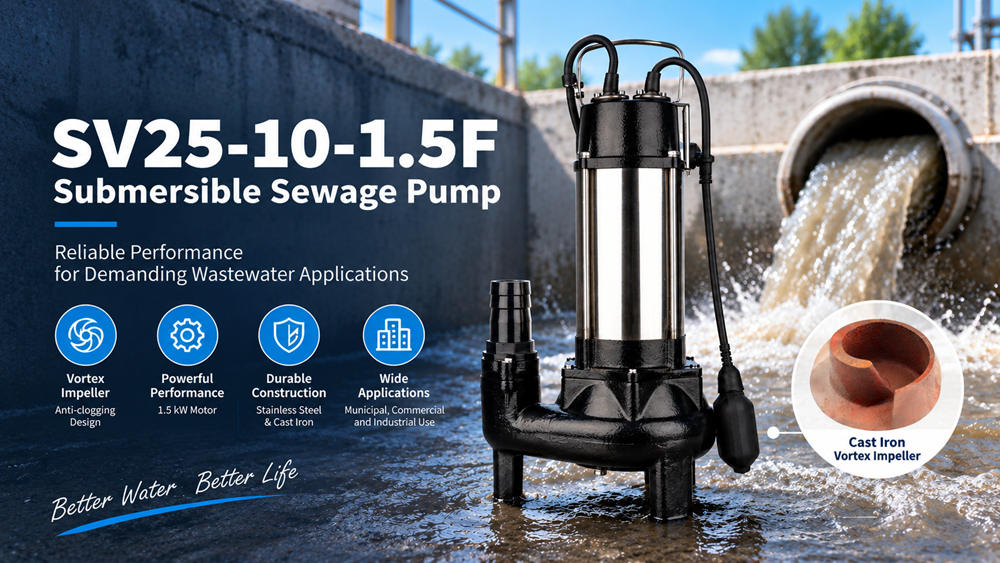
Wastewater pumping becomes much more difficult when the liquid contains long fibers, cloth, paper, hair, soft solids and other materials that can wrap around a conventional sewage pump impeller.
A standard vortex or non-clog sewage pump may be able to pass relatively large solids, but long fibrous material can still create a different problem: instead of simply blocking the flow passage, fibers can wrap around the rotating components and gradually restrict the pump.
The Stream SV25-10-1.5F Submersible Sewage Grinder Pump is designed to address this problem with a special grinding-type impeller.
Rather than relying only on a separate high-speed cutter blade positioned in front of the pump inlet, the SV25 integrates the shredding and grinding action more closely with the hydraulic impeller itself.
As fibrous sewage enters the pump, the special single-channel vortex grinding impeller repeatedly tears, breaks and crushes soft solids and fibers while maintaining a relatively large hydraulic passage.
This combination of grinding action and non-clog flow design makes the SV25-10-1.5F particularly suitable for domestic wastewater, septic systems and other sewage applications where fibrous materials are a common cause of pump blockage.
The Stream SV25-10-1.5F is a submersible grinder pump designed for dirty water and sewage applications.
Its defining component is a single-channel vortex-type grinding impeller designed to handle wastewater containing fibers and solid contaminants.
According to Stream's product specification, the grinding impeller allows the pump to handle fibrous material with a length of approximately three times the outlet size and particulate matter approximately 30% of the outlet size under the stated conditions.
The pump combines solids reduction with relatively high flow capacity, making it suitable for applications where both clog resistance and effective sewage transfer are required.
Domestic and commercial wastewater rarely contains only water.
Typical sewage can contain:
Toilet paper
Hair
Textile fibers
Cleaning cloth fragments
Soft plastics
Organic waste
Soft solids
Other fibrous material
These materials create very different hydraulic challenges from ordinary clean-water pumping.
Large rigid solids may block an inlet, but long flexible fibers can wrap around an impeller or shaft and form increasingly dense bundles.
This phenomenon is commonly referred to as ragging or fiber entanglement.
Once enough material accumulates, pump efficiency falls, motor current can increase, flow decreases and eventually the pump may require manual cleaning.
A conventional sewage pump and a grinder pump solve solids-handling problems in different ways.
| Feature | Conventional Sewage Pump | Grinder Pump |
|---|---|---|
| Main Strategy | Pass solids through large hydraulic passages | Reduce solids before or during pumping |
| Fiber Handling | Depends heavily on impeller type | Designed specifically to shred or grind fibrous material |
| Clog Resistance | Good for suitable solids sizes | Better suited to fibrous sewage and soft solids |
| Typical Application | General sewage and wastewater transfer | Sewage containing fibers, rags and soft solids |
Many grinder pumps use a distinct cutting system positioned ahead of the main pump impeller.
A typical design may use a rotating cutter together with a stationary cutting ring or shredding plate.
The incoming material is chopped or pulverized before reaching the hydraulic impeller.
The SV25 takes a different approach.
Its grinding function is integrated more closely into the impeller and hydraulic passage.
Instead of relying only on a separate knife-like cutting action, the impeller produces a combination of rotation, turbulence, shear and mechanical crushing.
Fibrous and soft solid material is repeatedly disturbed, torn and reduced as it moves through the pump.
This is why the operating action can be understood more as grinding and macerating than simply high-speed chopping.
The terms grinder pump, cutter pump and chopper pump are sometimes used interchangeably, but the mechanisms can be different.
A cutter pump normally uses one or more sharp cutting edges to slice long fibers and soft solids into smaller pieces.
The action is similar to a knife or rotating blade.
A grinder pump normally reduces sewage solids more aggressively through repeated cutting, crushing or grinding action.
Some grinder systems use a rotating cutter and stationary shredding ring, while others integrate much of the grinding action into the hydraulic impeller.
A chopper pump typically uses heavy cutting elements designed for tougher solids and fibrous material, often in agricultural or industrial applications.
The exact terminology differs among pump manufacturers, so the most useful comparison is not the product name alone but the actual solids-reduction mechanism.
Integrating the grinding action with the impeller creates several potential operating advantages.
The solids-reduction function is closely combined with the hydraulic pumping process rather than requiring all material to pass through a separate cutting mechanism first.
The vortex and rotating impeller movement continuously disturb fibers, making it more difficult for long material to remain stationary and form a blockage.
The single-channel design maintains a relatively open hydraulic passage compared with highly restrictive grinding assemblies.
This helps the SV combine grinder functionality with useful sewage flow capacity.
The shape of the impeller and hydraulic passage is designed to reduce the likelihood of fibers wrapping tightly around the rotating component.
The SV25 uses a single-channel vortex-type cutting and grinding impeller.
Single-channel impellers are widely used in wastewater applications because they provide a larger internal flow passage than many multi-vane impellers.
This reduces the number of narrow areas where fibrous or solid material can become trapped.
The vortex effect also keeps a significant portion of the wastewater moving through the pump chamber without forcing every contaminant into close contact with complex narrow impeller passages.
In the SV25, this non-clog flow concept is combined with grinding action so that fibers can be broken down while sewage continues moving through the pump.
Long fibers behave differently from hard solids.
A stone or grain usually follows the water stream through the pump until it either passes or becomes physically blocked.
A flexible fiber can bend, stretch and wrap around rotating components.
Once one fiber becomes trapped, others can collect around it.
Over time, this creates a rope-like mass around the impeller or shaft.
The result can include:
Reduced hydraulic efficiency
Lower flow
Higher motor load
Frequent pump blockage
Overheating
Manual cleaning requirements
Unexpected system downtime
For sewage systems where fibrous material is common, preventing this entanglement can be more important than simply maximizing solid passage diameter.
The special single-channel vortex grinding impeller is designed to reduce fibrous material while maintaining wastewater flow.
The SV series is specified to handle fibrous material approximately three times the pump outlet size under the stated operating conditions.
The pump specification also indicates grain or particulate passage of approximately 30% of the outlet size.
Unlike grinder pumps designed primarily for very high head and small flow, the SV25 is positioned as a relatively high-flow grinder pump for rapid sewage drainage.
The complete pump operates submerged directly in the wastewater, eliminating the need for a long suction line.
The SV25 uses double mechanical seals together with a lip seal to improve protection between the pump hydraulic section and electric motor.
An integrated thermal protector helps protect the motor if abnormal operating conditions cause excessive temperature.
The float switch allows automatic pump operation according to wastewater level.
A float-level adjustment device allows the operating level to be adapted to the installation requirements.
A sewage pump installed inside a septic chamber, wastewater basin or sump normally does not need to run continuously.
Wastewater enters the chamber gradually.
As the liquid level rises, the float switch rises with it.
When the selected start level is reached, the pump switches on and removes sewage from the chamber.
As the level falls, the float eventually returns to the stop position and switches the pump off.
This automatic cycle helps prevent unnecessary motor operation while maintaining wastewater level within the required range.
Septic systems frequently contain toilet paper, organic waste and fibrous materials that can create difficulties for standard wastewater pumps.
The SV grinding impeller helps reduce these materials before discharge.
Residential wastewater can contain hair, tissue, fibers and soft solids.
A grinder pump can reduce the risk of blockage where this material regularly enters the drainage system.
Municipal systems can encounter leaves, cloth, plastic fragments and other unexpected materials.
Where the contamination is compatible with the pump's operating limits, grinder technology can improve clog resistance.
Temporary drainage systems may need to handle dirty water containing soft debris and fibers.
The compact submersible design makes the pump convenient for suitable site applications.
The pump can be used for transferring wastewater within appropriate civil wastewater treatment processes.
The SV can be considered for compatible industrial wastewater where liquid chemistry, solids characteristics and temperature remain within the specified limits.
| Model | SV25-10-1.5F |
| Pump Type | Submersible Sewage Grinder Pump |
| Impeller | Single-Channel Vortex Grinding Impeller |
| Maximum Immersion Depth | 5 m |
| Liquid Temperature | 0–40°C |
| Liquid pH Range | 6.5–8.5 |
| Feature | SV Grinder Pump | Standard Vortex Sewage Pump |
|---|---|---|
| Solids Strategy | Breaks down fibrous and soft material | Attempts to pass solids without reducing size |
| Fiber Handling | Designed for fibrous sewage | Depends on free passage and impeller geometry |
| Risk of Ragging | Reduced through grinding action | Can remain a problem with long fibers |
| Best Use | Sewage containing fibers and soft solids | General wastewater with suitable solid size |
Both designs are intended to reduce wastewater solids, but the mechanism is not necessarily the same.
| Feature | SV Grinding Impeller | Traditional Separate Cutter System |
|---|---|---|
| Grinding Location | Integrated closely with impeller and hydraulic passage | Dedicated cutting assembly at suction inlet |
| Primary Action | Grinding, tearing, turbulence and shear | Direct knife-like cutting and shredding |
| Hydraulic Passage | Single-channel non-clog concept | Depends on cutter and downstream impeller design |
| Product Positioning | High-flow sewage grinding and clog reduction | Often optimized for aggressive shredding and pressure sewer duty |
No.
A grinder pump is designed to reduce specific types of wastewater solids, particularly fibrous, organic and relatively soft material.
It should not be treated as an industrial crusher capable of handling every foreign object.
Hard metal objects, stones, large pieces of rigid plastic and other inappropriate materials can still damage the pump.
Correct wastewater management should always minimize unsuitable foreign objects entering the sewage system.
Some grinder pumps are designed mainly for pressure-sewer systems where the priority is high discharge head through small pipes.
The Stream SV has a somewhat different positioning.
Its product design emphasizes relatively high flow together with grinding and non-clogging capability.
This makes it useful where sewage needs to be removed quickly while still reducing the risk created by fibrous contamination.
In other words, the SV25 does not only focus on creating very fine slurry for a small pressure pipe; it also aims to maintain effective wastewater transfer capacity.
A submersible sewage pump operates with the electric motor directly surrounded by wastewater.
Reliable separation between the hydraulic section and motor is therefore extremely important.
The SV25 uses a double mechanical seal arrangement together with an additional lip seal.
This multiple-seal structure provides additional protection against water entering the motor chamber under correct operating conditions.
Grinder pumps can experience increased motor load if wastewater conditions become more difficult than expected.
For example, excessive fibrous material or partial hydraulic blockage can increase resistance on the rotating components.
The integrated thermal overload protector helps protect the motor if operating temperature rises excessively.
Thermal protection should still be considered a safety feature rather than a substitute for correct pump selection and maintenance.
Even a non-clogging grinder pump benefits from correct installation and operation.
Keep hard foreign objects out of the wastewater system
Avoid excessive quantities of cloth or plastic material
Allow the float switch to move freely
Do not install the pump directly into heavy settled sediment
Check the discharge pipe for restrictions
Inspect the impeller if performance suddenly decreases
Operate the pump only within its specified liquid conditions
It is a submersible sewage grinder pump designed for dirty water and wastewater containing fibrous and soft solid materials.
The SV25 uses a special single-channel vortex grinding impeller that helps reduce fibers and soft solids instead of relying only on a large free passage to move them through the pump.
It has cutting and grinding functionality, but its solids-reduction action is integrated closely with the grinding impeller rather than depending only on a separate external cutter blade.
The process can involve both cutting and shear, but the operating behavior is better understood as repeated grinding, tearing and maceration within the impeller and hydraulic passage.
The pump is intended for wastewater containing fibers, toilet paper, organic waste and other compatible soft solid material.
Stream specifies fiber handling of approximately three times the outlet size under the stated operating conditions.
The product specification indicates particulate passage of approximately 30% of the outlet size.
Yes. The SV25-10-1.5F includes a float switch and an adjustable float-level device for automatic start and stop according to liquid level.
The specified maximum immersion depth is 5 meters.
The specified liquid temperature range is 0–40°C.
Yes. Septic tank systems are one of the primary applications listed for the SV25.
The grinding impeller is specifically designed to improve the handling of fibrous materials, but inappropriate large or exceptionally tough foreign objects should still be kept out of the sewage system.
No grinder pump should be treated as a crusher for hard metal or large rigid solids. Such materials can damage the impeller or other pump components.
The key advantage of the Stream SV25-10-1.5F is not simply that it is another submersible sewage pump.
Its value lies in the way the hydraulic system actively deals with fibrous waste.
A conventional sewage pump attempts to move contaminants through a sufficiently large passage. A traditional cutter-type pump may use a dedicated blade or grinding assembly before the main impeller.
The SV25 combines non-clog single-channel hydraulics with an impeller that provides grinding, tearing and macerating action as wastewater moves through the pump.
This approach allows the pump to maintain useful sewage flow while reducing the risk that long fibers and soft waste will wrap around the impeller and create blockages.
Combined with double mechanical sealing, thermal motor protection, automatic float control and compact submersible construction, the SV25 provides a practical solution for septic systems, domestic sewage and other wastewater applications where fibrous contamination is a recurring problem.
Address
No.17 XeDa Jimei Ind. Park, Xiqing Economic Development Area, Tianjin, China
Telephone
+86 13816508465
QUICK LINKS