+86 13816508465
Pump Introductions
Sep. 03, 2026
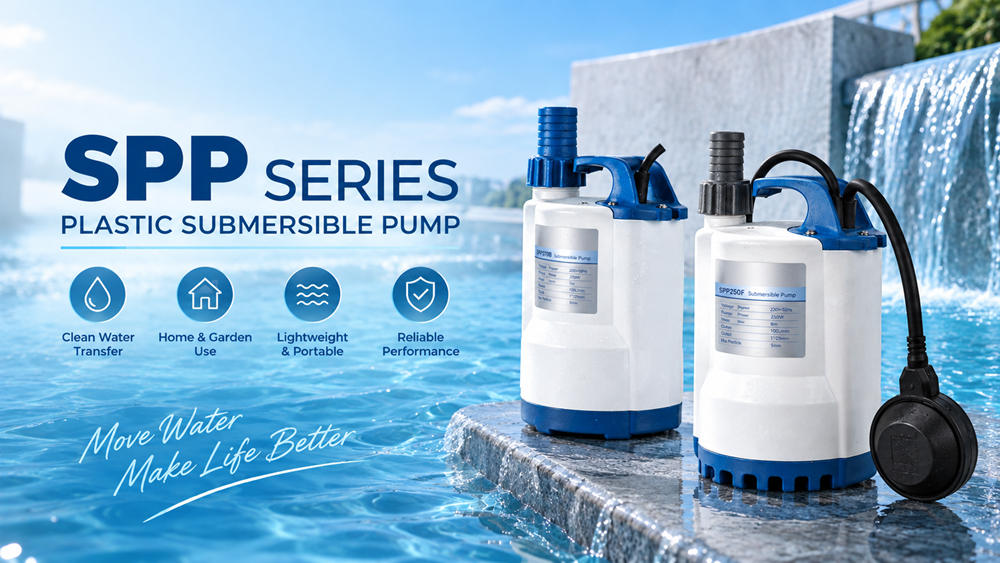
A utility pump does not need to be large, heavy or complicated to be useful.
In homes, gardens, basements, swimming pools, ponds, water tanks and construction areas, many drainage jobs simply require a lightweight pump that can be carried easily, placed directly into the water and started whenever water needs to be moved or removed.
The Stream SPP series is designed around exactly this idea.
The SPP family consists of compact submersible utility pumps for clean water, combining lightweight thermoplastic construction with simple operation and broad application flexibility.
Within the series, Stream offers two different operating concepts:
SPP250/370(A)F – automatic clean-water utility pumps equipped with a float switch
SPP250/370B – residual-water drainage pumps designed to remove water down to approximately 1 mm from floor level
Both belong to the same SPP clean-water utility pump family, but they solve different drainage problems.
The float-switch models focus on automatic operation when water levels rise and fall, while the B-series focuses on removing as much remaining water as possible from flat surfaces.
This guide explains how these two SPP versions work, where each type is most useful, and why a portable clean-water submersible pump is one of the most versatile tools for household and general drainage applications.
A utility pump is a compact water pump designed for general-purpose water transfer and drainage.
Unlike larger sewage, construction or deep-well pumps that are optimized for one specific application, utility pumps are designed for flexibility.
A typical clean-water utility pump can be moved between different locations and used whenever relatively clean water needs to be transferred or removed.
Common applications include:
Draining flooded rooms
Removing water from basements
Emptying swimming pools
Draining garden ponds
Emptying water tanks
Removing water from sumps
Moving irrigation water
Removing groundwater from small construction areas
Handling residual water after cleaning or maintenance
Portability is one of the biggest advantages of this pump category.
Instead of permanently installing the pump in one location, the user can carry it to the area where drainage is required, lower it into the water and connect the discharge hose.
The Stream SPP series consists of lightweight submersible drainage pumps intended primarily for clean-water applications.
The pumps use corrosion-resistant thermoplastic construction, which helps keep the overall product lightweight while also making it suitable for many common household and outdoor water-handling tasks.
The compact design also makes the pump easier to store when it is not being used.
This is particularly useful for homeowners who may only require a drainage pump occasionally, such as after heavy rain, a plumbing leak, pool maintenance or seasonal cleaning.
Although the SPP250/370(A)F and SPP250/370B belong to the same product family, they are optimized for different operating situations.
| Feature | SPP250/370(A)F | SPP250/370B |
|---|---|---|
| Pump Type | Automatic clean-water utility pump | Low-level residual-water drainage pump |
| Float Switch | Yes | No |
| Operation | Automatic start and stop according to water level | Manual / controlled drainage |
| Main Advantage | Convenient unattended drainage | Extremely low residual water level |
| Residual Drainage | Designed mainly for automatic general drainage | Down to approximately 1 mm |
| Best Applications | Sumps, tanks, ponds, basements and automatic drainage | Floors, pools, basements and situations requiring maximum drainage |
The SPP250/370(A)F models are designed as automatic utility pumps.
Their defining feature is the external float switch.
The float moves upward and downward according to the surrounding water level.
When water rises to the required level, the float switch activates the pump.
As the pump removes water and the level falls, the float eventually moves downward and switches the pump off.
This simple mechanical control system allows the pump to respond automatically to changing water levels without requiring the user to stand beside the pump continuously.
A float switch is particularly valuable in applications where water may accumulate gradually or unpredictably.
For example, groundwater can enter a basement or sump over several hours. Rainwater may slowly collect in a pit. Water inside a tank may need to be pumped down only after it reaches a certain level.
In these situations, automatic operation provides two major advantages.
First, the pump does not need to run continuously when there is no water to remove.
Second, the user does not need to manually monitor the water level and repeatedly switch the pump on and off.
A sump collects water from the surrounding area before it is pumped away.
The float switch makes the SPP(A)F particularly suitable for this type of application because the pump can automatically respond when water accumulates.
Heavy rain, groundwater seepage or plumbing problems can cause water to collect in residential basements.
A lightweight automatic utility pump can provide a convenient solution for removing this clean or lightly contaminated water where the pump's application limits are suitable.
The SPP can be placed directly inside a suitable water tank for transfer or maintenance drainage.
Its lightweight construction makes it easier to lower the pump into the tank and remove it again afterward.
Garden ponds sometimes need to be partially or completely emptied for cleaning, maintenance or landscaping.
A portable submersible utility pump avoids the need to permanently install a dedicated drainage system.
The pump can also transfer clean water for suitable garden and irrigation applications.
The SPP can be used for light-duty groundwater removal where the water is sufficiently clean and does not contain abrasive particles or large solids.
The SPP250/370B serves a different purpose.
Instead of focusing on automatic float-controlled operation, the B-series is designed to remove water from flat surfaces to an extremely low remaining level.
The Stream SPP250/370B can reduce residual water to approximately 1 mm above floor level.
This makes the B-series particularly useful after most of the standing water has already been removed but the remaining shallow layer is still too deep to dry efficiently by normal evaporation or manual cleaning.
Many standard drainage pumps eventually stop pumping when the remaining water becomes too shallow to enter the pump inlet effectively.
This can leave a noticeable layer of water on the floor.
In a basement, garage, pool or other flat area, even a few millimeters of residual water can mean that significant manual work is still required with mops, wet vacuums or other cleaning equipment.
A low-level drainage pump is designed specifically to extend pumping operation much closer to the floor.
Reducing residual water to approximately 1 mm can greatly reduce the amount of manual drying required after a flooding or drainage event.
The B-series is particularly well suited to emergency drainage of relatively small flooded areas where water needs to be removed as completely as practical.
Flat concrete floors are ideal examples of situations where low-level drainage capability is useful.
After the main standing water has been removed, the SPP-B can continue working until only a very thin layer remains.
After a swimming pool has been largely emptied, conventional drainage equipment may leave water at the lowest points.
A low-residual utility pump can help remove this final shallow layer during cleaning or maintenance.
Residual water may also remain on the bottom of storage tanks after normal emptying.
A low-level drainage pump can reduce the remaining water before inspection or cleaning.
Because the pump is portable and lightweight, it can be stored until it is needed for leaks, rainwater ingress or other unexpected drainage situations.
One of the biggest differences between a utility pump and a permanently installed drainage system is mobility.
A utility pump may be used in a basement today, a swimming pool next month and a garden tank later in the year.
The SPP thermoplastic construction helps reduce weight, making the pump easier to carry, position and remove.
This flexibility also makes the pump useful for maintenance contractors, homeowners, gardeners and other users who may need one pump for several different clean-water tasks.
The SPP uses corrosion-resistant thermoplastic construction.
For a portable utility pump, plastic construction provides several practical benefits.
Lower overall weight
Easy handling and transportation
Resistance to normal corrosion associated with clean-water use
Convenient storage
Suitable construction for domestic and general-purpose drainage
This does not mean that a plastic utility pump should be treated as a heavy-duty construction or sewage pump.
The SPP is designed primarily for clean-water applications within its specified working conditions.
| Maximum Immersion Depth | 5 m |
| Liquid Temperature | 0–40°C |
| Liquid pH Range | 6.5–8.5 |
| Duty | Continuous Service S1 |
| Pumped Liquid | Clean Water |
| Construction | Corrosion-Resistant Thermoplastic |
The SPP is a clean-water drainage pump.
This distinction is important because not every submersible pump is designed to handle the same type of liquid.
A sewage pump is normally designed with larger internal passages to handle suspended solids and wastewater.
A heavy-duty construction drainage pump may be designed to tolerate sand, mud or abrasive particles.
A clean-water utility pump is designed for substantially cleaner liquids.
Using a clean-water pump in water containing excessive sand, fibers, stones, sludge or large solid particles can block or damage the hydraulic components.
| Feature | SPP Utility Pump | Sewage Pump |
|---|---|---|
| Primary Liquid | Clean water | Wastewater / sewage |
| Solid Handling | Limited | Designed for larger suspended solids |
| Weight | Lightweight and portable | Often heavier |
| Typical Use | Home, pool, tank, pond and light drainage | Sewage pits and wastewater systems |
Choosing between the SPP(A)F and SPP-B versions depends less on motor size and more on how the pump will be used.
You want the pump to start and stop automatically
Water levels may rise unpredictably
The pump will remain inside a sump or tank for a period of time
Convenience and automatic water-level control are priorities
You want to drain a flat surface as completely as possible
Residual water level is more important than automatic operation
You are draining a basement, garage, pool or similar floor area
You want to reduce the amount of manual mopping required afterward
A float switch needs enough space and water depth to move freely.
This is excellent for automatic drainage but can become a limitation when the goal is to remove extremely shallow water.
As water level becomes very low, a conventional float will normally fall and switch the pump off before the floor is almost completely dry.
This explains why automatic drainage pumps and low-level residual pumps are often offered as separate configurations.
One design prioritizes automatic operation, while the other prioritizes minimum remaining water.
A portable clean-water pump can be extremely useful after minor household flooding.
Before operating the pump, electrical safety should always be considered first.
If flooding has affected electrical outlets, appliances or wiring, the area should be made electrically safe before entering the water or operating equipment.
Once conditions are safe, the pump can be positioned at the lowest practical point and connected to an appropriate discharge hose.
For areas where water may continue entering, an automatic SPP(A)F model can be particularly useful.
For final cleanup after most of the water has already been removed, the low-residual SPP-B can provide an advantage.
Swimming pools sometimes need to be partially or fully drained for cleaning, repair or maintenance.
A lightweight submersible utility pump can be lowered directly into suitable clean pool water and connected to a discharge hose.
The automatic float version is convenient during the main drainage stage.
When maximum remaining-water removal is required, the low-level B-series is particularly attractive because it can continue removing water down to approximately 1 mm under suitable conditions.
Pool drainage should always comply with local rules regarding water disposal and pool structure.
Water tanks periodically require cleaning, inspection or maintenance.
A portable submersible pump simplifies this process because no permanent suction piping is required.
The pump can simply be lowered into the tank, connected to a discharge hose and removed again after the work is complete.
This is one of the situations where lightweight construction provides a real practical advantage.
The pump should be positioned so that the inlet is not buried in loose sediment.
If the bottom contains sand, mud or debris, consider placing the pump on a clean stable base.
Kinked hoses, undersized discharge lines and excessive elevation can reduce the flow delivered by the pump.
For the SPP(A)F series, the float switch must have enough space to rise and fall without becoming trapped against the wall of a tank or sump.
Move or lower a submersible pump using the appropriate handle or lifting method rather than pulling on the electrical cable.
The Stream SPP series has a specified maximum immersion depth of 5 meters.
If the water contains significant quantities of sand, stones, fibers or other debris, a pump designed for dirty water or construction drainage may be more appropriate.
A utility pump is similar to many emergency household tools: its value becomes most obvious when unexpected water appears.
Heavy rain, a leaking pipe, overflowing tank, pool maintenance or groundwater seepage can create a drainage problem with little warning.
Because the SPP is compact and portable, it can be stored when not required and quickly put into service when water needs to be removed.
This versatility means one pump can cover many different tasks rather than being dedicated permanently to one installation.
The Stream SPP is a family of portable submersible utility pumps designed primarily for clean-water drainage and transfer.
SPP250/370(A)F models use a float switch for automatic start and stop according to water level. SPP250/370B models are designed for low-level residual drainage and can remove water down to approximately 1 mm from floor level.
The float-switch SPP(A)F is usually more suitable where water level changes automatically and the pump needs to start without manual intervention.
If the main goal is to remove as much remaining water as possible, the SPP-B low-residual version offers an important advantage.
The Stream SPP250/370B is designed to reduce residual water to approximately 1 mm from floor level under suitable operating conditions.
The series is primarily designed for clean-water applications. Water containing significant abrasive particles, sludge or large solids requires a more suitable dirty-water, sewage or construction drainage pump.
Residual water removal from pools is one of the applications specified by Stream, provided the water conditions are compatible with the pump.
Yes. Portable clean-water utility pumps are well suited to appropriate basement drainage applications.
Yes. Pond drainage is one of the applications listed for the SPP series, assuming the water does not contain unsuitable solids or abrasive contamination.
The specified maximum immersion depth is 5 meters.
The specified liquid temperature range is 0–40°C.
The Stream product specification lists the SPP series for continuous S1 service within its stated operating conditions.
Thermoplastic construction reduces weight and provides good corrosion resistance for appropriate clean-water applications. This makes the pump easier to transport and particularly suitable where portability is important.
The strength of the Stream SPP series is not specialization in one single drainage application.
Its strength is versatility.
The lightweight thermoplastic construction makes the pump easy to transport and store, while the submersible design allows it to be placed directly into the water whenever drainage or transfer is required.
For automatic applications, the SPP250/370(A)F models use a float switch to respond automatically as water levels rise and fall.
For jobs where the priority is removing as much remaining water as possible, the SPP250/370B provides low-level drainage down to approximately 1 mm.
Together, these configurations allow the SPP family to cover a wide range of domestic and utility applications including basements, water tanks, ponds, swimming pools, irrigation systems and light construction drainage.
For homeowners, maintenance users, contractors and distributors looking for a compact, lightweight and flexible clean-water submersible pump, the Stream SPP provides a practical utility-pump solution for both routine and emergency drainage.
Address
No.17 XeDa Jimei Ind. Park, Xiqing Economic Development Area, Tianjin, China
Telephone
+86 13816508465
QUICK LINKS