+86 13816508465
Pump Introductions
Sep. 02, 2026
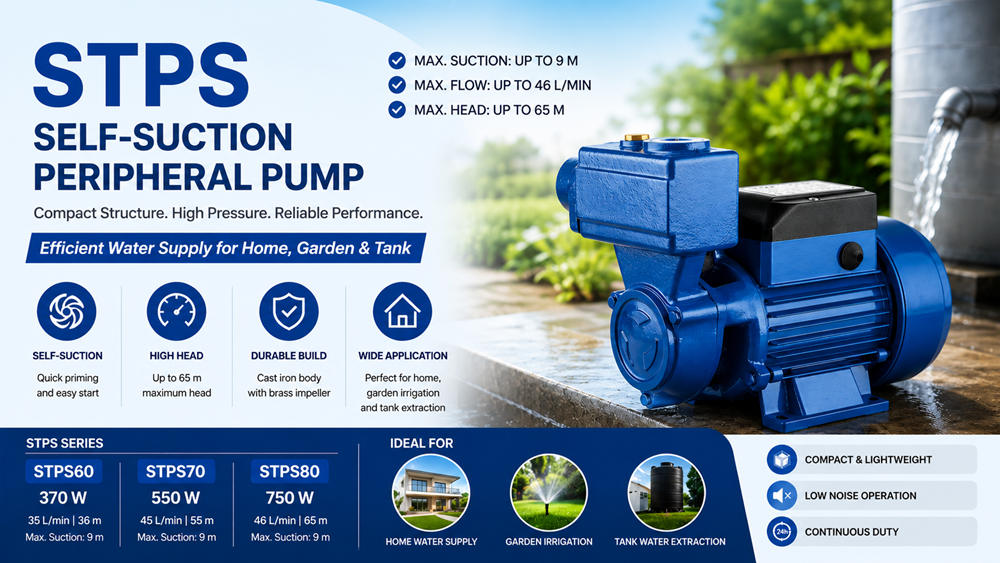
Not every domestic water system requires a large centrifugal pump or a traditional JET pump. In many homes, gardens and small water supply systems, the real requirement is simpler: a compact pump that can create useful pressure, draw water from a lower source and operate reliably without taking up much installation space.
The Stream STPS Self-Priming Peripheral Pump is designed for this type of application.
Combining a peripheral hydraulic design with self-priming capability and a built-in flap-check valve, the STPS series provides a compact solution for domestic water distribution, garden irrigation, tank water extraction and general clean-water handling.
The range includes STPS60, STPS70 and STPS80, with power from 370 W to 750 W, maximum flow from 35 to 46 L/min, maximum head from 36 to 65 m and maximum suction depth up to 9 m.
This guide explains what a self-priming peripheral pump is, how the STPS works, why peripheral pumps can produce relatively high pressure from a compact hydraulic design, and where this type of pump fits compared with conventional centrifugal and JET pumps.
The Stream STPS is a compact surface-mounted water pump designed for clean water and non-corrosive liquids compatible with the pump materials.
Its hydraulic design belongs to the peripheral pump family, sometimes also referred to as regenerative, turbine or vortex-type pumps in different markets.
Unlike a conventional centrifugal pump with a relatively simple radial-flow impeller, a peripheral pump uses an impeller with many small vanes around its outer edge.
These vanes operate inside a closely matched circular flow channel in the pump casing.
As water passes through this channel, it repeatedly interacts with the rotating impeller and gains energy several times before reaching the discharge.
This regenerative action allows a relatively small pump to generate useful discharge pressure and high head at modest flow rates.
| Model | Power | Max. Flow | Max. Head | Max. Suction |
|---|---|---|---|---|
| STPS60 | 370 W | 35 L/min | 36 m | 9 m |
| STPS70 | 550 W | 45 L/min | 55 m | 9 m |
| STPS80 | 750 W | 46 L/min | 65 m | 9 m |
These are maximum ratings for the individual STPS models. Maximum flow and maximum head do not occur at the same operating point. Actual flow depends on the installation, suction height, delivery height, pipe diameter, pipe length and hydraulic resistance of the complete system.
A peripheral pump is a type of rotodynamic pump designed to generate relatively high pressure from a compact hydraulic structure.
The defining component is the peripheral impeller.
Instead of relying mainly on a large central flow passage, the impeller has numerous small vanes positioned around its outer circumference.
These vanes rotate inside an annular channel built into the pump casing.
Water entering the pump interacts repeatedly with the rotating impeller vanes as it moves around the casing.
Each interaction transfers additional energy to the water.
As a result, pressure builds progressively as the liquid travels from the suction side toward the discharge side.
This is why peripheral pumps are also sometimes called regenerative turbine pumps.
One of the most interesting characteristics of the peripheral pump is its head-to-size ratio.
In a conventional centrifugal pump, water usually passes through the main impeller once before leaving the hydraulic chamber.
In a peripheral design, water can repeatedly exchange energy with the impeller as it travels through the peripheral channel.
Instead of receiving one major energy transfer, the water receives multiple smaller energy transfers.
This regenerative process allows significant pressure to be developed without requiring an exceptionally large impeller or pump casing.
For this reason, peripheral pumps are commonly selected where the required water flow is moderate but useful discharge pressure is important.
When the STPS motor starts, it rotates the brass peripheral impeller at high speed.
Water inside the pump enters the peripheral flow channel surrounding the impeller.
The small impeller vanes repeatedly transfer energy to the liquid as it moves around the hydraulic casing.
Pressure therefore increases progressively before the water exits through the discharge connection.
This operating principle helps explain why the STPS70 and STPS80 can provide maximum heads of 55 m and 65 m respectively despite their relatively compact physical size.
The STPS is not simply a standard peripheral pump. It is designed with self-priming capability.
A self-priming surface pump is designed to remove a limited amount of air from the suction line and re-establish water flow after the pump casing has been correctly filled.
During startup, residual water inside the hydraulic chamber interacts with incoming air and water from the suction pipe.
The pump gradually evacuates air and develops the pressure difference required for water to enter the suction line.
Once the air is removed and water reaches the pump, normal hydraulic operation begins.
This distinction is important.
A self-priming pump should not be confused with a pump that can operate continuously without water.
Before initial startup, the pump casing normally needs to be filled with clean water according to the installation instructions.
The self-priming feature helps the pump clear air from the suction pipe after the hydraulic chamber contains the water required for the priming process.
Running a water pump dry can damage the mechanical seal and other hydraulic components.
Another common misunderstanding is the difference between self-priming capability and suction lift.
Self-priming describes how effectively a pump can remove air and establish water flow.
Suction lift describes the vertical distance between the water level and the pump.
These two concepts are related but they are not the same thing.
A self-priming pump still operates within the physical limitations affecting all surface-mounted water pumps.
The Stream STPS series is rated for a maximum suction depth of up to 9 m under the specified conditions.
Actual achievable suction lift can be lower depending on water temperature, altitude, pipe friction, air leakage and other installation conditions.
Surface pumps do not literally pull water upward with unlimited force.
Instead, the pump creates a lower-pressure region at the inlet and atmospheric pressure acting on the water source pushes water toward the pump.
This creates a natural physical limitation on suction lift.
Long suction pipes, small pipe diameters, excessive fittings and air leakage all increase losses and reduce the practical suction capability.
For this reason, a pump rated for 9 m maximum suction should not automatically be selected for every installation with exactly 9 m of vertical lift.
A performance margin is generally preferable.
One of the practical features of the STPS is its built-in flap-check valve.
A check valve is designed to allow water to move in one direction while helping prevent reverse flow after the pump stops.
Maintaining water within the pump and suction system can improve restart convenience and reduce the likelihood of losing prime.
The integrated flap-check valve therefore supports the self-priming function and simplifies the overall pump design.
Peripheral pumps can generate useful head from relatively compact hydraulic components.
The STPS takes advantage of this characteristic to provide a practical surface pump for domestic installations where available space may be limited.
The self-priming design helps simplify operation when the pump is installed above the water level.
This makes the STPS suitable for storage tanks, water reservoirs and other clean-water sources located below the pump.
All three STPS models are rated for maximum suction depth up to 9 m under suitable operating conditions.
The series provides maximum head from 36 m to 65 m depending on model.
This pressure capability makes the pump useful in applications where water must not only be transferred but also delivered with useful pressure.
The integrated check valve helps prevent reverse water flow and supports reliable self-priming operation.
The STPS uses a cast iron hydraulic body, providing a rigid and durable structure for conventional clean-water applications.
The peripheral impeller is constructed from brass.
Brass is widely used in small domestic water pumps because it combines suitable mechanical properties with good resistance in clean-water applications.
| Pump Body | Cast Iron |
| Motor Housing | Aluminum |
| Impeller | Brass |
| Insulation | Class B / F |
| Duty | Continuous Rated |
| Mechanical Seal | Steatite Ceramic / Metalized Carbon |
| Maximum Ambient Temperature | +40°C |
| Maximum Fluid Temperature | 80°C |
| Maximum Pressure | 10 bar |
The STPS can be used to distribute clean water around residential properties where a compact surface pump is required.
Its relatively high head characteristics are especially useful where water needs to reach taps, small pressure systems or elevated delivery points.
Garden watering and small irrigation systems are typical applications for peripheral pumps.
The STPS can supply water to hoses, garden sprinklers and other small-scale irrigation equipment where moderate flow and useful pressure are required.
Water storage tanks are frequently positioned below or beside the pump installation.
The self-priming capability of the STPS allows it to draw clean water from suitable storage tanks and deliver it to the required point of use.
A peripheral pump can also be incorporated into a properly designed domestic pressure system.
When combined with suitable controls and a pressure tank, the pump can provide automatic water delivery according to demand.
The STPS is suitable for general handling of clean, non-aggressive liquids compatible with its construction materials.
Peripheral pumps occupy a practical position in the residential water pump market.
They are usually compact, mechanically simple and capable of generating useful pressure without requiring a large hydraulic casing.
For homeowners and installers, this can provide several advantages:
Compact installation footprint
Useful discharge pressure
Simple mechanical construction
Suitable performance for moderate household water demand
Good compatibility with small pressure tanks
Practical use for garden irrigation
This is why peripheral pump designs remain widely available from domestic water pump manufacturers around the world.
| Feature | Peripheral Pump | Standard Centrifugal Pump |
|---|---|---|
| Hydraulic Principle | Regenerative peripheral flow | Mainly centrifugal radial flow |
| Typical Characteristic | Higher head at modest flow | Often better suited to larger flow requirements |
| Size | Usually compact | Varies by hydraulic design |
| Liquid Requirement | Clean water is important | Depends on pump design |
| Typical Application | Domestic pressure, small irrigation and water supply | Water transfer, circulation and broader flow applications |
Because both pumps can be self-priming, buyers may wonder whether an STPS peripheral pump and a JET pump are essentially the same.
They are not.
| Feature | STPS Peripheral Pump | SJET Pump |
|---|---|---|
| Main Hydraulic Principle | Peripheral regenerative impeller | Centrifugal pump with ejector / nozzle system |
| Self-Priming Method | Self-priming hydraulic chamber with check-valve arrangement | Ejector creates low pressure through jet effect |
| Typical Strength | Compact size and useful pressure | Strong self-priming and versatile well-water use |
| Typical Use | Domestic water, tanks and small irrigation | Shallow wells, domestic supply and irrigation |
If compactness and relatively high pressure at modest flow are the main requirements, a peripheral pump such as the STPS can be an attractive choice.
If the application places greater emphasis on traditional JET-pump suction characteristics or shallow-well use, an SJET model may be more appropriate.
Peripheral pumps use relatively close clearances between the impeller and hydraulic casing.
This compact hydraulic geometry helps generate pressure efficiently, but it also means the pump is not designed to handle abrasive particles, sand or large solids.
The STPS should therefore be used with clean water and non-aggressive liquids compatible with the pump materials.
If the water source may contain sediment, a suitable inlet filter or strainer should be considered according to the installation requirements.
The STPS60 uses a 370 W motor and provides maximum flow up to 35 L/min, maximum head up to 36 m and maximum suction depth up to 9 m.
It is suitable for lighter domestic water distribution, tank transfer and smaller garden watering applications.
The STPS70 increases motor power to 550 W and maximum head to 55 m while providing maximum flow up to 45 L/min.
This makes it suitable where greater delivery pressure or higher water demand is required.
The STPS80 uses a 750 W motor and provides maximum flow up to 46 L/min with maximum head reaching 65 m.
It is the strongest model in the range for applications requiring higher pressure while still retaining the compact peripheral-pump format.
The shorter and more direct the suction line, the easier it is for a surface pump to establish reliable suction.
Avoid unnecessary vertical height and excessive pipe length where possible.
Even a very small air leak can interfere with self-priming.
All suction fittings, valves and threaded connections should therefore be properly sealed.
An unnecessarily small pipe increases friction loss and reduces available suction performance.
Before the first operation, prime the pump according to the installation instructions.
Do not intentionally operate the STPS dry.
Avoid pumping water containing sand, abrasive particles or solids that could damage or obstruct the close-clearance peripheral hydraulic components.
The Stream product specification states that the pump should be installed in a protected environment and shielded from adverse weather conditions.
Possible causes include inadequate initial priming, an air leak on the suction side, excessive suction depth, blocked piping or insufficient water in the source.
Check the flap-check valve and suction-side connections.
Reverse water flow or air entering the system can cause the pump to lose the water required for reliable restart.
The system may have excessive delivery head, long piping, restrictive fittings or a suction condition that reduces pump performance.
Unusual noise can indicate air entering the system, inadequate water supply, abnormal hydraulic conditions or mechanical issues requiring inspection.
Make sure the selected model is operating at the correct point on its performance curve.
Maximum head is measured at very low or zero flow and should not be interpreted as the operating pressure available at maximum flow.
The STPS is a self-priming peripheral clean-water pump designed for domestic water distribution, garden irrigation, tank water extraction and general water handling.
A peripheral pump uses an impeller with multiple small vanes operating inside an annular hydraulic channel. Water repeatedly interacts with the impeller and progressively gains pressure as it travels through the pump.
No. A peripheral pump uses regenerative peripheral hydraulic action, while a traditional JET pump uses an ejector and nozzle system to create suction.
Yes. The STPS is specifically designed as a self-priming pump and includes a built-in flap-check valve.
The STPS60, STPS70 and STPS80 are rated for maximum suction depth up to 9 m under suitable operating conditions.
The STPS80 provides maximum flow up to 46 L/min.
The STPS80 provides maximum head up to 65 m.
Yes. Domestic water distribution is one of the main intended applications of the STPS series.
Yes. Garden irrigation is one of the specified applications.
Yes. Tank water extraction is specifically listed among the intended applications of the series.
No. It is designed for clean water free from abrasive particles and compatible non-corrosive liquids.
No. Self-priming means the pump can evacuate air and restore water flow after correct initial priming. It should not be intentionally operated dry.
A peripheral pump is attractive when the system needs a compact pump capable of relatively high head at modest flow. A conventional centrifugal pump can be more suitable where higher flow is the primary requirement.
The Stream STPS fills a useful position in the domestic surface pump range.
It combines the compact size and relatively high-pressure characteristics of a peripheral pump with practical self-priming capability and a built-in flap-check valve.
With three models covering 370–750 W, maximum flow from 35–46 L/min, maximum head from 36–65 m and suction depth up to 9 m, the STPS range provides options for different household and garden water requirements.
Its cast iron pump body, brass impeller, continuous-duty design and compact construction make it suitable for clean-water distribution, garden irrigation, water storage tanks and other everyday domestic applications.
For users who need a compact surface pump with useful pressure, reliable self-priming operation and straightforward construction, the Stream STPS Self-Priming Peripheral Pump provides a practical alternative to larger centrifugal or traditional JET pump designs.
Address
No.17 XeDa Jimei Ind. Park, Xiqing Economic Development Area, Tianjin, China
Telephone
+86 13816508465
QUICK LINKS