+86 13816508465
Pump Introductions
Sep. 01, 2026
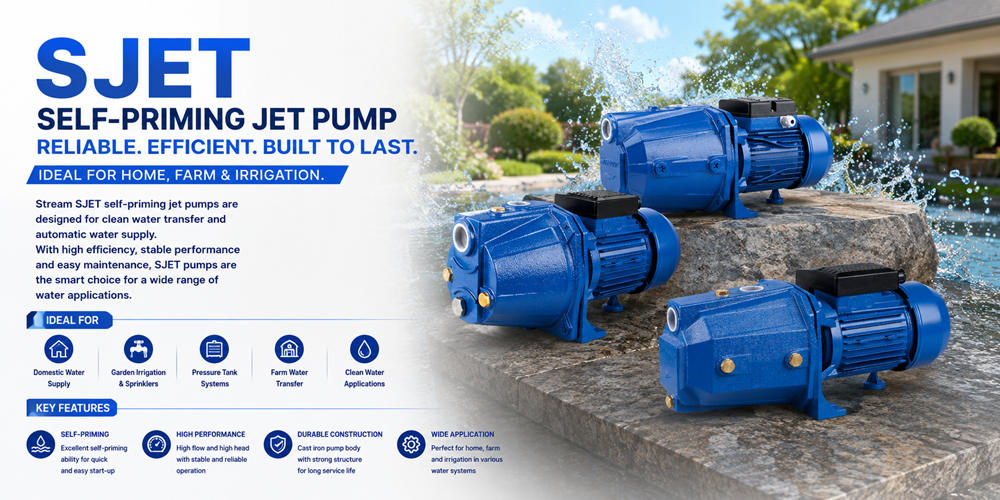
Some water pump designs become popular for a short period and are eventually replaced by newer technologies. Others remain in the market for decades because they solve common water supply problems simply, reliably, and economically.
The cast iron self-priming jet pump belongs to the second category.
From domestic water supply and shallow wells to garden irrigation, pressure boosting, washing systems, and general clean-water transfer, the traditional cast iron JET pump remains one of the most widely used types of surface water pump around the world.
The Stream SJET/B/L series follows this proven design philosophy. It combines a rugged cast iron pump body with an internal ejector system to provide reliable self-priming capability, strong suction performance, and relatively high discharge pressure.
With a series flow range of 42–75 L/min, maximum head from 38–65 m, and motor power from 370–1500 W, the Stream SJET/B/L range covers many common household, agricultural, commercial, and general water supply requirements.
This guide explains how a cast iron jet pump works, why this pump design remains so common, where the Stream SJET/B/L can be used, how to select the right pump, and when a traditional cast iron JET pump may be a better choice than stainless steel or other surface pump designs.
A cast iron jet pump is a surface-mounted self-priming centrifugal pump equipped with an ejector or venturi system.
Unlike a basic centrifugal pump, which performs best when the suction pipe and pump are completely filled with water, a jet pump is designed to deal more effectively with air in the suction line.
This makes jet pumps particularly useful when water must be drawn from a source located below the pump, such as a shallow well, underground storage tank, cistern, or other clean-water source.
The term cast iron jet pump refers primarily to the material of the hydraulic pump body. Cast iron provides a strong, rigid structure and has been widely used for traditional domestic and agricultural surface pumps for many years.
The Stream SJET/B/L series is an injection-type clean-water pump consisting of a centrifugal pump combined with an internal nozzle and ejector system.
The design provides several characteristics that are commonly expected from a traditional JET pump:
Self-priming capability
Strong suction performance
Relatively high discharge head
Reliable clean-water pumping
Simple and mature mechanical construction
Wide application flexibility
The pump is intended for clean water and other non-aggressive liquids with similar characteristics.
| Parameter | SJET/B/L Series |
|---|---|
| Series Flow Range | 42–75 L/min |
| Series Head Range | 38–65 m |
| Series Power Range | 370–1500 W |
| Maximum Ambient Temperature | +40°C |
| Maximum Fluid Temperature | 80°C |
| Maximum Pressure | 10 bar |
| Duty | Continuous Rated |
These values represent the overall SJET/B/L series. Actual operating flow and pressure depend on the selected model and the hydraulic conditions of the installation.
Maximum flow and maximum head should not be interpreted as occurring at the same operating point. Correct pump selection should always consider the performance curve of the individual model.
The popularity of cast iron JET pumps is not based on one unusual technical feature. Instead, it comes from the fact that the design satisfies a large number of everyday water pumping requirements at the same time.
The basic jet pump concept has been used in domestic and agricultural water systems for many years.
Manufacturers, distributors, installers, and service technicians are already familiar with its operating principle, installation requirements, and common maintenance procedures.
For markets where simple mechanical equipment and straightforward maintenance are important, this maturity is a major advantage.
Many household and agricultural applications require a pump to be installed above the water source.
A jet pump's internal ejector system allows it to handle air in the suction line more effectively than many conventional centrifugal pump designs.
This is why the JET pump is so closely associated with shallow wells, tanks, cisterns, and other suction applications.
JET pumps are also known for producing useful pressure.
The Stream SJET/B/L series provides maximum head ratings from 38 to 65 m across the range.
This makes the pump suitable not only for moving water, but also for applications where pressure is required, such as household distribution, sprinklers, washing systems, and pressure boosting.
Cast iron has traditionally been widely used for pump housings because it provides a solid and mechanically robust structure.
The Stream SJET/B/L uses a cast iron pump body designed for rugged durability.
For conventional clean-water installations where stainless steel construction is not essential, cast iron provides a practical balance between durability, performance, and cost.
Another advantage of the conventional JET pump format is familiarity.
Pump dealers in many markets already understand this type of pump. Installers recognize the inlet and outlet arrangement, pressure tank combinations, typical applications, and maintenance requirements.
For distributors, this makes the cast iron JET pump a practical core product rather than a highly specialized pump requiring extensive customer education.
The SJET/B/L combines a centrifugal impeller with an ejector and nozzle system.
When the electric motor rotates the impeller, water inside the pump is accelerated through the hydraulic chamber.
Part of the water passes through the nozzle at increased velocity. This creates a lower-pressure region around the ejector, helping generate suction at the pump inlet.
Water and air entering from the suction pipe are mixed inside the pump. The air is gradually separated and discharged while water continues circulating through the hydraulic system.
Once the air has been removed and the suction pipe is filled with water, the pump enters normal water pumping operation.
This ability to remove a limited amount of air is what gives the JET pump its self-priming characteristic.
One of the most common misunderstandings about self-priming pumps is that they can simply be installed dry and immediately begin drawing water.
That is not what self-priming means.
Before initial startup, the pump body should normally be filled with water according to the installation instructions.
Once properly primed, the internal ejector system helps the pump remove air from the suction pipe and establish stable water flow.
A self-priming pump should not be intentionally operated dry for prolonged periods.
The internal ejector is one of the most important characteristics of the SJET/B/L.
It allows the pump to maintain useful suction capability even when some air is present in the suction system, which is particularly important for shallow-well and tank applications.
The hydraulic pump housing is constructed from cast iron.
This traditional construction provides a rigid and durable structure well suited to conventional clean-water pumping applications.
The SJET/B/L platform is available in multiple configurations, allowing different markets and customers to select suitable designs according to performance and application requirements.
Depending on configuration, impeller material options include:
Brass
Stainless steel
PPO engineering plastic
This flexibility allows the product configuration to be adapted to different market requirements and price positions.
The pump uses a closed motor design with external ventilation to support reliable continuous operation within the specified working conditions.
| Component | Material / Design |
|---|---|
| Pump Body | Cast Iron |
| Motor Housing | Aluminum |
| Motor | Closed, Externally Ventilated |
| Impeller | Brass / Stainless Steel / PPO Optional |
| Insulation | Class B / F |
| Mechanical Seal | Steatite Ceramic / Metalized Carbon |
One of the strongest advantages of this pump category is application versatility.
The SJET/B/L can be used to supply clean water from suitable wells, tanks, cisterns, or other water sources to residential systems.
When combined with appropriate pressure control equipment, the pump can form part of an automatic domestic water supply system.
Shallow-well pumping is one of the most traditional applications for a self-priming jet pump.
The pump is installed above ground while the suction pipe extends down toward the water source.
A correctly sized and airtight suction system is essential for reliable operation.
The combination of useful flow and relatively high head makes the SJET/B/L suitable for gardens, lawns, small agricultural plots, and sprinkler systems.
Water can be drawn from tanks, wells, and other suitable clean-water sources and delivered to hoses or irrigation equipment.
Where existing water pressure is insufficient, a jet pump can be integrated into an appropriately designed pressure boosting system.
The relatively high head characteristics of the SJET/B/L make this one of the pump's important application areas.
A traditional JET pump is frequently combined with a pressure tank, pressure switch, pressure gauge, and check valve.
In this type of installation, the pump automatically replenishes pressure when the system pressure falls below the selected starting point.
The pressure vessel provides stored pressurized water and helps reduce unnecessary pump starts during small water demands.
The SJET/B/L can provide clean water for general washing applications where moderate flow and useful discharge pressure are required.
The pump can also transfer clean, non-aggressive liquids between suitable storage tanks or water supply locations.
Small farms and rural properties frequently require relatively straightforward pumps for well water, storage tank transfer, livestock-related water supply, and irrigation.
The proven jet pump configuration makes it suitable for many of these general clean-water duties.
Stream offers both traditional cast iron and stainless steel versions of the JET pump concept.
Neither material is automatically the correct choice for every customer.
| Factor | Cast Iron JET Pump | Stainless Steel JET Pump |
|---|---|---|
| Market Position | Traditional mainstream solution | More premium material option |
| Pump Body | Cast iron | Stainless steel |
| Corrosion Resistance | Suitable for conventional clean-water use | Greater material corrosion resistance |
| Appearance | Traditional industrial appearance | Premium stainless appearance |
| Typical Buyer Priority | Proven design, value and familiarity | Material quality and corrosion resistance |
For conventional domestic, agricultural, and garden water supply applications, cast iron remains a practical and familiar choice.
Customers who place greater importance on corrosion-resistant pump body materials or stainless steel appearance may instead prefer a stainless steel model such as the Stream SJETS.
A conventional centrifugal pump and a JET pump may look similar from the outside, but their hydraulic characteristics are different.
| Feature | JET Pump | Standard Centrifugal Pump |
|---|---|---|
| Self-Priming | Designed specifically for self-priming operation | Usually more dependent on a fully flooded suction system |
| Air Handling | Better able to deal with some air in the suction line | Generally less tolerant of air |
| Shallow Well Application | Common application | Depends on pump design and installation |
| Pressure Performance | Typically strong relative to its flow | Varies significantly by hydraulic design |
For flooded-suction water transfer where very high flow is the priority, a conventional centrifugal pump may be more suitable.
For applications requiring self-priming, suction from below pump level, and relatively strong pressure, a JET pump is often the more practical solution.
Selecting a JET pump only according to motor power can lead to poor system performance.
The correct pump should be selected according to the complete hydraulic requirement.
First determine how much water the application requires.
A single household outlet requires much less flow than several simultaneous outlets, a sprinkler irrigation system, or a larger water transfer application.
The pump must generate enough head to overcome elevation and pipeline resistance while still providing adequate pressure at the point of use.
If water needs to be delivered to an elevated tank or upper floor, this vertical height must be included in the total required head.
The vertical distance between the water surface and the pump is particularly important for a surface-mounted JET pump.
Long suction pipes, small pipe diameters, elbows, valves, and air leaks can all reduce actual suction performance.
Every meter of pipe and every fitting creates hydraulic resistance.
Long or undersized piping can significantly reduce the actual flow delivered by the pump.
The pump should ideally operate within an efficient and stable region of its performance curve rather than continuously at either extreme of maximum flow or maximum head.
Keep the suction pipe as short and direct as practical.
Reducing suction distance and unnecessary fittings helps improve priming reliability and hydraulic performance.
Air leakage is one of the most common causes of self-priming pump problems.
Even when no water leaks outward, a loose fitting can allow air to enter the suction pipe while the pump is running.
Where required by the installation, a properly selected non-return device helps maintain water in the suction system and reduces the need for repeated priming.
Fill the pump body with clean water before the first startup according to the installation instructions.
Restrictive suction piping increases friction losses and can negatively affect self-priming performance.
Surface pumps should be installed in an appropriate location with adequate ventilation and protection from unsuitable environmental exposure.
Possible causes include insufficient initial priming, excessive suction height, an air leak, a blocked suction line, or a faulty non-return valve.
Check the suction pipe for leaks, reduce unnecessary pipe length and fittings, and confirm that the pump casing contains enough water.
The pump may be operating against greater system resistance than expected, or the selected model may not provide sufficient head at the required flow rate.
In a pressure tank system, frequent cycling can indicate incorrect pressure tank charge, insufficient tank capacity, pressure switch settings, or water leakage within the system.
Unusual noise can be related to air entering the suction line, inadequate water supply, hydraulic restriction, loose installation, or other operating conditions that should be inspected.
Because it belongs to such a mature pump category, the SJET/B/L can serve a broad customer base.
Homeowners requiring independent water supply
Rural households using shallow wells
Garden and irrigation users
Small farms
Water pump installers
Water system contractors
Pump distributors and wholesalers
OEM customers
General clean-water system integrators
The water pump industry increasingly includes variable-speed drives, intelligent controllers, permanent magnet motors, integrated sensors, and smart constant-pressure systems.
However, not every pumping application requires advanced electronics.
In many markets, customers still prioritize several basic requirements:
Can the pump draw water reliably?
Can it provide enough pressure?
Is the construction durable?
Is the design familiar to local installers?
Can it be serviced easily?
Is the purchase cost reasonable?
This is precisely where the traditional cast iron JET pump remains relevant.
Its continued presence in residential, agricultural, and general water supply markets is not because the technology is new, but because the basic design remains practical for a very large number of everyday pumping applications.
A cast iron jet pump is commonly used for shallow wells, domestic water supply, pressure boosting, garden irrigation, washing systems, pressure tank systems, and general clean-water transfer.
Yes. The series uses a built-in ejector designed to support self-priming and to pump water even when some air is present in the suction system.
The series flow range reaches up to 75 L/min depending on model.
Maximum head reaches up to 65 m depending on the selected SJET/B/L model.
The series covers motor power from 370 W to 1500 W.
The SJET/B/L is designed for clean water and non-aggressive liquids with similar characteristics.
Yes. Garden and small-scale irrigation are among the most common applications for self-priming JET pumps.
Yes. Self-priming JET pumps are frequently combined with pressure tanks and suitable control components to create automatic domestic water supply systems.
Yes. Shallow-well water supply is one of the traditional applications of this pump design, provided the actual suction conditions remain within the capability of the selected pump.
Self-priming capability should not be confused with dry-running capability. The pump should be properly primed before operation and should not be intentionally operated without water for prolonged periods.
The Stream SJET/B/L series is rated for fluid temperatures up to 80°C under the specified working conditions.
The most obvious difference is the pump body material. Cast iron is the traditional mainstream option for general clean-water applications, while stainless steel provides greater material corrosion resistance and a more premium construction.
The Stream SJET/B/L does not need to reinvent the surface water pump.
Its value comes from using a mature and widely accepted self-priming JET pump design for the applications where this type of pump has proven effective for many years.
With a rugged cast iron pump body, built-in ejector, series flow from 42 to 75 L/min, maximum head from 38 to 65 m, and power options from 370 to 1500 W, the SJET/B/L provides a broad operating range for everyday clean-water systems.
It can be used for domestic water supply, shallow wells, irrigation, pressure systems, washing applications, and general liquid transfer.
For pump distributors, installers, OEM customers, and users looking for a familiar and versatile self-priming surface pump, the traditional cast iron JET pump remains one of the most practical categories in the market.
The Stream SJET/B/L brings this proven pump concept into a flexible product range designed to cover many of the most common clean-water pumping requirements.
Address
No.17 XeDa Jimei Ind. Park, Xiqing Economic Development Area, Tianjin, China
Telephone
+86 13816508465
QUICK LINKS