+86 13816508465
Pump Introductions
Aug. 31, 2026
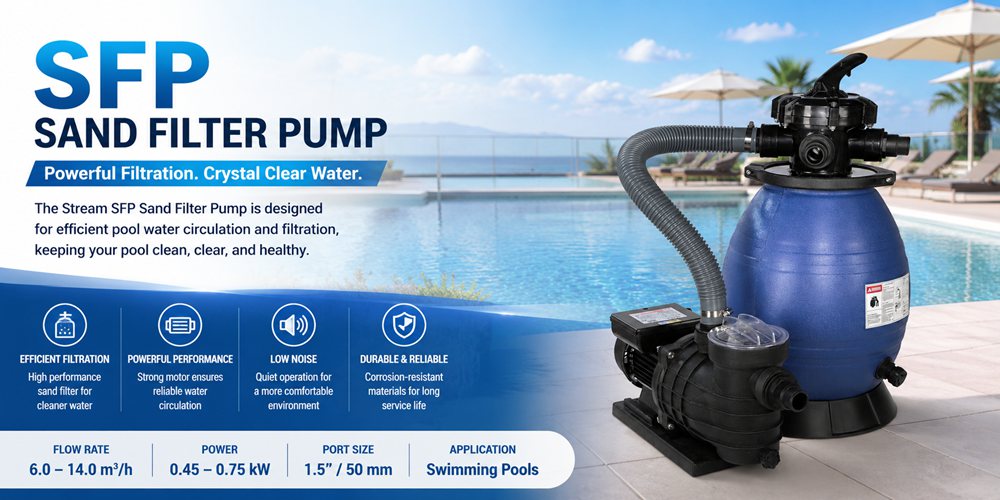
Keeping swimming pool water clear requires more than simply moving water. A complete pool circulation system must continuously draw water from the pool, remove suspended debris, and return filtered water back into the swimming area. This is exactly what a properly matched sand filter pump system is designed to do.
The Stream SFP Sand Filter Pump combines a swimming pool pump with a sand filtration system to provide an integrated solution for pool water circulation and filtration. Designed particularly for above-ground and residential swimming pools, the SFP series covers flow rates from 5 to 11.2 m³/h and is suitable for pool capacities from 40 to 90 m³, depending on the selected model.
Unlike a standalone pool pump, which primarily circulates water, the SFP system combines pumping and mechanical filtration. Water is moved through a bed of filter sand where suspended contaminants are captured before the cleaned water is returned to the pool.
In this guide, we will explain how the Stream SFP sand filter pump works, what its major components do, how the five valve positions function, how to select the right system for your pool, and how proper backwashing and maintenance can help maintain reliable filtration performance.
A sand filter pump is a pool circulation and filtration system that combines a water pump with a filter tank containing specially selected filter media, typically pool-grade silica or quartz sand.
The pump creates the water flow required to move pool water through the filtration circuit. Before entering the main filter tank, larger debris can be captured by the pump's strainer basket. The water is then directed through the filter by a multiport valve.
Inside the filter tank, the sand forms a filtration bed. As pool water passes through this bed, suspended particles are trapped between the filter media. The filtered water is then collected and returned to the swimming pool.
This circulation and filtration process repeats while the system is operating, helping continuously remove suspended contaminants from the pool water.
The Stream SFP is designed as an integrated sand filter pump system for swimming pool water circulation and filtration.
Rather than requiring pool owners to separately match a pump, filter tank, valve, pressure gauge, and connecting components, the SFP brings the primary circulation and filtration functions together into a practical system.
The series is available with pump power options from 0.25 HP to 1 HP, tank volumes of 26 L, 38 L, and 71 L, flow rates from 5 to 11.2 m³/h, and recommended pool capacities from 40 to 90 m³.
This range allows different SFP configurations to serve different residential pool sizes while maintaining the relationship between pump flow and filter capacity.
| Parameter | SFP Series |
|---|---|
Pump Power Options | 0.25 HP / 0.35 HP / 0.5 HP / 0.75 HP / 1 HP |
Tank Volume | 26 L / 38 L / 71 L |
Flow Range | 5–11.2 m³/h |
Pool Capacity | 40–90 m³ |
Multiport Valve | Top-Mounted 1.5" Multiport Valve |
Valve Functions | Filter / Waste / Closed / Backwash / Rinse |
The exact combination of pump performance, filter tank size, and pool capacity depends on the individual SFP model. Pool owners and installers should therefore select the system according to the specific technical data and performance curve of the required model.
Understanding the water path through the system makes it easier to understand why the pump and sand filter must be correctly matched.
During normal filtration, pool water is drawn toward the pump through the circulation piping. The pump generates the hydraulic energy required to move this water through the complete filtration circuit.
The water is then directed by the multiport valve toward the top of the sand filter bed.
As water passes through the filter media, suspended dirt and debris are trapped within the sand bed. The filtered water continues through the internal filter structure and is directed back through the valve toward the swimming pool.
The basic circulation process can therefore be understood as:
Swimming Pool → Pump → Sand Filter → Filtered Water → Swimming Pool
As this process continues, more suspended contaminants are captured inside the filter bed. Eventually, the accumulated dirt increases resistance to water flow. This is why sand filters require periodic backwashing.
The pump is the driving force behind the entire filtration system.
Without sufficient pump flow, pool water cannot circulate effectively through the filter. If the pump is incorrectly sized or water flow becomes restricted, overall filtration performance can decline.
The Stream SFP pump is designed with a durable corrosion-proof housing for outdoor pool environments. Its high-performance motor includes an integrated thermal overload protector and is designed for reliable operation with low operating noise.
An extra-large strainer basket is positioned on the pump side to capture larger debris before it reaches the main hydraulic components and filter tank.
The basket is covered by a see-through lid, allowing users to visually inspect debris accumulation without unnecessarily opening the pump.
If the pump provides circulation, the sand filter provides the main mechanical filtration.
The Stream SFP filter uses an extra-thick one-piece tank blow molded from durable polymeric material. Its UV-resistant surface is designed to support all-weather outdoor performance and long service life.
Inside the tank, filter media creates a large filtration bed. The internal design is intended to expose circulating water to a large sand surface area, supporting efficient filtration during normal operation and effective cleaning during backwashing.
This is an important distinction between a basic water pump and a complete sand filter pump system: the pump moves the water, while the filter media removes suspended contaminants.
One of the most important components of a sand filtration system is the multiport valve.
The Stream SFP uses a top-mounted, clamp-style 1.5-inch multiport valve equipped with a pressure gauge. Instead of physically reconnecting pipes every time the filter needs cleaning or draining, the valve allows the water path through the system to be changed according to the required operation.
The SFP provides five primary valve functions:
Filter – normal pool filtration
Backwash – reverses water flow to clean the sand bed
Rinse – settles and cleans the filter after backwashing
Waste – sends water directly to the waste outlet
Closed – closes the water path for servicing
Understanding these five functions is essential for correct sand filter pump operation.
FILTER is the standard operating position and the mode the system will use for most of its running time.
Pool water containing suspended dirt and debris is moved by the pump and directed by the multiport valve into the filter tank.
The water passes through the sand bed, where suspended particles are captured. The filtered water is then collected and directed through the return line back into the swimming pool.
This creates a continuous circulation loop that gradually processes the pool water and helps maintain water clarity.
As the sand filter captures more dirt, debris accumulates within the filter bed and creates additional resistance to water flow.
Instead of removing and manually washing the sand, a sand filter is cleaned by reversing the direction of water flow. This process is called backwashing.
When BACKWASH is selected, water enters the filter in the opposite direction from normal filtration. The reversed flow loosens the filter bed and carries accumulated contaminants upward and out through the waste line.
The pressure gauge provides an important indication of filter condition. As the filter becomes increasingly dirty, operating pressure typically rises.
A commonly used maintenance indication is to backwash when filter pressure rises approximately 8–10 PSI above the clean filter's normal starting pressure.
Backwashing disturbs the sand bed as contaminants are flushed out of the filter. The system should therefore not normally be switched directly from BACKWASH to FILTER.
RINSE mode directs water through the filter in a way that helps settle the sand bed and flush remaining dirty water toward the waste outlet.
After rinsing, the multiport valve can be returned to FILTER for normal pool circulation.
Using the rinse function correctly helps prevent residual debris from being immediately returned to the swimming pool after a backwash cycle.
WASTE mode sends water directly toward the waste outlet without passing it through the sand filtration bed.
This mode can be useful when the objective is to remove water from the swimming pool rather than filter and return it.
For example, it may be used when the pool water level needs to be reduced.
Because water is discharged from the system rather than returned to the pool, the water level should be monitored during WASTE operation.
The CLOSED position stops the normal water path through the multiport valve and can be used when the filtration system needs to be serviced.
Never operate the pump while the multiport valve is in the CLOSED position.
Running the pump against a closed water path can create abnormal pressure and may damage the pump, filter, piping, or other system components.
The pressure gauge is more than a simple accessory. It provides useful information about resistance inside the filtration system.
When the sand is clean, the system operates at a normal baseline pressure. As suspended debris accumulates inside the filter bed, resistance increases and the pressure reading can rise.
Pool owners should therefore become familiar with the normal clean-filter pressure of their particular installation.
When pressure rises approximately 8–10 PSI above the normal starting pressure, it is generally an indication that the filter should be backwashed.
Monitoring pressure rather than backwashing according to an arbitrary calendar schedule can help avoid both excessive filter clogging and unnecessary backwashing.
The SFP combines the main components required for pool water circulation and mechanical filtration into one coordinated system.
For pool owners and installers, this simplifies system planning compared with independently selecting and matching a pump and sand filter.
The SFP range provides flow rates from 5 to 11.2 m³/h, depending on the selected configuration.
This gives the series the flexibility to serve different residential and above-ground swimming pool sizes.
Depending on model selection and system conditions, the SFP series covers pool capacities from 40 to 90 m³.
This makes the range suitable for many residential swimming pool applications where an integrated filtration and circulation solution is required.
Pool equipment is commonly installed outdoors, where sunlight, weather, and temperature changes can affect component durability.
The SFP filter uses an extra-thick one-piece polymeric tank with a UV-resistant surface designed for all-weather operation and long service life.
Swimming pool equipment operates in a humid environment and may be exposed to splashing water and outdoor conditions.
The SFP pump uses a corrosion-proof housing to improve durability under appropriate pool operating conditions.
The high-performance motor incorporates thermal overload protection.
This provides an additional level of motor protection if abnormal operating conditions cause excessive motor temperature.
Leaves, hair, insects, and other relatively large debris should ideally be captured before reaching the pump's hydraulic components or main sand filter.
The SFP uses an extra-large strainer basket to collect this debris.
The transparent lid allows quick visual inspection, making it easier to determine when the basket requires cleaning.
The multiport valve provides the five primary functions needed for normal filtration and routine filter management: FILTER, BACKWASH, RINSE, WASTE, and CLOSED.
This makes routine operation more convenient because the user can change the internal water path through the valve instead of modifying the plumbing.
Sand filtration provides a proven method for removing suspended debris from swimming pool water.
As water passes through the filter bed, contaminants are physically trapped within the media rather than being allowed to continuously circulate through the pool.
One of the major advantages of a sand filter is that routine cleaning does not require removing and washing a cartridge.
The filter can instead be cleaned by operating the BACKWASH and RINSE functions.
This makes regular maintenance straightforward for residential pool owners.
Filter sand is reused over many filtration and backwash cycles rather than being replaced after every cleaning.
The actual replacement interval depends on water conditions, operating time, maintenance practices, and the filter media used.
Sand filtration systems are particularly attractive when a pool contains enough water that frequent cartridge cleaning or replacement would become inconvenient.
The Stream SFP series, with flow rates up to 11.2 m³/h and pool capacity ratings up to 90 m³, provides options for a broad range of residential swimming pool sizes.
Selecting a pool filter pump should not be based only on motor horsepower.
A complete pool filtration system must balance several factors:
Swimming pool water volume
Required circulation or turnover time
Pump flow rate
Filter capacity
Pipe diameter and length
Hydraulic resistance through fittings and valves
Pool usage and contamination load
Pool volume is one of the most useful starting points.
For a rectangular pool, approximate volume can be calculated as:
Pool Volume (m³) = Length (m) × Width (m) × Average Depth (m)
For example, a pool measuring 8 meters long, 4 meters wide, and averaging 1.5 meters deep contains approximately:
8 × 4 × 1.5 = 48 m³
Once pool volume is known, required circulation flow can be estimated according to the desired turnover period.
For example, if a 48 m³ pool is intended to complete one theoretical turnover in eight hours:
48 m³ ÷ 8 h = 6 m³/h
This calculation provides a useful starting point, but actual system selection must also consider hydraulic losses and the performance curve of the specific SFP model.
A larger pump is not automatically a better pool pump.
The pump and filter operate as one hydraulic system. The filter must be capable of handling the flow generated by the pump, while the pump must provide sufficient flow after accounting for resistance through the sand bed, valve, pipes, fittings, and pool circulation equipment.
An oversized pump can create excessive flow through an undersized filter, while an undersized pump may provide inadequate circulation.
This is one of the advantages of an integrated sand filter pump system such as the Stream SFP: the pump and filtration components are offered as coordinated configurations for different pool requirements.
Backwashing is one of the most important maintenance procedures for a sand filtration system.
Turn off the pool pump.
Move the multiport valve from FILTER to BACKWASH.
Make sure the waste line is correctly positioned.
Start the pump and allow dirty water to discharge through the waste outlet.
Turn the pump off after the backwash cycle.
Move the valve to RINSE.
Restart the pump briefly to rinse and settle the filter bed.
Turn the pump off again.
Return the valve to FILTER.
Restart normal filtration and check the pressure gauge.
Important: Always turn the pump off before changing the position of the multiport valve.
The exact backwash and rinse duration should follow the instructions for the specific filter installation and operating conditions.
Backwashing should be based primarily on filter condition rather than simply being performed every few days.
The pressure gauge provides one of the best indicators. When filter pressure rises approximately 8–10 PSI above the clean-filter starting pressure, accumulated debris is creating additional resistance and the filter should normally be backwashed.
Other signs can include reduced return flow and declining filtration performance.
Heavy swimming pool use, large amounts of debris, vacuuming, or unusual contamination can cause the filter to require more frequent cleaning.
Inspect the transparent strainer lid regularly. If the basket contains a large amount of debris, turn off the system and clean the basket before water flow becomes excessively restricted.
Record or remember the normal pressure when the filter is clean. This provides a useful baseline for determining when backwashing is required.
Air entering the suction side can reduce pump performance and interfere with stable circulation.
Inspect connections, seals, and fittings if you notice air bubbles, unusual pump noise, or difficulty maintaining flow.
The pool water level must remain sufficient for stable circulation. Insufficient water supply to the pump can introduce air into the system and interfere with filtration.
A sand filter removes suspended particles, but it is not a substitute for correct swimming pool water treatment.
Pool water chemistry should be maintained according to the requirements of the pool system and applicable local guidelines.
Where freezing temperatures occur, pool equipment should be correctly winterized. Water left inside pumps, filter tanks, or piping can freeze, expand, and damage components.
Follow the appropriate winterization procedure for the specific installation before prolonged freezing conditions.
| Sand Filter Pump | Cartridge Filter System |
Uses filter sand or compatible filter media | Uses replaceable or washable filter cartridges |
Cleaned primarily through backwashing | Cartridge normally needs to be removed for cleaning |
Well suited to regular pool circulation | Often convenient for smaller systems |
Backwashing discharges some pool water | Routine cleaning generally uses less pool water |
Filter media can remain in service for extended periods | Cartridge condition must be monitored and eventually replaced |
Neither filtration method is universally better. The correct choice depends on pool size, maintenance preferences, water conditions, available space, and system design.
For users who value straightforward backwashing and an integrated circulation system for medium-sized or larger residential pools, a sand filter pump can provide a practical solution.
| Problem | Possible Cause | What to Check |
Reduced Water Flow | Dirty sand filter or clogged strainer basket | Check pressure, backwash filter and clean basket |
Cloudy Pool Water | Filtration, filter media or water chemistry issue | Check filter operation, sand condition and water chemistry |
High Filter Pressure | Accumulated contamination in filter bed | Compare with clean-filter pressure and backwash if required |
Unusual Pump Noise | Restricted flow or air entering system | Check water level, basket, suction connections and flow |
Sand Returning to Pool | Possible internal filter component issue | Inspect filter internals and media condition |
The Stream SFP is designed for swimming pool water circulation and sand filtration, particularly for above-ground and residential swimming pool applications.
The SFP series covers pool capacities from approximately 40 to 90 m³ depending on the selected model and installation conditions.
The Stream SFP series covers flow rates from 5 to 11.2 m³/h depending on model.
Available SFP pump configurations include 0.25 HP, 0.35 HP, 0.5 HP, 0.75 HP, and 1 HP.
The SFP series is available with 26 L, 38 L, and 71 L filter tank volumes.
The pump circulates pool water through a tank containing filter sand. Suspended contaminants are trapped within the sand bed, while the filtered water is collected and returned to the swimming pool.
The five functions are FILTER, WASTE, CLOSED, BACKWASH, and RINSE.
A useful indicator is the pressure gauge. Backwashing is generally required when filter pressure rises approximately 8–10 PSI above the normal clean-filter starting pressure or when water flow becomes noticeably restricted.
No. Always switch off the pump before changing the position of the multiport valve.
No. Never operate the sand filter pump while the multiport valve is in the CLOSED position.
No. Sand filtration primarily removes suspended physical contaminants. Correct pool water chemistry and sanitization are separate parts of swimming pool water management.
Yes. Above-ground swimming pool filtration is one of the primary applications for this type of integrated sand filter pump system.
Start with the volume of the swimming pool and required turnover rate, then determine the required flow. The final selection should also consider pipe resistance, filter capacity, installation layout, and the performance curve of the specific SFP model.
A swimming pool filtration system depends on two processes working together: reliable water circulation and effective removal of suspended contaminants.
The Stream SFP Sand Filter Pump combines these functions into one coordinated pool filtration system. The pump creates the circulation required to move water through the system, while the sand filter captures suspended debris before the cleaned water returns to the pool.
With pump options from 0.25 to 1 HP, filter tank volumes of 26 to 71 L, flow rates from 5 to 11.2 m³/h, and configurations suitable for pool capacities from 40 to 90 m³, the SFP series provides multiple options for different residential swimming pool requirements.
Its UV-resistant polymeric filter tank, corrosion-proof pump housing, integrated motor thermal protection, large transparent-lid strainer basket, pressure gauge, and five-function multiport valve are designed to make pool filtration practical to operate and maintain.
For homeowners, swimming pool equipment distributors, pool installers, and project buyers looking for an integrated sand filter pump for above-ground or residential swimming pools, the Stream SFP provides a practical combination of water circulation, mechanical filtration, straightforward backwashing, and multiple system sizes.
Address
No.17 XeDa Jimei Ind. Park, Xiqing Economic Development Area, Tianjin, China
Telephone
+86 13816508465
QUICK LINKS