+86 13816508465
Aug. 31, 2026
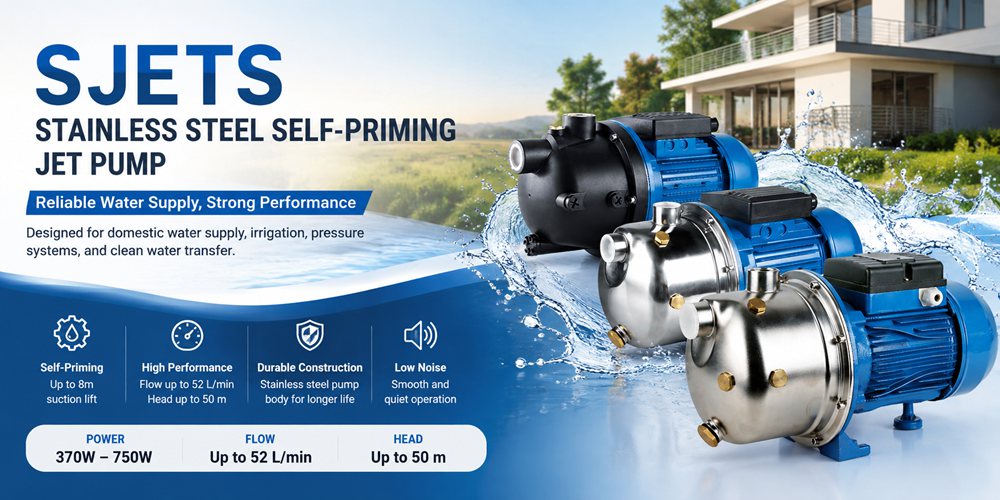
For homes, gardens, shallow wells, pressure systems, and general clean-water transfer, a self-priming jet pump provides a practical balance of suction capability, pressure performance, and installation flexibility.
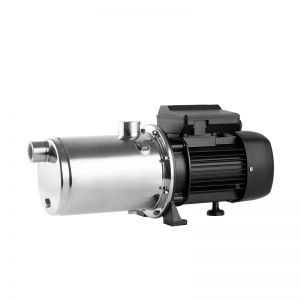
The Stream SJETS Stainless Steel Self-Priming Jet Pump is designed for domestic and light commercial clean-water applications where reliable suction, stable pressure, and durable construction are required.
Built around an injection-type jet pump design, the SJETS series combines centrifugal pumping action with a nozzle system to support fast self-priming, high head, and dependable suction performance.
The SJETS range includes three main power options from 370 W to 750 W, with maximum flow rates up to 52 L/min and maximum heads up to 50 m.
The series is particularly suitable for drawing clean water from wells, supplying water to homes, supporting garden irrigation, operating pressure systems, and transferring non-aggressive liquids.
The Stream SJETS is an injection-type clean-water jet pump that combines a centrifugal pump with a nozzle system.
This hydraulic arrangement is designed to improve suction performance and allow the pump to handle situations where some air is present in the suction line.
Compared with a standard centrifugal pump, a self-priming jet pump is better suited to applications where the water source is below the pump and the system needs to recover suction after startup.
Stream specifically positions the SJET(P/S) series for clean water and non-aggressive liquids, with applications including domestic water supply, irrigation, pressure systems, washing systems, and liquid transfer.
Within the SJET(P/S) platform, the SJETS version is the premium configuration because it uses a stainless steel pump body.
The stainless steel pump head gives the SJETS a more durable and corrosion-resistant exterior hydraulic structure compared with lower-cost alternatives using non-metallic pump bodies.
For customers who prioritize product durability, appearance, long-term value, and a more premium construction, SJETS is the stronger choice.
This is particularly relevant for distributors, installers, and homeowners looking for a jet pump that combines strong hydraulic performance with a stainless steel pump body.
The SJETS and SJETP models share the same hydraulic performance platform and use the same basic performance ratings within corresponding models.
The main difference is the pump body material.
Feature | SJETS | SJETP |
Pump Body | Stainless steel | Plastic |
Hydraulic Performance | Same platform | Same platform |
Positioning | Premium durability and appearance | Lower-cost alternative |
Best For | Users prioritizing durability and stainless construction | Price-sensitive applications |
In practical terms, customers choosing between the two versions do not need to change the expected flow and head simply because of the pump body material.
The decision is mainly about construction preference and budget.
For most applications where a more durable and premium pump body is preferred, SJETS is the recommended version.
Model | Power | Max Flow | Max Head |
SJET(P/S)60 | 370 W | 42 L/min | 38 m |
SJET(P/S)80 | 550 W | 46 L/min | 45 m |
SJET(P/S)100 | 750 W | 52 L/min | 50 m |
The exact operating flow and pressure depend on the installation and the hydraulic resistance of the system.
For pump selection, users should consider not only maximum flow and maximum head, but also suction height, pipe length, pipe diameter, fittings, and the required delivery pressure.
The defining feature of the SJETS version is its stainless steel pump body.
This gives the pump a robust and premium construction while supporting reliable use in clean-water applications.
For users comparing different jet pump materials, stainless steel is often selected when appearance, durability, and corrosion resistance are important purchasing factors.
The SJETS is designed to pump water even when some air is present in the suction system.
This makes it particularly useful for shallow well water supply, garden irrigation, and surface-mounted installations where the pump must draw water from a source below the pump.
The Stream SJET series can provide self-priming capability with suction lift of up to approximately 8 m under suitable installation conditions.
One of the main advantages of a jet pump is its ability to generate useful discharge pressure.
The SJETS series reaches maximum heads from 38 m to 50 m depending on model, making it suitable for pressure boosting, garden sprinklers, water supply systems, and other applications requiring higher delivery pressure.
The product series is available with stainless steel impeller construction, while other impeller material options may also be available depending on configuration.
The pump body is stainless steel, the motor housing is aluminum, and the motor uses a closed, externally ventilated design.
The SJETS is designed for continuous rated duty within its stated working conditions.
This makes it suitable for repeated daily use in domestic water supply, garden irrigation, liquid transfer, and pressure systems.
A self-priming jet pump combines centrifugal pumping with a jet or nozzle system.
When the motor drives the impeller, water inside the pump body is accelerated through the hydraulic passages.
The nozzle helps create a low-pressure region that supports suction from the inlet side.
This arrangement allows the pump to evacuate a limited amount of air from the suction line and gradually restore water flow.
Once the suction line is filled and the pump reaches normal operation, water continues to move from the source through the pump and toward the discharge system.
This is why jet pumps are widely used for shallow wells and domestic water systems where the pump itself is installed above the water source.
Self-priming does not mean that a surface pump can operate permanently without water inside the pump casing.
Before the first startup, the pump casing and suction system should normally be filled with clean water according to the installation instructions.
Once correctly primed, the internal design helps the pump handle residual air and re-establish suction more easily than a conventional centrifugal pump.
It is also important to understand that self-priming capability does not eliminate the physical limitation of suction lift.
For surface pumps such as the SJET series, practical suction lift is generally limited to approximately 6–8 m under suitable conditions.
The SJETS can be used to move clean water from wells, storage tanks, pools, and other suitable water sources into domestic water systems.
When combined with a pressure tank and pressure switch, the pump can support automatic water distribution around the home.
The self-priming jet design makes the SJETS well suited to shallow well applications where the water level is below the pump.
Correct suction pipe sizing and airtight installation are essential for reliable performance.
The pump can provide the flow and pressure required for garden watering, sprinklers, hose systems, and general landscape irrigation.
Higher-head SJETS models are especially useful where pressure is required to operate sprinklers or distribute water over longer distances.
The SJETS can be used in pressure systems where incoming water pressure is insufficient for the intended application.
Depending on the installation, the pump can work with suitable control equipment, pressure tanks, or pressure switches to improve water supply pressure.
The relatively strong head performance of the SJETS makes it suitable for clean-water washing applications where stable pressure is useful.
The pump can also transfer clean, non-aggressive liquids between tanks or other suitable water storage locations.
Maximum ambient temperature: up to +40°C
Maximum fluid temperature: up to 80°C
Maximum system pressure: up to 10 bar
Suitable liquids: clean water and non-aggressive liquids
Duty: continuous rated
The pump should be installed in a covered area and protected from direct exposure to weather.
Component | Material / Design |
Pump Body | Stainless steel |
Motor Housing | Aluminum |
Motor | Closed, externally ventilated |
Impeller | Brass / stainless steel / PPO optional |
Insulation | Class B / F |
Mechanical Seal | Steatite ceramic / metalized carbon |
Both stainless steel and engineering plastic can be used successfully in clean-water pumps, but they serve different market priorities.
The SJETP plastic-body version offers the same basic hydraulic platform and is intended mainly for applications where purchase cost is a primary consideration.
The SJETS stainless steel version is positioned as the more premium choice.
Its stainless steel pump body gives the product a more robust appearance and provides customers with a construction material that is widely preferred in water supply equipment.
For distributors, the two versions can therefore cover different price segments without changing the basic performance range.
SJETP can serve the entry-level or price-sensitive market, while SJETS can be promoted to customers who value stainless steel construction and a higher-end product specification.
Selecting the correct model starts with the required water flow and pressure.
The 370 W version provides up to 42 L/min flow and 38 m maximum head.
It is suitable for lighter domestic water supply, garden watering, and smaller pressure systems.
The 550 W version increases maximum flow to 46 L/min and maximum head to 45 m.
This makes it suitable for applications requiring more pressure or a slightly larger water demand.
The 750 W model provides the highest performance in the series, with flow up to 52 L/min and head up to 50 m.
It is the stronger choice for larger irrigation systems, pressure boosting, longer pipelines, and higher water demand.
A self-priming pump relies on creating sufficient vacuum in the suction line.
Even a small air leak at a fitting, connector, valve, or hose can prevent the pump from drawing water correctly.
An undersized suction pipe creates additional resistance and can reduce pump performance.
Follow the recommended connection size and avoid unnecessary restrictions.
Install the pump as close to the water source as practical.
The greater the vertical distance between the pump and the water surface, the more difficult it becomes for a surface pump to maintain suction.
Before the first operation, fill the pump casing with clean water through the priming opening.
Starting a dry centrifugal pump can prevent proper suction and may damage internal components.
The SJETS should be installed in a covered location protected from direct rain and severe weather exposure.
A loss of prime or air leak in the suction line is one of the most common causes.
Check that the pump casing is filled with water and inspect all suction-side connections for leaks.
Low flow can be caused by excessive suction height, restricted piping, clogged suction components, or operating the pump at a higher head than intended.
Repeated loss of prime often indicates that air is entering the suction line or water is draining back toward the source.
Inspect seals, fittings, and the foot valve or non-return valve if used.
Make sure ventilation around the motor is not blocked and that ambient temperature remains within the stated operating limits.
Also confirm that the pump is operating within an appropriate hydraulic range.
Feature | SJETS Jet Pump | Standard Centrifugal Pump |
Self-Priming Ability | Yes, designed for easier air handling | Usually more limited |
Shallow Well Use | Well suited | Depends on design |
Pressure Performance | Strong head performance | Varies by model |
Typical Applications | Well supply, irrigation, pressure boosting | General water circulation and transfer |
The SJETS is designed for clean-water applications including domestic water supply, shallow wells, irrigation, washing systems, liquid transfer, and pressure boosting.
The maximum flow reaches 52 L/min on the SJET(P/S)100 model.
The maximum head reaches 50 m on the 750 W SJET(P/S)100 model.
Yes. The self-priming jet design makes it suitable for shallow well applications where the pump is installed above the water level.
The main difference is the pump body material. SJETS uses a stainless steel pump body, while SJETP uses a plastic pump body. Corresponding models share the same basic performance parameters.
Choose SJETS if stainless steel construction, product durability, and premium appearance are priorities.
Choose SJETP when a lower initial purchase cost is more important.
No. The series is designed for clean water and non-aggressive liquids.
The maximum fluid temperature is 80°C.
The maximum ambient temperature is +40°C.
The pump should be installed in a covered area and protected from direct weather exposure.
Yes. The pump casing should normally be filled with clean water before initial startup so the self-priming process can operate correctly.
The Stream SJETS combines self-priming jet pump technology with a stainless steel pump body, making it a strong option for users who need reliable clean-water pumping with good suction and pressure performance.
With three main models ranging from 370 W to 750 W, maximum flow up to 52 L/min, and maximum head up to 50 m, the series covers a broad range of domestic and garden water applications.
Its self-priming capability makes it particularly useful for shallow wells, while its head performance supports irrigation, washing systems, domestic water supply, and pressure boosting.
For customers who want the same SJET hydraulic performance at a lower purchase cost, the SJETP plastic-body version provides an alternative.
However, for distributors, installers, and end users who prefer stainless steel construction and a more premium product configuration, the Stream SJETS remains the primary model to consider.
Address
No.17 XeDa Jimei Ind. Park, Xiqing Economic Development Area, Tianjin, China
Telephone
+86 13816508465
QUICK LINKS