+86 13816508465
Pump Troubleshooting
May. 25, 2026
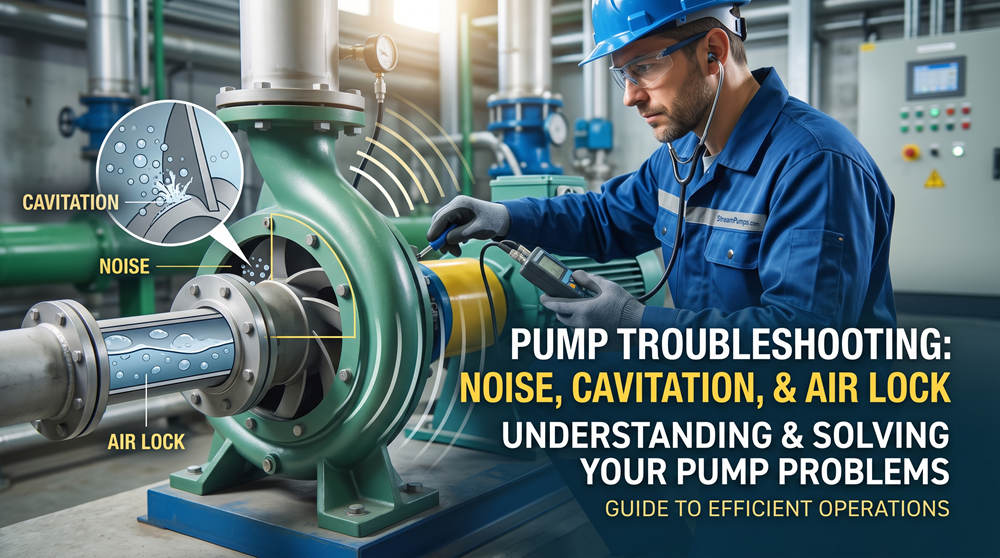
Quick answer: Air lock (air binding) occurs during startup when trapped air prevents the impeller from creating a vacuum, resulting in a high-pitched whine and zero discharge pressure. Cavitation happens during operation when fluid vaporizes due to low pressure, causing violent bubble collapse, erratic gauge flutter, and a sound resembling pumping gravel.
When an industrial centrifugal pump suddenly loses flow or begins emitting terrifying mechanical noises, field technicians must act quickly. Plant operators and maintenance personnel frequently confuse [air binding] (commonly known as air lock) with [cavitation.] This fundamental misunderstanding is one of the leading causes of unnecessary maintenance expenditures in industrial fluid processing facilities. Misdiagnosing these issues leads to the wrong repairs, wasted capital, extended downtime, and prematurely destroyed equipment.
To resolve pump noise and flow failure, engineers must accurately identify the root cause of the disruption. Treating an air lock as cavitation often results in technicians uselessly adjusting tank levels or calculating system curves. Conversely, treating cavitation as an air lock leads to futile attempts at venting the pump casing while the impeller continuously disintegrates.
The distinction between the two phenomena is absolute. Air binding is strictly a piping and venting issue associated with the presence of atmospheric gases. Cavitation is a complex fluid dynamics problem governed by the vapor pressure of the liquid being pumped. By mastering the diagnostic differences between air binding vs cavitation, process engineers and technicians can implement the correct engineering solutions, safeguard their equipment, and maximize continuous operational uptime.
To resolve a centrifugal pump failure, field professionals must first understand the distinct physical mechanics driving each issue. Creating a strict contrast between the two phenomena prevents misdiagnosis on the plant floor.
Air binding occurs when air or process gas becomes trapped inside the pump volute or the suction piping. Because centrifugal pumps are designed to move dense liquids, they are generally incapable of compressing and moving atmospheric gases. When a significant volume of air accumulates in the eye of the impeller, the impeller merely spins in the air. It cannot create the necessary vacuum to draw liquid into the casing.
This failure prevents the pump from generating differential pressure, effectively deadheading the system without closing a valve. Crucially, a centrifugal pump air lock almost always happens during the initial startup phase. If the pump casing and suction lines are not properly flooded and vented before the motor is energized, the trapped air forms a barrier that the impeller cannot overcome.
Cavitation is an entirely different physical process. It occurs when the absolute pressure at the pump inlet drops below the vapor pressure of the pumped liquid at its current operating temperature. When the localized pressure drops this low, the liquid literally boils at ambient temperature. This localized boiling creates microscopic vapor bubbles within the fluid stream.
As the fluid travels through the impeller and enters the high-pressure discharge zone of the volute, the surrounding pressure rapidly increases. This sudden pressure spike forces the vapor bubbles to collapse violently. The implosion of these bubbles generates microscopic shockwaves that strike the metal surfaces of the impeller, tearing away small pits of material. Unlike air binding, cavitation typically manifests during normal operation, often triggered by changing tank levels, fouled strainers, or fluctuating process temperatures.
Field diagnostics require practical, on-site criteria to determine the root cause of a pump malfunction. You do not need to dismantle a centrifugal pump to identify the problem. By analyzing the acoustic signatures and evaluating the instrumentation gauges, industrial maintenance technicians can easily differentiate the two conditions.
The acoustic profile of a failing pump provides immediate clues to the underlying physics. The pump cavitation sound is distinct and aggressive. Technicians consistently describe it as sounding like pumping marbles, gravel, or rocks through the metal casing. This severe noise is accompanied by heavy, erratic mechanical vibration that can shake the baseplate and damage the mechanical seals.
In contrast, air binding presents a completely different auditory signature. Because the impeller is freely spinning in a pocket of compressible air, the heavy impacts of collapsing bubbles are absent. Instead, air lock produces a smoother, high-pitched whine. The vibration levels remain minimal because the motor is completely unloaded and the fluid is simply not moving.
Relying solely on human hearing can be subjective, so technicians must verify their acoustic diagnosis using the pump's discharge pressure gauge and motor amp draw.
During a cavitation event, the discharge pressure gauge will flutter erratically. The needle will bounce rapidly as the vapor bubbles randomly form and collapse, causing sudden micro-fluctuations in the hydraulic output. Similarly, the motor amp draw will bounce and fluctuate as the density of the fluid passing through the impeller rapidly shifts between liquid and vapor.
During an air binding event, the discharge pressure drops strictly to zero. The pump is moving zero liquid, generating zero head. Consequently, the motor amp draw drops to an abnormally low, steady state. The electrical load is minimal because the motor is only working to overcome the mechanical friction of the bearings and the aerodynamic drag of spinning in trapped air.
Eradicating air binding requires strict adherence to fluid handling best practices and proper piping design. Because air binding is a mechanical trapping of gas, the engineering solutions focus entirely on venting procedures and the physical layout of the suction lines.
The absolute necessity of properly priming and venting the pump casing before startup cannot be overstated. Before the motor is energized, technicians must open the casing vent valve to allow atmospheric air to escape as the incoming liquid floods the volute. Only when a steady, bubble-free stream of process liquid exits the vent should the valve be closed and the pump started.
If a pump repeatedly air binds despite proper priming, the fault likely lies in the suction piping geometry. Suction piping must continuously slope upwards from the fluid source to the pump inlet. Engineers must strictly avoid installing inverted U-bends or high points in the suction line, as these geometries act as permanent air traps. When the fluid velocity slows, entrained gases naturally migrate to these high points, forming an air pocket that eventually travels to the impeller and causes an air lock.
When transitioning from a larger diameter suction pipe to a smaller diameter pump inlet flange on a horizontal run, piping designers must specify the correct pipe fitting. The critical rule is to always install a flat-top eccentric reducer pump suction fitting. A concentric reducer will create a void at the top of the pipe where air can accumulate. By keeping the flat side of the eccentric reducer positioned at the top, engineers ensure that any entrained air bubbles are swept directly into the pump casing and discharged before they can aggregate into a flow-stopping air lock.
Transitioning from piping geometry to fluid dynamics, curing cavitation requires an evaluation of the system's absolute pressure parameters. The golden rule of centrifugal pump engineering dictates that the Net Positive Suction Head available (NPSHa) must always be greater than the Net Positive Suction Head required (NPSHr).
NPSHr is a fixed value provided by the pump manufacturer, representing the minimum pressure required at the suction nozzle to prevent the liquid from boiling. NPSHa is a variable value calculated by the process engineer, based on the physical realities of the piping system and the fluid properties. Performing an accurate NPSHa vs NPSHr calculation is the only definitive way to prove whether a system is susceptible to cavitation.
If a system is cavitating, the engineer must manipulate the process variables to increase the NPSHa. There are several practical, field-proven methods to achieve this:
1. Raise the liquid level in the supply tank to increase the static head pressure pushing down on the pump inlet.
2. Clean clogged suction strainers to immediately remove friction penalties.
3. Increase the suction pipe diameter to reduce overall friction loss.
4. Lower the liquid temperature to reduce its vapor pressure, making it harder for the fluid to boil.
Furthermore, plant operators must ensure the pump is operating near its Best Efficiency Point (BEP). Operating the pump too far out on the right side of its performance curve drastically increases the fluid velocity, which in turn increases the NPSHr. Throttling the discharge valve to push the pump back toward its BEP will often immediately suppress active cavitation.
Industrial centrifugal pumps are robust machines, but they cannot defy physics. You cannot fix cavitation by venting the pump casing, and you cannot fix air binding by recalculating the NPSHa. By accurately analyzing acoustic profiles, gauge behavior, and timing, technicians can immediately differentiate between a piping layout failure and a vapor pressure crisis.
When your facility experiences chronic pump vibration, rapid impeller pitting, or persistent suction issues, guessing is not an option. Match the engineering solution directly to the governing science.
If your facility is struggling to isolate the root cause of mechanical pump failures, take action today. Contact the StreamPumps technical team for a complete system review, piping geometry audit, and comprehensive NPSH calculation to secure your fluid processing reliability.
The most obvious indicator is the acoustic signature combined with gauge behavior. Cavitation sounds like pumping gravel and causes erratic fluctuations on the discharge pressure gauge. Air binding produces a smooth whine with the discharge pressure dropping to absolute zero.
Yes. Cavitation generates microscopic shockwaves that violently pit and erode the metal impeller, leading to rapid mechanical destruction. Air binding unloads the motor and stops fluid flow, which can cause heat buildup over a long period, but it lacks the immediate destructive mechanical impacts of cavitation.
No. An eccentric reducer installed flat-side up on a horizontal suction line prevents air binding by stopping the formation of trapped air pockets. It does not alter the vapor pressure or the fluid temperature required to prevent cavitation.
If you cannot increase the static head by raising the tank level, you can increase NPSHa by lowering the fluid temperature (reducing vapor pressure) or by reducing friction losses in the suction line (cleaning strainers, minimizing elbows, or increasing the suction pipe diameter).
Address
No.17 XeDa Jimei Ind. Park, Xiqing Economic Development Area, Tianjin, China
Telephone
+86 13816508465
QUICK LINKS