+86 13816508465
Pump Troubleshooting
May. 22, 2026
There is a harsh engineering truth that every maintenance manager and reliability engineer must eventually accept: industrial pump bearings rarely die of natural causes. In fact, field data consistently shows that over 90 percent of industrial pump bearing failures are not the result of natural metal fatigue. Instead, these precision components are effectively murdered. They are destroyed prematurely by a combination of shaft misalignment, contamination, poor lubrication practices, or severe operational abuse.When a bearing fails, it brings the entire pumping system to a grinding halt, costing facilities thousands of dollars in unplanned downtime and emergency repair labor. However, conducting a proper pump bearing failure analysis requires more than simply swapping out the damaged parts and hitting the start button. It requires a fundamental understanding of the specific pump geometry you are working with. The forces acting on a vertical turbine are completely different from those impacting a horizontal cantilevered shaft.Troubleshooting these issues effectively means looking beyond the bearing housing to evaluate the entire hydraulic system. You must analyze the operating environment, the process fluid, the motor drive, and the piping infrastructure.This guide acts as a deep-dive extension of our [Internal Link Placeholder: Ultimate Pump Maintenance Checklist]. By understanding the unique mechanical stresses inherent to end-suction, submersible, and multistage pumps, facility operators can shift their maintenance strategy from reactive firefighting to proactive reliability.
Universal Diagnostics: Catching Failures Before the Teardown
The most effective maintenance programs do not wait for a pump to seize before taking action. You can diagnose the health of your bearings long before you need to unbolt the pump casing or remove a bearing housing. Predictive maintenance technologies allow technicians to catch early-stage degradation, significantly reducing repair costs and preventing catastrophic damage to the shaft and impeller.
Acoustic Monitoring
Human hearing is often the first line of defense on the plant floor, but knowing what to listen for is critical. Different sounds indicate entirely different failure modes. A high-pitched, steady whine typically points to a lack of lubrication or a bearing that has been improperly mounted with too tight of a fit (pinching). Conversely, a low-frequency, grinding rumble indicates that spalling—the flaking away of metal from the bearing raceway or rolling elements—has already begun. By the time you hear this rumble, the bearing is in its final stages of life.
Thermal Baselining
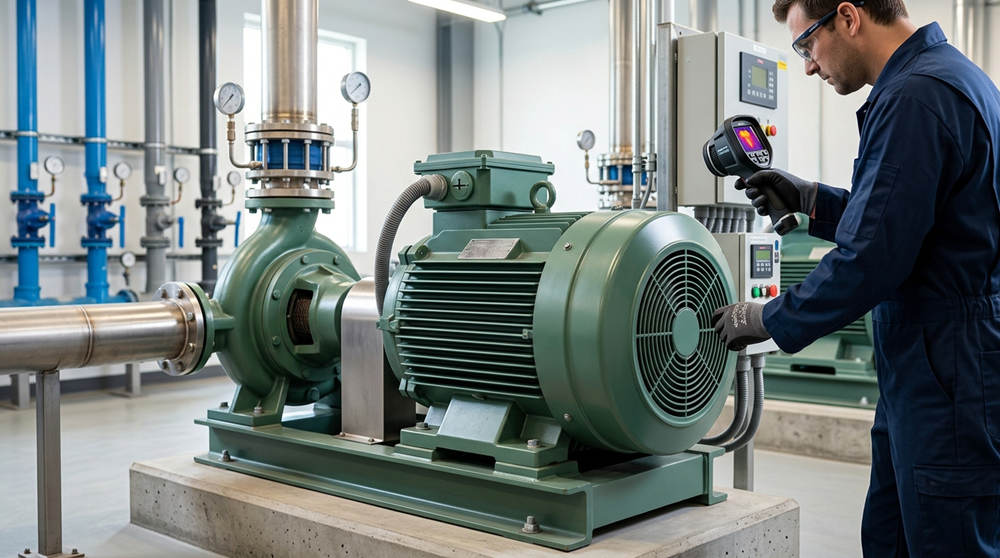
Heat is the enemy of rotating equipment. As a general industrial rule, bearing housings should not operate at temperatures exceeding 75°C (167°F), or roughly 40°C above the ambient room temperature. When temperatures climb beyond this red line, the lubricating oil or grease begins to degrade rapidly. The lubricant loses its viscosity, causing the metal-to-metal contact to increase, which generates even more heat in a destructive feedback loop. Routine thermal imaging or RTD (Resistance Temperature Detector) monitoring is essential for catching these temperature spikes early.
High-Frequency Vibration Analysis
While standard vibration analysis is standard practice, catching bearing defects early requires high-frequency enveloping technology. This advanced diagnostic technique isolates the specific, high-frequency impacts generated by microscopic cracks in the bearing raceway or rollers. High-frequency enveloping can detect bearing degradation weeks or even months before humans can hear the damage or feel the heat, giving maintenance teams ample time to schedule a planned outage.
End-Suction Pumps: The Alignment and Pipe Strain Trap
End-suction pumps are the workhorses of the industrial world, but their specific cantilevered design makes them highly susceptible to external radial forces. Because the impeller overhangs the bearings, any deflection at the shaft end is magnified at the bearing housing.The number one cause of premature bearing failure in these units is coupling misalignment. When the motor shaft and pump shaft are not perfectly collinear, the resulting rotational forces bend the shaft with every revolution. This constant deflection destroys the radial bearings and compromises the mechanical seal. To combat this, facilities must mandate precision laser alignment for all end-suction installations, targeting a strict tolerance of within 0.05mm.Equally destructive, yet frequently overlooked, is the issue of pipe strain. Recognizing pump pipe strain symptoms—such as a pump that is impossible to align, or casing bolts that bind when loosened—is critical for reliability engineers. Pipe strain occurs when heavy, unsupported suction or discharge piping rests its weight directly on the pump casing. This external force pulls the casing out of shape, immediately ruining the shaft alignment and placing massive, uneven loads on the bearings. The permanent fix is ensuring that all piping is independently supported and properly anchored before it is bolted to the pump flanges.
Submersible Pumps: Moisture Ingress and VFD Electrical Fluting
Submersible pumps operate in harsh, unforgiving environments where they are completely surrounded by the fluid they are pumping. This submerged, sealed environment introduces two unique threats to bearing longevity that surface pumps rarely encounter.
Threat 1: Moisture Contamination
The primary defense mechanism for a submersible pump is its mechanical seal system. If the lower mechanical seal fails, process fluid or wastewater bypasses the barrier and travels directly up the shaft into the bearing housing. Water is a terrible lubricant. Even a microscopic amount of water in the bearing grease will wash away the protective oil film, causing rapid oxidation, rust, and eventual bearing seizure. Routine oil analysis of the seal chamber is critical to detect water ingress before it reaches the bearings.
Threat 2: VFD Electrical Fluting
Modern submersible pumps are frequently paired with Variable Frequency Drives (VFDs) to optimize energy consumption. However, VFDs can induce high-frequency common-mode voltages on the pump shaft. Because the rotor is isolated by the bearings, this stray voltage builds up until it arcs through the bearing lubricant film to the grounded stator.This arcing causes microscopic pitting on the bearing raceway, known as submersible pump VFD bearing fluting. Over time, these craters create a washboard pattern on the metal, resulting in loud, destructive vibration. To prevent this, facilities must demand clean-room conditions for teardowns and mandate the installation of grounding rings or insulated (ceramic-coated) bearings for all VFD-driven submersibles.
Vertical Multistage Pumps: Battling Downward Axial Thrust
Vertical multistage pumps are widely used for high-pressure applications like boiler feed and reverse osmosis. The vertical orientation relies on gravity and complex hydraulics, which fundamentally changes how the bearings support the rotating assembly.Pumping fluid vertically through multiple impellers creates a massive downward force known as axial thrust. This constant downward pressure tries to completely crush the top vertical multistage thrust bearing. If the thrust bearing is improperly sized, or if the pump operates outside of its Best Efficiency Point (BEP), the resulting forces will overload the rollers, leading to rapid catastrophic failure and severe vibration.At the bottom of the pump, the situation is entirely different. The bottom sleeve bearing (or bushing) does not use traditional grease or oil. Instead, it relies entirely on the pumped fluid to create a hydrodynamic lubricating film. Because of this, dry running is a fatal error. Running a vertical multistage pump without fluid will vaporize the bottom bearing instantly due to extreme friction. When rebuilding these units, technicians must execute strict measurements of rotor axial play to ensure the thrust bearing can handle the load and the sleeve bearing maintains proper clearances.
Horizontal Multistage Pumps: The Balance Disc Catastrophe
Horizontal multistage pumps manage extreme pressures by staging multiple impellers along a long horizontal shaft. Because all the impellers generally face the same direction, they generate an enormous amount of axial thrust pushing toward the suction end of the pump.To counteract this extreme force, manufacturers utilize a specific internal hydraulic component called a balance disc or balance drum. The balance device bleeds off high-pressure fluid to equalize the thrust, effectively floating the rotor and protecting the bearings.However, if the process fluid contains abrasives, the tight clearances of the balance disc will eventually wear out. When the balance disc fails, the hydraulic equalization is lost. The entire hydraulic load shifts violently to the end bearings, destroying them in a matter of hours. During overhauls, engineers cannot simply swap out the ruined bearings. They must measure and restore the residual clearance of the balance device; otherwise, the replacement bearings will suffer the exact same fate the moment the pump is brought back online.
The Over-Greasing Myth: When Maintenance Causes Failure
It is a common misconception on the plant floor that if a little grease is good, more grease must be better. This belief leads to one of the most frequent technician-induced failures: over-greasing.Pumping too much grease into a bearing housing does not provide extra protection. Instead, it eliminates the free space required for the grease to expand and dissipate heat. The rolling elements are forced to plow through the dense cavity of packed grease, creating severe fluid friction. This friction traps heat inside the housing, literally cooking the bearing and accelerating the degradation of the lubricant. Furthermore, the excessive pressure from a grease gun can blow out the bearing lip seals, allowing external dirt and contaminants to enter the housing. Precision lubrication, using calculated volumes at strictly controlled intervals, is the only way to avoid this self-inflicted damage.
Precision Diagnostics Save Capital and Extend Equipment Life
The anatomy of a bearing failure tells a detailed story about the health of your entire pumping system. Understanding the specific mechanical stresses and common failure modes of each pump type—whether it is the pipe strain on an end-suction unit, the electrical fluting in a submersible, or the extreme thrust forces in a multistage pump—allows you to address the root cause of the problem, rather than just treating the symptom.Implementing precision alignment, rigorous lubrication standards, and advanced vibration diagnostics can easily extend your Mean Time Between Failures (MTBF) by two to three times.
Address
No.17 XeDa Jimei Ind. Park, Xiqing Economic Development Area, Tianjin, China
Telephone
+86 13816508465
QUICK LINKS