+86 13816508465
Pump Solutions
Mar. 30, 2026
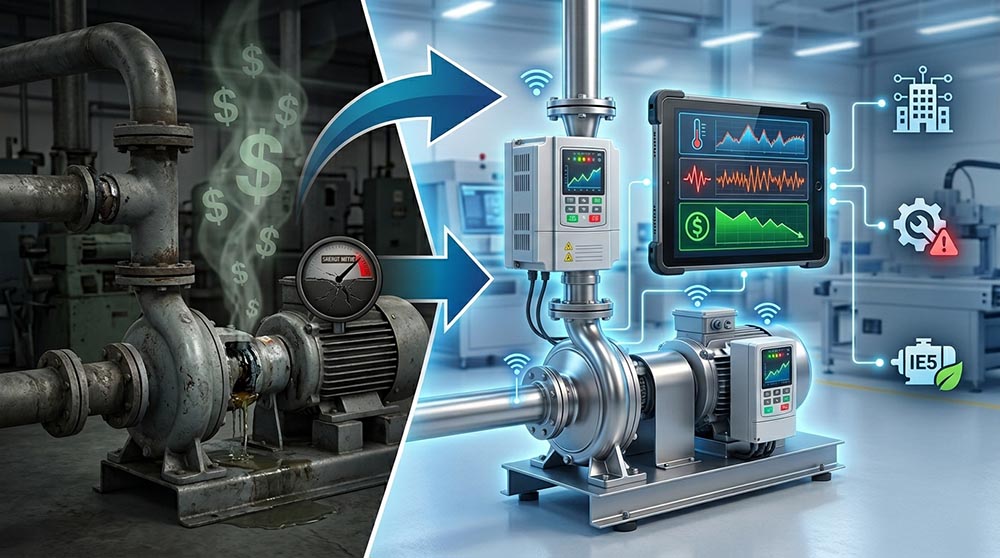
Waiting for a pump to break before replacing it is a strategy that costs modern manufacturing and commercial facilities millions in unplanned downtime and wasted energy. The era of 【run-to-failure】 maintenance has officially ended. As industrial operations become more complex and margins grow tighter, facility leaders are recognizing that reactive maintenance is a massive drain on operational expenditure (OpEx).
Looking toward the 2026 reality in developed markets, legacy fixed-speed pumps have become major financial liabilities. Stringent new energy efficiency regulations, such as the European Union’s Energy-related Products (ErP) directive and the US Department of Energy (DOE) standards, mandate strict compliance. Simultaneously, organizations are setting aggressive corporate environmental, social, and governance (ESG) targets. Operating outdated equipment directly contradicts these goals, inflating both energy bills and carbon footprints.
Stream Pumps delivers Next-Gen pump upgrades designed specifically for this new industrial landscape. By combining ultra-efficient hydraulics with smart IoT connectivity, Stream Pumps Industry 4.0 solutions transform your standard pump room into a data-driven, carbon-reducing asset. The right industrial pump system upgrades provide a definitive competitive edge, ensuring regulatory compliance while dramatically lowering lifecycle costs.
The regulatory push across North America, Europe, and Oceania has rendered older IE2 motors obsolete. Facilities are now rapidly shifting towards IE4 and IE5 ultra-high-efficiency motors to meet strict compliance metrics and reduce their carbon footprint. These advanced motors utilize superior materials and optimized electromagnetic designs to minimize energy losses, establishing a new baseline for industrial performance.
Running a pump without a Variable Frequency Drive (VFD) in a developed market is the mechanical equivalent of leaving a car engine redlining at a stoplight. Traditional fixed-speed systems operate at maximum capacity regardless of actual demand, wasting massive amounts of electricity. VFDs solve this problem by continuously matching the motor speed to the precise flow and pressure requirements of the facility. This dynamic adjustment prevents energy waste and reduces mechanical stress on the equipment.
The return on investment (ROI) for these motor and drive upgrades is compelling. Upgrading to a Stream Pumps VFD-controlled multistage system frequently pays for itself in under 18 months through electricity savings alone. Once that payback period ends, the ongoing energy reductions translate directly into pure OpEx savings, strengthening the facility's bottom line year after year.
Skilled maintenance labor in developed countries is incredibly expensive and increasingly scarce. Sending a technician to a pump room to manually check vibration levels on a daily basis is no longer a viable use of resources. Facilities require automated, intelligent solutions that monitor equipment health continuously without requiring constant human intervention.
Smart water pumps solve this labor challenge by attaching Internet of Things (IoT) sensors directly to the pump bearing housing. These sophisticated devices continuously monitor critical performance metrics, including vibration, temperature, and cavitation, in real-time. By tracking these variables, the system establishes a baseline of normal operation and immediately detects minute deviations that indicate early mechanical wear or hydraulic instability.
This is where the Stream Pumps edge becomes highly apparent. Our IoT pump monitoring solutions utilize cloud-based alerts that ping a Facility Manager's smartphone well before a mechanical seal actually fails. This predictive maintenance approach turns what would have been an expensive, catastrophic emergency into a highly manageable, cheaply scheduled repair. Facility teams can order parts in advance and schedule maintenance during planned downtime, eliminating the chaos and financial losses associated with unexpected equipment failure.
Industrial pumps should never operate in a vacuum. To maximize efficiency, they must communicate seamlessly with the rest of the factory or smart building. Unfortunately, many legacy facilities suffer from the silo problem, where mechanical assets operate independently from the central control systems. This lack of integration prevents plant engineers from viewing the full operational picture, leading to inefficient energy distribution and suboptimal system performance.
Stream Pumps controllers eliminate these communication silos. They come equipped with advanced communication protocols—including Modbus, BACnet, and Profibus—that plug directly into the facility's central SCADA or Building Management System (BMS). This connectivity enables total facility automation, allowing ESG Directors and Facility Managers to monitor energy consumption, track performance trends, and adjust operational parameters from a single, centralized dashboard.
Achieving this level of integration is a core component of Industry 4.0. When your pumping infrastructure talks directly to your cooling towers, boilers, and HVAC systems, the entire facility operates as a cohesive, highly optimized organism. This holistic approach ensures that energy is only consumed exactly when and where it is needed.
Replacing an old pump with a new high-efficiency model will not save energy if the surrounding pipe network remains choked by half-closed valves. A common misconception in industrial upgrades is that swapping out the primary prime mover automatically fixes systemic inefficiencies. If the fluid network is poorly designed or heavily throttled to control flow, even an IE5 motor will struggle to deliver its promised ROI.
Stream Pumps advocates for a comprehensive engineering approach through a complete 【System Assessment.】 Our engineering teams evaluate the entire fluid network to identify bottlenecks, excessive friction losses, and improper control strategies. The goal is to eliminate throttling valves entirely, replacing their function with smart VFD control.
Furthermore, we ensure that impellers are correctly sized for the specific application. Oversized pumps are a rampant problem in legacy facilities, leading to chronic inefficiency and excessive wear. By optimizing the entire fluid network from the suction source to the final discharge point, Stream Pumps guarantees that the new equipment operates at its Best Efficiency Point (BEP), maximizing reliability and delivering on your ESG targets.
Upgrading your pumping infrastructure is one of the fastest, most measurable ways to achieve your corporate sustainability goals while immediately boosting your bottom line. Transitioning to smart water pumps, integrating predictive maintenance, and demanding system-level optimization transforms a traditional cost center into a major source of OpEx reduction.
Are your legacy pumps eating into your energy budget and putting your facility at risk of non-compliance? Contact the Stream Pumps advanced engineering team for a comprehensive energy audit and smart system upgrade proposal today.
Address
No.17 XeDa Jimei Ind. Park, Xiqing Economic Development Area, Tianjin, China
Telephone
+86 13816508465
QUICK LINKS