+86 13816508465
Pump Introductions
Aug. 21, 2026
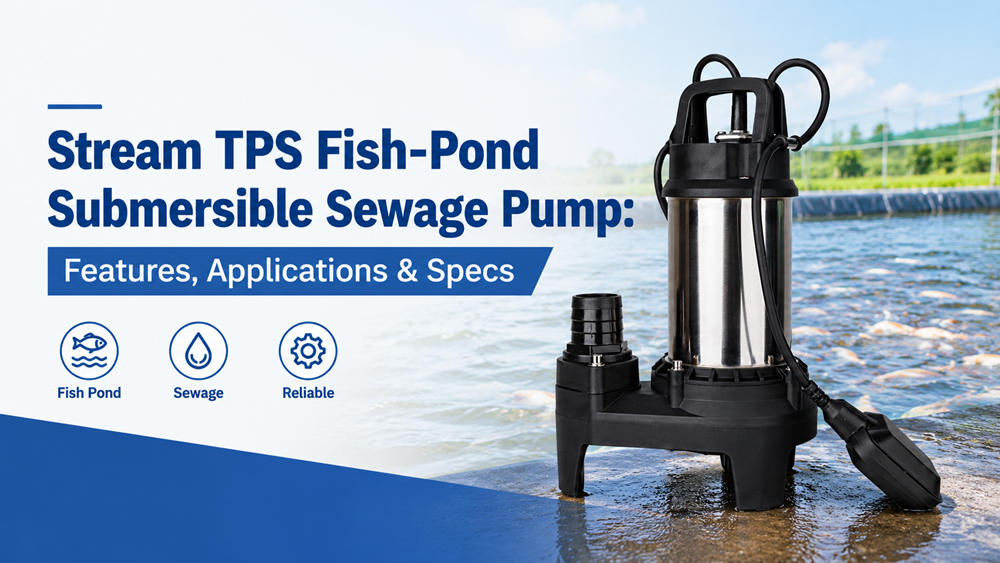
The Stream TPS is a submersible sewage pump engineered specifically for fish pond and koi breeding applications. It features a corrosion-resistant lightweight body, double silicone carbide mechanical seal, and a vortex impeller that handles solids up to 15mm. The TPS operates across a pH range of 4–10, handles clean water, seawater, and sewage, and suits a wide range of pond management, drainage, and circulation tasks.
Managing water quality in a fish pond is not a passive task. Waste accumulates continuously, oxygen levels shift, and suspended solids—if left unaddressed—create conditions that threaten fish health, tank clarity, and water chemistry. For koi breeding facilities, aquaculture operations, and hobbyist pond owners alike, the pump at the center of a water management system determines how reliably those challenges get resolved.
The Stream TPS Fish-Pond Submersible Sewage Pump was developed to meet the specific demands of pond environments. Its design priorities—corrosion resistance, efficient solids handling, and compatibility with diverse water types—make it a purpose-fit solution rather than a general-purpose pump adapted for fish pond use.
This guide covers the TPS in full: its construction, key features, recommended applications, working conditions, and technical specifications. Whether you are evaluating the TPS for a koi pond, a fishery water supply system, or a landscaping water feature, the following sections provide the technical detail needed to make a confident selection decision.
The Stream TPS is a submersible sewage pump classified within Stream's sewage pump product line. It is designed primarily for fish pond applications—particularly koi breeding facilities—where the pump must handle fish waste, support water circulation, and operate reliably in water conditions that vary in salinity, organic load, and pH.
Unlike standard sewage pumps, which are optimized for general wastewater removal, the TPS series prioritizes features that matter in aquatic and pond-specific environments: lightweight and corrosion-resistant construction, a sealed mechanical system rated for sustained submersion, and a vortex impeller capable of passing soft solids without clogging.
Fish pond environments expose pump components to a range of corrosive agents: dissolved minerals, organic waste compounds, saline water, and varying pH levels. Standard cast iron construction handles mechanical stress well but degrades under prolonged chemical exposure—particularly in aquaculture settings where water chemistry fluctuates.
The TPS addresses this with corrosion-resistant materials throughout its construction. The lightweight body reduces installation effort and makes repositioning the pump within a pond straightforward, which is a practical consideration for facilities that adjust their pond layouts seasonally or during breeding cycles.
Durability in the TPS is not achieved through material weight. It comes from selecting materials suited to the chemical environment in which the pump operates.
The mechanical seal is the component that prevents water from entering the motor housing. Seal failure is one of the most common causes of submersible pump breakdown, and it is particularly consequential in aquaculture environments where pump replacement or downtime can disrupt water circulation at a critical time.
The TPS uses a double silicone carbide mechanical seal. Silicon carbide is a hard ceramic material with high resistance to abrasion and chemical attack. A double-seal configuration provides a redundant barrier against liquid ingress, extending seal service life compared to single-seal designs—especially in water containing fine abrasive particles, as is common in fish pond conditions.
This sealing system contributes directly to the TPS's suitability for continuous submersion and sustained operation in aquaculture environments.
Fish pond water carries suspended solids: fish waste, uneaten feed, decomposing organic matter, and fine sediment. A pump with a conventional closed impeller would clog frequently under these conditions, requiring regular manual cleaning and creating operational interruptions.
The TPS uses a vortex impeller design. A vortex impeller creates a rotating flow pattern that draws solids through the pump casing without those solids making direct contact with the impeller blades. This non-clog design allows the TPS to pass solid particles up to 15mm, significantly reducing blockage risk in environments with organic waste loads.
For koi breeding facilities—where fish waste is produced continuously and water must be circulated and cleaned around active livestock—this impeller design is a key operational advantage.
The TPS is widely adopted by koi breeding facilities for two primary functions: efficient removal of fish waste and water circulation. Both functions are critical to koi health. Fish waste produces ammonia, which breaks down into nitrite and nitrate through the nitrogen cycle—compounds that become toxic at elevated concentrations. Regular waste removal, combined with active circulation, keeps these compounds within safe limits.
The vortex impeller allows the TPS to draw waste-laden water without clogging, while the corrosion-resistant body withstands the chemical properties of pond water over extended service periods. For hobbyist koi ponds and commercial breeding facilities alike, these characteristics make the TPS a reliable primary or secondary pump in a water management system.
Beyond ornamental ponds, the TPS serves water supply functions in agricultural and aquaculture contexts. Farming operations requiring water transfer from open sources, forestry irrigation systems, and fishery water supply networks all present conditions where a corrosion-resistant submersible pump with broad pH tolerance provides reliable performance.
The TPS's pH scope of 4–10 is notably wide. Most standard submersible sewage pumps operate within a narrower range—typically 6.5–8.5, as seen in Stream's SWK series. The broader pH tolerance of the TPS makes it suitable for water sources that are more acidic or alkaline than typical municipal supplies, which is common in natural ponds and agricultural water systems.
Active water circulation is essential in closed or semi-closed aquatic systems. Stagnant water depletes oxygen, accumulates waste, and creates thermal stratification that harms fish. Regular water changes dilute nitrates and replenish minerals.
The TPS supports both functions. Its submersible design allows placement directly within the pond at the optimal depth for circulation efficiency, and its solids-passing impeller ensures that partial water changes—which temporarily disturb sediment—do not result in blockage.
The TPS's operational range extends beyond fish ponds. Its clean water compatibility makes it suitable for:
Garden water features: Supplying flow to landscape waterfalls, decorative fountains, and ornamental ponds
Aquarium support: Moving water through filtration systems in larger aquarium setups
General drainage: Removing standing water from flooded areas, garden beds, or low-lying spaces
Filtration systems: Pumping water through external filter units in pond management setups
This range of applications reflects the TPS's design flexibility. Its corrosion resistance and solids-handling capacity allow it to function across water types and environments that would challenge narrower-specification pumps.
The TPS handles three distinct water categories:
Clean water: Standard garden and pond water with low suspended solid content
Seawater: Saline water with higher corrosive potential than freshwater
Sewage: Water containing organic waste, suspended solids, and elevated chemical load
This range of liquid compatibility—combined with the pH scope of 4–10—makes the TPS one of the more versatile submersible pumps in Stream's product lineup for aquatic and outdoor applications.
The Stream TPS operates within the following parameters:
Parameter | Specification |
|---|---|
Max. Immersion Depth | 5 m |
Liquid Temperature Range | 0–40 °C |
Liquid pH Scope | 4–10 |
Solids Passage (Vortex Impeller) | Up to 15 mm |
Max. Suspended Solids Passage | < 10 mm |
Compatible Liquid Types | Clean water, seawater, sewage |
Mechanical Seal | Double silicone carbide |
Construction | Corrosion-resistant, lightweight |
Note on solids passage: The vortex impeller is rated for solids passage up to 15mm, while the maximum suspended solids passage specification for the pump's working conditions is listed at less than 10mm. For applications involving solids at the upper end of this range, confirm compatibility with Stream's technical team before installation.
These working conditions define where the TPS performs optimally. Applications involving liquid temperatures above 40°C, pH values outside the 4–10 range, or immersion depths beyond 5 meters would require a different pump specification.
Several submersible sewage pumps on the market can move water. Fewer are configured specifically for the conditions present in fish pond environments. The TPS's advantages in this context are concrete:
Broad pH tolerance: The 4–10 pH scope accommodates the natural pH variation of fish ponds, which shifts with biological activity, feeding cycles, and seasonal changes. Pumps with narrower pH ranges risk seal and component degradation when operating outside their rated conditions.
Vortex impeller for non-clog operation: Fish waste is unavoidable in any stocked pond. A pump that clogs regularly under these conditions creates maintenance burdens and circulation gaps that directly affect water quality. The TPS vortex impeller reduces clogging events, supporting more consistent operation.
Seawater and sewage compatibility: Koi breeding facilities that manage brackish or saltwater tanks, or that need to pump waste-laden water to external treatment or disposal systems, benefit from a pump rated for both seawater and sewage—rather than needing separate pumps for different water types.
Corrosion-resistant construction: Long-term submersion in biologically active water is a harsh environment for pump materials. The TPS's corrosion-resistant body resists degradation from the organic compounds, mineral content, and chemical variation inherent in pond water.
Lightweight design: Repositioning, maintenance access, and seasonal storage are all easier with a lightweight pump body. For pond operators who regularly adjust their water management setup, this practical feature reduces labor.
The Stream TPS is configured specifically for fish pond and aquaculture environments. Its distinguishing features—vortex impeller for non-clog solids passage, double silicone carbide mechanical seal, broad pH tolerance of 4–10, and seawater compatibility—are design choices that address the specific conditions of fish pond operation. Standard sewage pumps are typically optimized for municipal or residential wastewater and may not provide the same corrosion resistance or pH range required in aquatic environments.
Yes. The TPS is widely adopted by koi breeding facilities for fish waste removal and water circulation. Its vortex impeller handles the organic solids produced by koi without clogging, and its corrosion-resistant construction withstands the water chemistry typical of koi ponds. Both functions—waste extraction and active water circulation—are essential for maintaining the water quality conditions koi require.
Yes. The TPS is rated for clean water, seawater, and sewage. Its corrosion-resistant construction and broad pH scope of 4–10 make it suitable for saline water applications, including coastal fisheries and marine aquaculture setups.
The TPS vortex impeller is designed for solids passage up to 15mm. The working conditions specification lists a maximum suspended solids passage of less than 10mm. For applications at the upper end of this range, consult Stream's technical team to confirm suitability.
The TPS is rated for a maximum immersion depth of 5 meters. Installations requiring deeper submersion should consider a pump with a higher rated depth.
The TPS operates in liquid temperatures between 0°C and 40°C. This range covers standard fish pond temperatures across temperate and tropical climates. Applications in environments where water temperature regularly exceeds 40°C would require a different pump specification.
The double silicone carbide seal provides two layers of protection against water ingress into the motor housing. Silicon carbide resists both abrasion and chemical attack—properties that matter in fish pond water, which contains fine particulates and organic compounds. This dual-seal configuration extends seal service life compared to single-seal alternatives, reducing maintenance frequency and the risk of motor failure from seal breach.
Yes. The TPS is suitable for pumping water through external filtration units, landscape waterfalls, and drainage systems. Its compatibility with water containing suspended solids means it can move pond water to filter media without clogging, supporting effective mechanical and biological filtration.
Address
No.17 XeDa Jimei Ind. Park, Xiqing Economic Development Area, Tianjin, China
Telephone
+86 13816508465
QUICK LINKS