+86 13816508465
Pump Knowledge
Nov. 20, 2026
A 50Hz water pump is not automatically suitable for a 60Hz power supply, even when the voltage or motor power appears similar. For a fixed-speed induction motor, supply frequency affects speed; a speed change can affect pump flow, head, absorbed power and motor loading. Buyers should confirm the motor nameplate, voltage, phase, frequency rating and the performance curve for the actual supplied configuration before ordering.
Hertz (Hz) measures how often alternating-current electricity changes cycle each second. A direct-on-line induction motor's approximate synchronous speed depends on supply frequency and pole count:
Synchronous speed (rpm) = 120 × frequency (Hz) ÷ number of motor poles
Actual induction motor speed is slightly lower because of slip. For example, a four-pole motor has a synchronous speed of 1,500 rpm at 50Hz and 1,800 rpm at 60Hz. These are theoretical synchronous speeds, not a claim about a specific Stream motor.
| Characteristic | 50Hz | 60Hz |
|---|---|---|
| Supply frequency | 50 cycles/second | 60 cycles/second |
| 2-pole synchronous speed | 3,000 rpm | 3,600 rpm |
| 4-pole synchronous speed | 1,500 rpm | 1,800 rpm |
| Pump selection | Use verified 50Hz rating and curve | Use verified 60Hz rating and curve |
For a rotodynamic pump with the same impeller diameter, the pump affinity laws give a first approximation of performance at corresponding points when rotational speed changes:
Flow (Q): proportional to speed.
Head (H): proportional to speed squared.
Shaft power (P): approximately proportional to speed cubed when efficiency is assumed unchanged.
For a simplified change from 50Hz to 60Hz, assuming speed increases in the same ratio, the speed ratio is 60 ÷ 50 = 1.20.
| Quantity | Illustrative relationship | Estimated change |
|---|---|---|
| Rotational speed | 1.20 × | +20% |
| Flow at corresponding curve point | 1.20 × | +20% |
| Head at corresponding curve point | 1.20 × 1.20 = 1.44 × | +44% |
| Shaft power at corresponding curve point | 1.20 × 1.20 × 1.20 = 1.728 × | +72.8% |
Important: These are idealized affinity-law comparisons, not measured results, not the actual operating-point change on a fixed piping system, and not a prediction for any Stream model. Real motor slip, efficiency, system head, motor limits and pump construction matter. A 50Hz-only motor must not be connected to 60Hz simply because this table suggests higher performance.
Only if the complete pump and motor configuration is explicitly rated and approved for that supply. Changing frequency without a corresponding approved voltage and motor design can alter the voltage-to-frequency ratio, magnetic loading, current, cooling, temperature rise and mechanical speed. Running a 60Hz-only motor on 50Hz can also reduce available speed and change its thermal conditions.
Check the exact nameplate and manufacturer-approved ratings. Do not infer dual-frequency compatibility from the controller label, the power plug, or the catalogue for a different model. If a variable frequency drive is proposed, confirm motor suitability, drive output settings, cooling, minimum/maximum permissible speeds and system protection.
| Stream product | Published frequency information | Buyer action |
|---|---|---|
| SP Deep Well Pumps | Standard single-phase and three-phase specifications list 50Hz; 60Hz is listed as an option on request. | Specify 60Hz at quotation stage and request the matching motor and pump curve. |
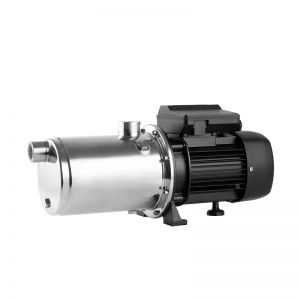
| SGA Stainless Steel Centrifugal Pump | Product page states 50Hz or 60Hz and VFD availability. | Confirm the ordered motor, voltage and frequency-specific duty point. |
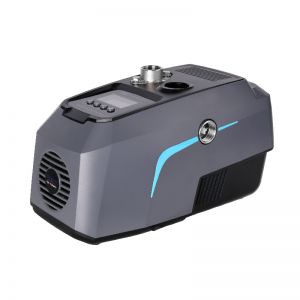
| Intelligent Self-Priming Booster Pump | Single-phase 220V/50Hz; 60Hz available on request. | Ask for the 60Hz electrical rating and performance data before ordering. |
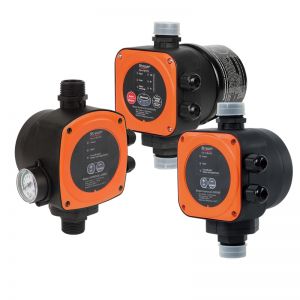
| Hydrobuddy Controller | Controller supply: 100–240V, 50/60Hz. | Controller compatibility does not establish the connected pump motor's frequency rating. |
These examples come from published Stream product pages. Availability, phase, voltage, motor configuration and performance must be reconfirmed for each quotation.
| RFQ item | Specify |
|---|---|
| Destination electrical supply | ___ V / ___ Hz / single- or three-phase |
| Required duty point | ___ m³/h at ___ m total head |
| Frequency-specific curve | 50Hz or 60Hz performance data for exact model |
| Motor nameplate rating | Voltage, frequency, current, speed, rated power, insulation |
| Motor protection | Overload / dry-run / thermal protection as applicable |
| Drive or controller | Motor and controller compatibility; permissible speed range |
| Installation conditions | Liquid, temperature, suction, piping and operating hours |
No. The approximate 20% flow change refers to corresponding points on an idealized pump curve when rotational speed rises by 20%. Actual flow depends on the piping system, pump curve and motor configuration.
No. The controller and the pump motor have separate electrical ratings. Check both devices and their combined compatibility.
Yes. When a pump is offered in both frequency configurations, ask for the performance curve and electrical nameplate data for the exact version being supplied.
Always specify voltage, phase and frequency before selecting or ordering a water pump. The frequency affects motor speed and can change hydraulic performance and electrical loading. Choose from the actual rated 50Hz or 60Hz configuration, not from an assumed conversion of the other version.
Explore the Stream Pump Range or contact Stream Pumps with your required duty point and destination electrical supply for a configuration-specific quotation.
Address
No.17 XeDa Jimei Ind. Park, Xiqing Economic Development Area, Tianjin, China
Telephone
+86 13816508465
QUICK LINKS