+86 13816508465
Pump Knowledge
Oct. 23, 2026
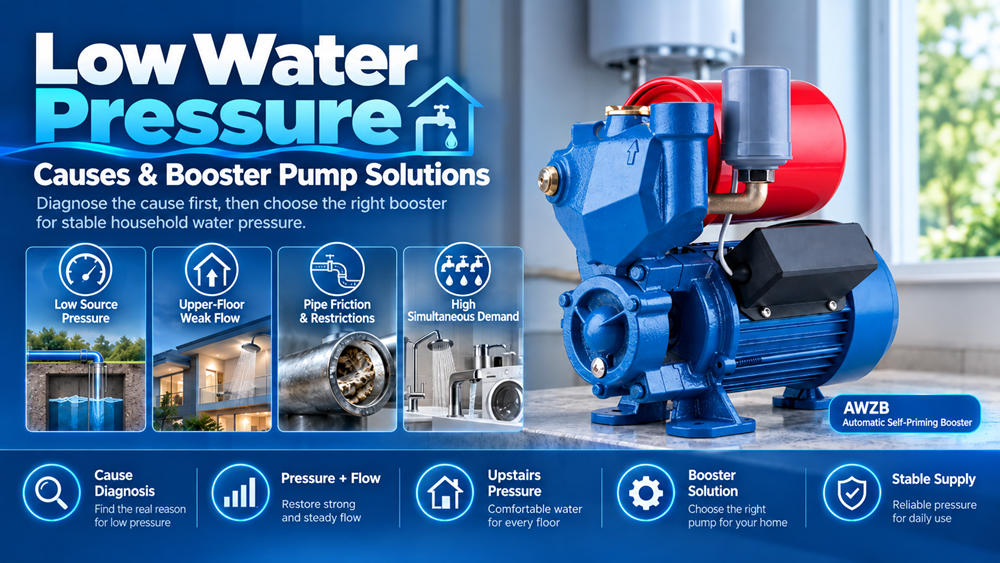
Low water pressure is not always a pump problem. Common causes include insufficient source pressure, elevation difference, undersized or restricted pipework, partially closed valves, leaks, and high simultaneous demand. A booster pump can help when the available supply is adequate but cannot provide the required pressure at the outlets. It cannot repair a leak, clear a blocked pipe, or create water when the source cannot supply enough flow.
Use the checks below to identify the likely cause before choosing a household booster pump or constant-pressure system.
Check whether the problem affects one outlet, an entire floor, or the whole building. Compare conditions with one tap open and with several outlets running. If possible, have a qualified installer measure static pressure (no flow) and dynamic pressure (while water is flowing) at suitable test points.
| Observed symptom | Possible cause | Check before installing a booster |
|---|---|---|
| Only one tap or shower is weak | Blocked aerator, filter, mixer or local valve | Inspect and clean the affected fixture |
| Whole property has weak flow | Low incoming supply, restriction or leakage | Compare inlet and downstream pressure; contact the supply provider if needed |
| Upper-floor outlets are weaker | Elevation head and pipe friction | Measure highest-outlet demand and available head |
| Pressure falls when several outlets run | Insufficient supply flow or excessive pipe losses | Measure simultaneous flow and pressure drop |
| Pressure has suddenly deteriorated | Leak, closed valve, blocked filter or supply fault | Investigate the change before selecting equipment |
| Pressure swings as demand changes | Changing demand or unsuitable existing control | Review flow profile and constant-pressure control options |
Diagnostic guide: symptoms suggest possible causes, not a confirmed fault. Pipe inspection and pressure tests are needed for a reliable diagnosis.
Pressure and flow are related but different. Static pressure measures pressure when no water is moving. Once outlets open, friction through pipes, fittings, valves and filters causes additional pressure loss. In a gravity-fed or pumped system, raising water to a higher outlet also requires elevation head.
For water at ordinary temperatures, approximately 10 m of water head equals 1 bar. This is a useful engineering conversion, not a minimum pressure requirement for every home. The pressure required at a shower, tap or sprinkler depends on the fixture and the project.
Consider a storage-tank-fed system with the following hypothetical design inputs:
| Vertical rise to the critical outlet | 8 m |
| Desired outlet pressure (approx. 2 bar) | 20 m head |
| Estimated pipe and fitting losses at design flow | 5 m |
| Approximate total required head | 33 m |
At the selected flow rate, this example requires approximately 33 m of total head when the reference source pressure is zero gauge pressure. Any reliably available inlet pressure, suction losses and actual system configuration must be accounted for separately. Confirm the duty point against the selected pump's Q–H curve; a published maximum head cannot be assumed available at the desired flow.
A properly sized booster pump may be suitable when:
Water is available from a suitable tank or approved inlet source, but pressure at the required outlets is insufficient.
Elevation and distribution losses leave upper-floor fixtures with inadequate dynamic pressure.
Several outlets require a defined flow and pressure at the same time, within the source's supply capacity.
Demand changes throughout the day and more stable delivery pressure is desired.
Do not use a booster as a shortcut for a damaged plumbing system. Repair leaks, open restricted valves, clean filters, and verify source flow first. Never connect a booster directly to a public main without checking local water-supply rules, backflow protection requirements and the utility's conditions. Some installations require a break tank or other approved arrangement.
Once the water source and pipework have been checked, choose the control arrangement according to actual demand rather than assuming that a more complex pump is always better.
| Selection factor | Automatic self-priming booster | VFD constant-pressure system |
|---|---|---|
| Typical need | Straightforward water transfer and boosting | Pressure stability under changing demand |
| Water source | May suit a tank or suction-lift installation within rated limits | Depends on the model's approved inlet conditions |
| Demand variation | Best assessed for simpler duty patterns | Controls motor speed to respond to varying demand |
| Selection priority | Required duty point, suction conditions and control type | Required duty point, inlet conditions and pressure setting |
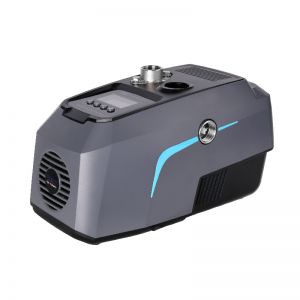
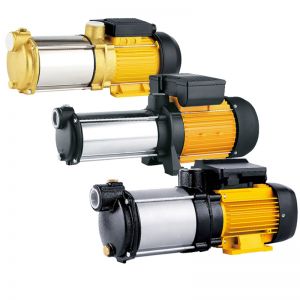
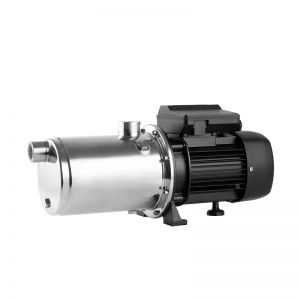
Stream product examples: The AWZB Automatic Self-Priming Booster Pump is listed for suitable clean-water household and garden applications. The series covers model-dependent maximum flow ratings of 30–66 L/min and maximum heads of 25–62 m. The Hydrobox 900 VFD Booster System uses variable-speed constant-pressure control and has published maximum flow of 5.2 m³/h and maximum head of 50 m.
The figures above describe published ranges or maxima, not the flow and head simultaneously available at a single operating point. Neither product should be selected without checking the relevant performance curve and installation requirements.
Send the following information with your quotation request:
Water source: rooftop tank, ground tank, shallow well or other approved supply.
Measured inlet conditions: water level or inlet pressure, including worst-case conditions.
Required flow: expected simultaneous outlets and total L/min or m³/h.
Required outlet pressure: at the highest or most demanding fixture.
Elevation and pipework: height, pipe diameter, length, fittings and filters.
Controls and power: automatic on/off or constant pressure, voltage and frequency.
To compare models, review the Stream product range and send your operating requirements to Stream.
Elevation reduces available pressure, while the longer distribution route may add friction losses. Check the highest outlet's dynamic pressure and pipe conditions before sizing a booster.
No. Blocked pipes, fouled filters and partially closed valves should be corrected first. A pump cannot remove the underlying restriction safely or reliably.
No. Variable-speed control can help maintain pressure when demand changes, but the right solution depends on the system curve, required flow, incoming supply and budget.
Find the cause first, then select the pump. If the plumbing and water source are sound, a correctly sized booster can address insufficient delivery pressure. For simple clean-water transfer, an automatic self-priming pump may be appropriate; for fluctuating demand and stable pressure control, a VFD system may be worth evaluating. In either case, use measured conditions and a matched flow–head duty point to make the final decision.
General low-pressure causes: Ofwat — Water Pressure (UK water-sector regulator; cited only for general diagnostic principles, not as requirements for other markets). Product details: Stream AWZB and Stream Hydrobox 900. The worked calculation and diagnostic table are illustrative guidance, not Stream field tests.
Address
No.17 XeDa Jimei Ind. Park, Xiqing Economic Development Area, Tianjin, China
Telephone
+86 13816508465
QUICK LINKS