+86 13816508465
Pump Knowledge
May. 27, 2026
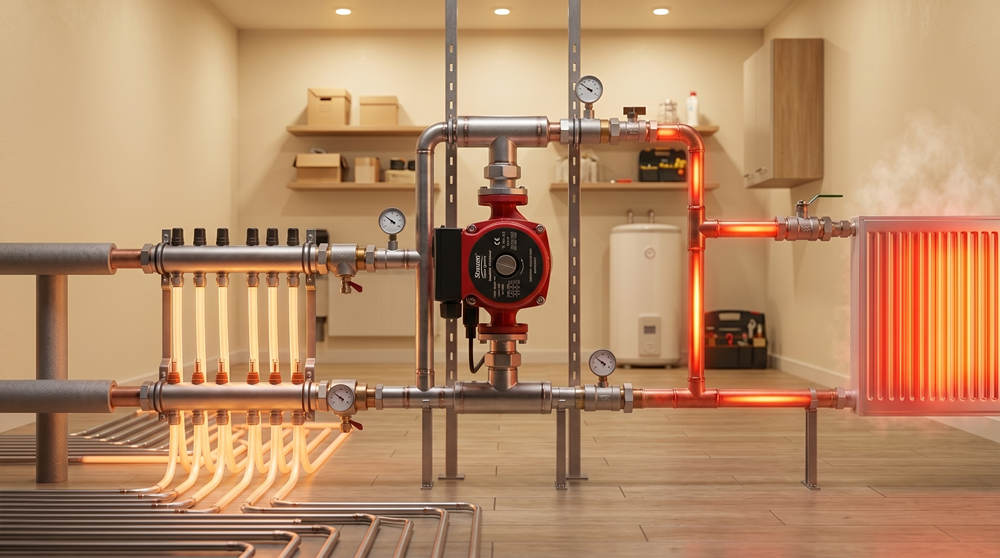
Proper hydronic balancing requires matching the circulator pump's control mode to the specific heat emitter. Choose Proportional Pressure Mode for radiator systems with thermostatic valves to eliminate noise and save energy. Choose Constant Pressure Mode for underfloor heating to maintain strict flow across high-friction manifold loops.
The heating season arrives, and within weeks, the phone starts ringing. Clients complain about rooms that never get warm, whistling pipes, or energy bills that have suddenly spiked. To avoid these dreaded [cold room] callbacks, many installers fall back on an old industry habit: buying the largest circulator pump available. The logic seems sound on the surface. Pushing more water through the system should guarantee that heat reaches every corner of the building.
In modern hydronic heating, this oversizing approach is a recipe for disaster. Oversized pumps waste massive amounts of electricity, create excessive velocity that causes whistling valves, and lead to severe hydronic imbalance. The rooms closest to the boiler overheat, while the furthest rooms remain freezing cold.
Modern heating systems rely on precise physics, variable-speed technology, and exact flow calculations. Installing a smart pump is only half the battle. Setting it up correctly is what separates an amateur installation from a master-level system.
This guide breaks down the essential principles of hydronic balancing. We will cover pump sizing myths, flow calculations, and the exact control modes required for both traditional radiators and underfloor heating systems.
For decades, the standard practice in the plumbing and HVAC industry was to oversize equipment just to be safe. Installers reasoned that a larger pump would overcome any unforeseen pipe restrictions or poor balancing. Today, we know that this approach actively harms the system.
When you install a pump that is too large for the system's actual flow demand, you force high-velocity water against restrictive valves. This high velocity creates turbulence. Turbulence translates directly into noise, leading to complaints about hissing pipes and banging valves.
Furthermore, pushing excess water through the closest heating circuits means the water returns to the boiler too quickly. This destroys the necessary temperature differential ($\Delta T$) that modern condensing boilers need to operate efficiently. A boiler that cannot condense will burn more fuel, driving up operating costs. The client ends up paying for wasted electricity to run an oversized pump and wasted gas because the boiler operates inefficiently.
One of the most persistent sizing myths in the hydronic heating industry involves pump [Head.] Installers frequently look at a three-story building and assume they need a massive pump to push the water all the way to the top floor. This represents a fundamental misunderstanding of how a closed-loop system operates.
A hydronic heating system is completely filled with water and pressurized. The water going up the supply pipe is perfectly balanced by the weight of the water coming down the return pipe. Gravity effectively cancels itself out. The pump does not need to lift the water against gravity. It only needs to overcome the friction loss created by the pipes, elbows, fittings, and valves.
Think of it like a Ferris wheel. The motor driving the Ferris wheel does not have to lift every passenger from the ground to the top. The weight of the people coming down balances the weight of the people going up. The motor only needs to provide enough energy to overcome the friction of the wheel's bearings.
Therefore, when calculating the required pump head for a building, you must focus entirely on the pressure drop (measured in feet of head or kilopascals) of the longest, most restrictive circuit in the system. The physical height of the building is irrelevant to the circulator pump in a closed-loop system.
Understanding flow requirements is the next critical step in achieving hydronic balance. The required flow rate (Q) for any heating system depends directly on two factors: the required heat output (in BTUs or kW) and the temperature difference ($\Delta T$) between the supply and return lines.
Different heat emitters require entirely different flow characteristics based on their designed $\Delta T$.
Underfloor heating systems operate at relatively low temperatures to protect the floor finish and maintain human comfort. Because the supply water is cooler (often around 100°F to 115°F), the temperature drop across the floor loop is small. This is known as a low temperature spread or small $\Delta T$ (typically around 10°F to 15°F).
To deliver the necessary heat output into the room with a small $\Delta T$, the system requires a high volume of water flow. The pump must move water quickly through the loops so the water does not lose all its heat before reaching the end of the circuit.
Traditional panel radiators operate at much higher temperatures (often 140°F to 160°F or higher). Because the water is hot, it can release a significant amount of thermal energy into the room, resulting in a large $\Delta T$ (typically 20°F to 35°F).
Because the water drops in temperature significantly from the supply to the return, the system requires comparatively less flow to deliver the same amount of heat. The water moves slower, spends more time in the radiator, and transfers energy efficiently.
Modern radiator systems are almost always equipped with Thermostatic Radiator Valves (TRVs). These valves are essential for localized temperature control. As a room warms up, the liquid or wax inside the TRV head expands, slowly pushing the valve pin down to restrict flow. When the room reaches the desired temperature, the TRV closes completely.
This dynamic creates a major challenge for the circulator pump. If a standard pump operates at a fixed speed, it continues pushing water at a constant pressure. As the TRVs across the building start closing, the water has fewer places to go. The pressure inside the remaining open pipes spikes. The water velocity increases dramatically as it squeezes through the partially closed TRVs. This creates a loud, annoying [hissing] or whistling noise that clients despise.
The definitive solution is to set the smart circulator pump to Proportional Pressure Mode.
In Proportional Pressure Mode, the pump actively monitors the system's resistance. As TRVs close and the system flow demand drops, the pump intelligently reduces its head pressure. It slows down exactly when the valves restrict, instantly eliminating the excess velocity and the resulting noise. This mode maintains quiet operation and drastically reduces the pump's electrical consumption. Choose Proportional Pressure Mode if noise reduction and energy efficiency in variable-flow radiator systems matter most.
Underfloor heating operates on an entirely different hydraulic principle than wall-mounted radiators. UFH systems utilize central manifolds to distribute water through very long, high-friction pipe loops embedded in the concrete or subfloor.
If you attempt to use Proportional Pressure Mode on an underfloor heating manifold, the system will fail to heat evenly. When the thermal actuators on several loops close because those rooms are warm, a pump in Proportional Pressure Mode will reduce its head pressure. However, the remaining open loops are still hundreds of feet long and possess massive friction. By dropping the pressure, the pump loses the strength needed to push water through the remaining distant loops. Those rooms will immediately go cold.
To prevent this, UFH systems strictly require Constant Pressure Mode.
When set to Constant Pressure Mode, the pump maintains a strict, unyielding pressure setpoint regardless of how many flow paths are open or closed. If only one manifold actuator remains open, the pump will adjust its speed to maintain the exact same pressure across that single loop as it did when all loops were open. This guarantees even heat distribution across every square inch of the floor, ensuring that high-friction circuits always receive the force they need. Choose Constant Pressure Mode if even temperature distribution across high-friction manifold loops is your primary objective.
Modern variable-speed circulator pumps are marvels of engineering. They feature advanced microprocessors, ECM motors, and digital displays. However, their [smart] features are completely useless if the installer selects the wrong control mode during commissioning.
Achieving perfect hydronic balance, zero noise, and maximum comfort comes down to matching the correct pressure mode to the correct heat emitter. Radiators with TRVs need Proportional Pressure to combat noise as valves close. Underfloor heating manifolds need Constant Pressure to overcome extreme friction loss reliably.
By understanding closed-loop physics and moving away from the [bigger is better] mentality, HVAC professionals can deliver highly efficient, whisper-quiet heating systems that eliminate callbacks and maximize client satisfaction.
What is hydronic balancing?
Hydronic balancing is the process of adjusting the flow of water in a heating or cooling system to ensure that heat is distributed evenly. Proper balancing prevents issues where some rooms overheat while others remain cold.
How much does an oversized pump cost in wasted energy?
According to industry energy studies, an oversized circulator pump running continuously can consume up to three times more electricity than a correctly sized variable-speed pump operating in the proper control mode.
What is the main risk of using the wrong pump mode for radiators?
If you use Constant Pressure or fixed-speed modes on radiators with thermostatic valves, the primary risk is excessive water velocity. This causes loud whistling noises at the valves and accelerates wear on system components.
Are there alternatives to using smart pumps for balancing?
Historically, installers used manual balancing valves to restrict flow physically. While manual valves are still necessary for baseline balancing, variable-speed pumps automate dynamic adjustments, making them the superior choice for modern, changing loads.
Who should perform hydronic balancing on a commercial system?
Hydronic balancing should be performed by a certified HVAC technician, mechanical engineer, or plumbing contractor trained in fluid dynamics and system commissioning.
Address
No.17 XeDa Jimei Ind. Park, Xiqing Economic Development Area, Tianjin, China
Telephone
+86 13816508465
QUICK LINKS