+86 13816508465
Pump Knowledge
Apr. 26, 2026
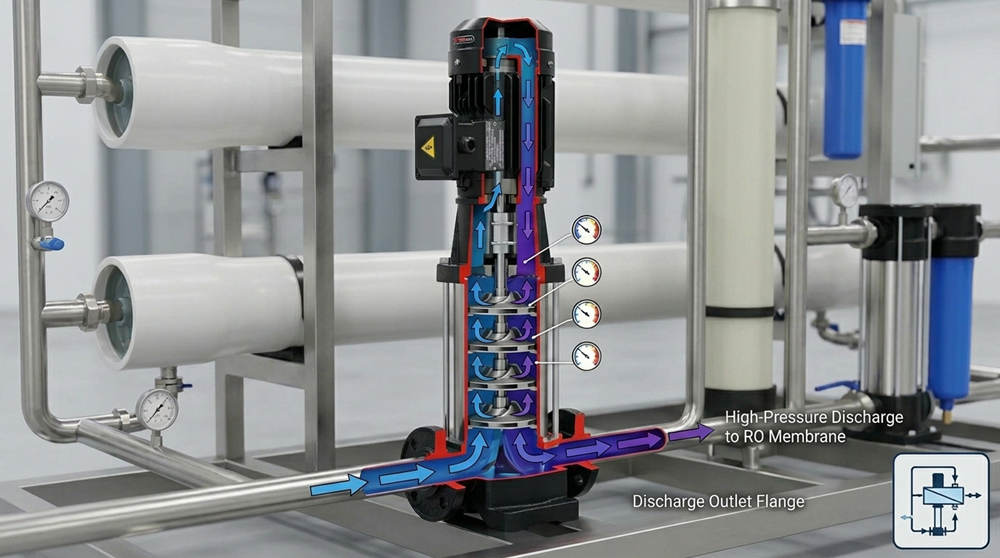
Reverse osmosis is a foundational process in modern water treatment, yet the membranes themselves are passive components. They do not pull water; they require an external force to push the feed water through their microscopic pores. This process demands immense, relentless pressure to separate pure solvent from dissolved solids. Without a reliable mechanical driver capable of overcoming natural osmotic pressure, membrane filtration simply stops functioning.
Standard single-stage centrifugal pumps struggle to meet these rigorous demands. Attempting to generate the required high head for commercial and industrial reverse osmosis systems with a single impeller necessitates a massive, inefficient design. These oversized pumps consume excessive power, generate unmanageable radial loads, and occupy substantial floor space, making them highly impractical for modern modular skid designs.
Engineers must look toward a different fluid dynamics solution. This is why Stream Pumps’ vertical multistage pumps, particularly the CDL/CDLF series, operate as the undisputed heart of these setups. By engineered design, they offer uncompromising pressure generation, superior hydraulic efficiency, and the critical material purity required for advanced water purification pumps.
To understand the efficacy of vertical multistage pumps for RO systems, engineers must examine the fluid dynamics happening inside the casing. The design operates on a cumulative pressure model rather than a single massive energy transfer.
At the core of the vertical multistage design is the concept of impeller stacking. Instead of relying on one large impeller to transfer all kinetic energy into the fluid at once, the pump utilizes multiple closely matched impellers mounted securely along a single vertical rotating shaft. Each impeller operates within its own diffuser chamber, forming a distinct 【stage.】 When the motor activates the shaft, these impellers spin in unison, accelerating the fluid sequentially.
A crucial mechanical principle of multistage pumping is the relationship between flow rate and head. As water enters the suction port at the base of the pump, it hits the first stage. The fluid gains a specific amount of pressure before the diffuser directs it directly into the eye of the second stage.
The flow rate—measured in gallons per minute (GPM) or cubic meters per hour (m³/h)—remains entirely constant as the fluid travels upward through the pump casing. However, the pressure (head) compounds multiplicatively with every single stage. If one stage generates 30 feet of head, a 10-stage pump will deliver 300 feet of head at the discharge port. This sequential energy addition allows the pump to achieve extraordinary discharge pressures without requiring a massive motor or an impractically large volute.
Industrial environments and water treatment facilities rarely have excess square footage. Stacking impellers vertically saves critical floor space. A horizontal pump capable of producing equivalent head would require a massive footprint, complicating the design of compact RO skids. The vertical orientation allows manufacturers to install high-capacity membrane filtration systems in tight utility rooms, significantly reducing the overall spatial requirements of the plant.
The intersection of multistage mechanics and membrane technology creates the foundation of modern water purification. Vertical multistage pumps for RO systems are not just an option; they are an engineering necessity.
Osmosis is a natural phenomenon where water moves from an area of low solute concentration to an area of high concentration. Reverse osmosis forces the exact opposite. Pushing feed water through a semi-permeable membrane requires precise, non-pulsating high pressure to overcome the natural osmotic pressure of the fluid.
If the pressure drops or fluctuates, the permeate recovery rate plummets, and the concentration polarization layer on the membrane surface thickens. This leads to rapid membrane fouling and scaling. A reverse osmosis high pressure pump delivers the steady, relentless force necessary to maintain optimal cross-flow velocity, keeping the membrane clean while ensuring a high yield of purified water.
In applications involving drinking water, semiconductor manufacturing, or pharmaceuticals, the introduction of iron oxide (rust) is catastrophic. The wetted parts of the pump must resist the highly corrosive nature of purified water, which acts as an aggressive solvent.
This makes the CDLF stainless steel pump series a mandatory specification for high-purity RO applications. By utilizing 304 or 316L stainless steel for all wetted components—including the impellers, diffusers, and outer sleeve—Stream Pumps ensures that the equipment will not contaminate the processed water. This precise material selection prevents localized pitting and extends the operational lifecycle of the pump even when handling aggressive brackish water.
While membrane filtration relies heavily on multistage technology, the precise head generation of these pumps makes them critical across multiple industrial sectors.
Boiler Feed Pump Applications: Pumping feed water into a highly pressurized steam boiler requires a mechanical unit capable of overcoming the boiler's immense internal pressure. Vertical multistage pumps achieve this effortlessly while handling the extremely high temperatures required in power generation and industrial heating systems.
High-Rise Pressure Boosting: Supplying adequate water pressure to the penthouse of a 50-story commercial building requires significant head. Vertical multistage pumps push water up hundreds of feet efficiently, maintaining consistent pressure across all floors without taking up the entire basement equipment room.
High-Pressure Washdown (CIP): Clean-In-Place systems in food, beverage, and pharmaceutical plants require high-velocity fluids to sanitize internal piping and tanks. Multistage pumps deliver the exact hydraulic force needed to shear biofilms and residue from internal surfaces without requiring disassembly.
Mechanical efficiency is only one half of the operational equation. Modern industrial system design requires sophisticated control mechanisms to optimize energy consumption and protect expensive components.
RO membranes are highly sensitive components that degrade and clog slowly over time, even with proper pretreatment. As the microscopic pores accumulate trace minerals and organic matter, the required pressure to push water through the membrane steadily increases. A pump running at a fixed speed cannot adapt to these changing hydraulic conditions. It will either over-pressurize new membranes (causing physical damage) or under-pressurize aged membranes (reducing system output).
Integrating a Variable Frequency Drive (VFD) with a Stream Pumps multistage unit provides an elegant engineering solution. A VFD allows operators to automatically adjust the electrical frequency supplied to the motor, controlling its rotational speed in real-time.
By tying the VFD to a pressure transmitter downstream, the pump dynamically adapts to the exact requirements of the RO membrane. As the membrane ages and requires more force, the VFD marginally increases the motor speed to maintain precise pressure. This smart setup saves massive amounts of electricity by preventing over-pumping, drastically extending the lifespan of the costly RO membranes and reducing overall total cost of ownership (TCO).
Downtime in a water treatment facility translates directly to lost revenue and operational failure. Stream Pumps engineers vertical multistage pumps with rapid maintenance and long-term reliability at the forefront of the design phase.
Replacing a traditional mechanical seal on a high-pressure pump often requires a complete teardown of the equipment. Stream Pumps mitigates this labor-intensive process by utilizing advanced cartridge mechanical seals. These self-contained seal units slide directly over the shaft.
When maintenance is required, technicians can replace the cartridge seal in minutes without removing the heavy motor or disconnecting the complex, rigid pipework of the RO skid. This engineering feature transforms a multi-hour maintenance headache into a swift, routine procedure, keeping system downtime to an absolute minimum.
A long vertical shaft spinning at 3,500 RPM requires exact alignment to prevent catastrophic failure. Even microscopic deviations can result in destructive vibration, which accelerates bearing wear and destroys mechanical seals. Stream Pumps utilizes heavy-duty tungsten carbide bearings strategically placed along the shaft assembly. These ultra-hard, wear-resistant components keep the rotating assembly perfectly aligned under extreme hydraulic loads, ensuring smooth, vibration-free operation throughout the pump's service life.
An industrial RO system is only as reliable as the mechanical equipment driving it. Settling for an inferior centrifugal pump results in fluctuating pressure profiles, rapidly degraded membranes, and catastrophic system downtime. The precise engineering of vertical multistage pumps ensures that water treatment facilities can meet their output targets consistently and efficiently.
Are you designing a commercial RO skid or upgrading an industrial boiler feed system? Contact the Stream Pumps engineering team today to size the perfect vertical multistage pump for your exact pressure, flow, and material purity requirements.
Address
No.17 XeDa Jimei Ind. Park, Xiqing Economic Development Area, Tianjin, China
Telephone
+86 13816508465
QUICK LINKS