+86 13816508465
Apr. 23, 2026
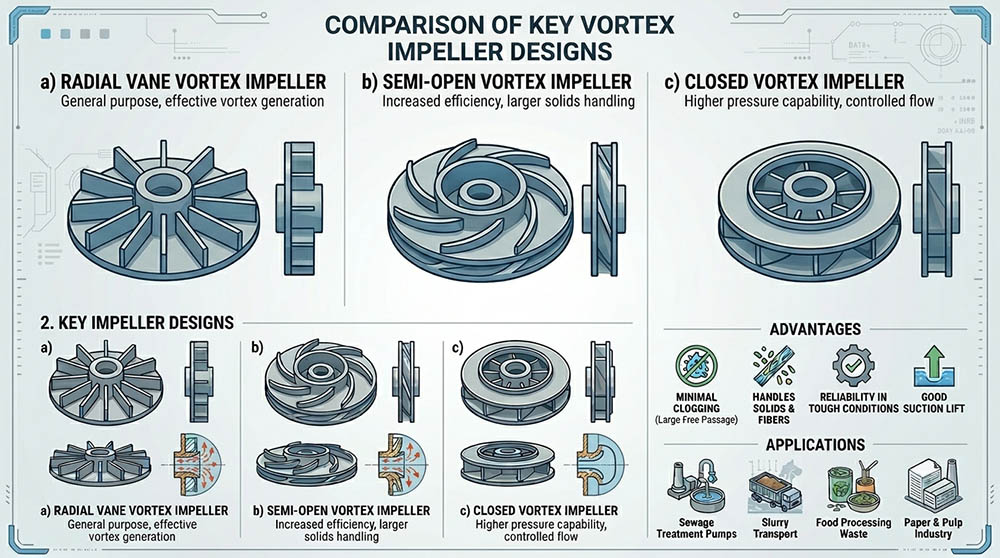
Managing a pumping system is rarely straightforward when the fluids involved contain challenging solids or stringy materials. Facility managers and wastewater engineers frequently confront a difficult reality: the fluid being moved is rarely just water. It is often a complex, abrasive, and unpredictable mixture of grit, industrial byproducts, sanitary wipes, and fibrous debris. When these challenging materials enter a system equipped with the wrong type of pump, the results are almost immediately disruptive.
Choosing the incorrect impeller design inevitably leads to severe operational headaches. Pumps become clogged, flow rates drop to zero, and motors overload. The subsequent downtime stops processes entirely, requiring maintenance teams to perform difficult and often hazardous manual cleanouts. These unscheduled maintenance events drive up operational costs and drastically reduce the lifespan of your equipment. For any facility, repeated pump failures represent a massive drain on resources and budget.
To mitigate these risks, system designers must carefully evaluate the internal mechanics of their pumps. Two main contenders dominate the market for fluid transfer: the standard centrifugal impeller and the vortex impeller. While they may look similar from the outside, their internal fluid dynamics are vastly different. Each design offers distinct advantages and specific limitations depending on the application at hand.
This article will systematically compare the standard centrifugal impeller and the vortex impeller. By understanding the mechanical principles, efficiency metrics, and ideal applications of both, you can make an informed, data-driven choice that maximizes system reliability and minimizes costly downtime.
The standard centrifugal impeller is the workhorse of the fluid transfer industry. Typically designed as either a closed or semi-open unit, it operates on a straightforward principle of direct kinetic energy transfer.
As fluid enters the pump through the suction nozzle, it is drawn directly into the [eye] (the center) of the rotating impeller. The impeller features a series of curved vanes. As the motor turns the shaft, these vanes physically catch the incoming fluid. The rapid rotation generates centrifugal force, which pushes the fluid outward along the vanes at high velocity. The fluid is then expelled into the pump's volute casing, where its high velocity is converted into pressure, driving it out through the discharge pipe.
The primary advantage of a standard centrifugal impeller is its exceptional hydraulic efficiency. Because the vanes make direct physical contact with the fluid, they are highly effective at converting the motor's mechanical energy into fluid flow and pressure. The tolerances between the impeller vanes and the casing are typically very tight, which minimizes internal recirculation and energy loss. For facility managers looking to optimize energy consumption, standard impellers are highly attractive because they require less horsepower to move a given volume of fluid compared to other designs.
This high efficiency comes with a significant operational vulnerability. The tight clearances and narrow passages between the impeller vanes create natural choke points. When pumping fluids that contain solids, rags, or stringy debris, these materials are drawn directly into the vanes. Fibrous materials, such as flushable wipes or agricultural debris, tend to wrap around the leading edges of the vanes—a phenomenon commonly known as [ragging.] As debris accumulates, the narrow passages become completely blocked. This transforms a highly efficient machine into a locked rotor, causing the pump to fail and requiring immediate manual intervention.
Due to these precise tolerances, standard centrifugal impellers are best utilized in environments where the fluid is predictable and clean. They are the optimal choice for clean water transfer, boosting municipal water pressure, cooling tower circulation, HVAC systems, and agricultural irrigation using adequately filtered water. They excel wherever suspended solids are minimal, small, and easily manageable.
When the fluid becomes too aggressive or heavily laden with solids for a standard pump, engineers turn to the vortex impeller. A vortex impeller, often referred to as a recessed impeller, represents a fundamentally different approach to fluid dynamics.
Unlike a standard impeller that sits squarely within the primary flow path of the volute, a vortex impeller is physically recessed. It is positioned at the very back of the pump casing, out of the direct line of fluid flow. This subtle design change drastically alters how the fluid is moved from suction to discharge.
Because the impeller is set back, it does not physically push the bulk of the fluid with its vanes. Instead, the rapid spinning of the recessed impeller creates a powerful, localized liquid vortex—much like a tornado or a whirlpool—inside the open pump casing. It is the kinetic energy of this swirling vortex, rather than direct contact with the impeller vanes, that draws fluid into the suction port and accelerates it out through the discharge.
The recessed design provides a massive operational advantage for solid handling. Because the impeller is tucked away, the main flow path through the pump casing remains wide open. The vast majority of solids, rags, and stringy debris pass directly through the pump volute from suction to discharge without ever physically touching the impeller. There are no narrow vane passages to navigate and no leading edges for fibrous materials to snag on. If a solid can fit through the discharge pipe, it can generally pass through a vortex pump.
This lack of direct contact also translates to superior wear resistance. In applications involving highly abrasive materials like sand, grit, or industrial slurry, a standard impeller will degrade rapidly as the abrasive particles constantly scrape against its vanes. Because a vortex impeller moves fluid via an induced whirlpool, abrasive particles bypass the impeller entirely. This drastically reduces mechanical wear and tear, extending the lifecycle of the internal components and preserving the pump's performance over a much longer period.
Selecting the right pump requires navigating a fundamental engineering trade-off: hydraulic efficiency versus non-clogging reliability. There is no single pump that offers both the highest possible energy efficiency and absolute immunity to clogging.
Standard impellers provide superior hydraulic efficiency. They require smaller motors and consume less electricity to achieve desired flow rates and head pressures. In a clean fluid application, a standard centrifugal pump will consistently save a facility money on energy costs. However, placing this highly efficient pump into a harsh wastewater environment is a recipe for disaster. The energy savings evaporate instantly when the pump clogs, requiring maintenance crews to spend hours pulling the pump, disassembling it, clearing the blockage, and bringing the system back online.
Vortex impellers sit on the opposite end of this spectrum. Because they rely on an induced whirlpool rather than direct kinetic transfer, they have lower hydraulic efficiency. They typically require slightly more horsepower and consume more electricity to move the exact same volume of fluid as a standard pump.
However, in heavy solid applications, vortex impellers offer unmatched reliability. They provide a true non-clogging pump solution, effectively eliminating the downtime associated with ragging and blockages. For facility managers dealing with raw sewage or industrial slurries, the choice becomes clear when applying a fundamental rule of thumb: downtime costs more than electricity. The slight increase in monthly power consumption is vastly outweighed by the elimination of emergency maintenance calls, halted production lines, and premature equipment failure.
To ensure your pumping system operates reliably and efficiently, specify the impeller design based strictly on the fluid characteristics. Use the following guidelines to make the appropriate selection.
·Pumping clean water or treated effluent.
·Boosting pressure in municipal or commercial water lines.
·Operating closed-loop HVAC cooling or heating systems.
·Managing agricultural irrigation with well water or filtered sources.
·The fluid contains only trace amounts of very fine, manageable particulate.
·Pumping raw, untreated sewage containing sanitary wipes and fibrous waste.
·Transferring heavy industrial slurry, mining run-off, or agricultural waste.
·Handling fluids with long stringy materials that cause traditional pumps to rag up.
·Moving fluids laden with large, hard solids or highly abrasive grit.
·System reliability and zero-downtime are the highest priorities for the facility.
Address
No.17 XeDa Jimei Ind. Park, Xiqing Economic Development Area, Tianjin, China
Telephone
+86 13816508465
QUICK LINKS