+86 13816508465
Pump Introductions
Aug. 21, 2026
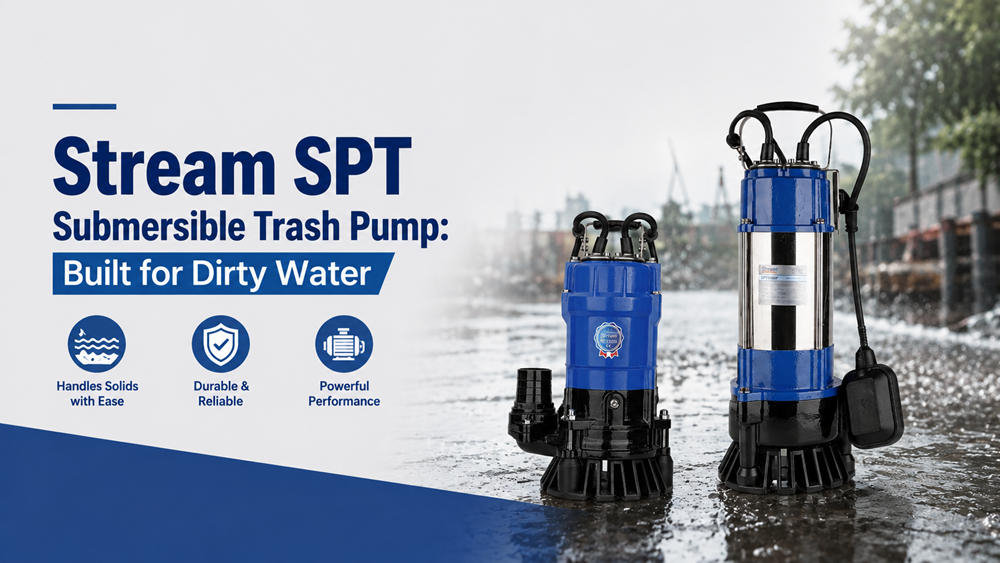
The Stream SPT Submersible Trash Pump is a wear-resistant, high-performance pump engineered for construction sites, civil engineering projects, and any application involving sandy, slimy, or debris-laden water. Its urethane semi-vortex impeller, double-end mechanical seal, and specially engineered rubber bottom base combine to deliver reliable, long-service performance in conditions that defeat standard submersible pumps.
Every construction site manager knows the scenario. Water accumulates at the base of an excavation—and it's not clean. It's thick with sand, heavy with silt, and laced with construction debris. Send in a standard submersible pump, and within hours—sometimes minutes—you're dealing with a clogged impeller, reduced flow, or a seized unit sitting in a puddle it was supposed to drain.
This is not a niche problem. Foundation dewatering, civil earthworks, trench drainage, and below-grade construction all generate the same challenge: water that no standard off-the-shelf pump handles reliably over time. The cost of pump failure in these environments is real. Project delays, equipment rental extensions, and emergency replacement costs stack up fast—and the downstream effects on project timelines can be significant.
The Stream SPT is a single-phase or three-phase electric submersible pump engineered for the continuous removal of water containing suspended solids, sand, silt, and light debris. Unlike standard submersible drainage pumps—which are designed primarily for relatively clean water—the SPT is purpose-built for trash water applications where solid content, abrasion, and sediment accumulation are constant operating conditions.
Stream Pumps developed the SPT for contractors and engineers who need a pump that performs reliably over extended periods in harsh site conditions, without requiring constant manual intervention or causing repeated clogging events. The design integrates several engineering choices that collectively reduce wear, extend service life, and maintain consistent flow even when the water column is heavily loaded with particulate matter.
For procurement officers evaluating total cost of ownership rather than unit price alone, those design choices translate directly into lower labor costs, fewer replacement cycles, and less project disruption.
The SPT's wetted components are manufactured from materials selected for abrasion resistance. In sandy and gritty water environments, suspended particles degrade pump internals rapidly in standard units—a process that accelerates as flow rates drop and solids concentration increases.
Stream's wear-resistant construction addresses this directly. By reducing the rate of material loss from impeller surfaces and pump housings, the SPT sustains its flow rate and head performance over longer operating periods. The practical result: fewer unplanned maintenance interventions and a longer replacement cycle.
The semi-vortex impeller design is one of the SPT's defining engineering features. In a vortex-type pump, the impeller is recessed from the flow path. Water and solids pass through the pump casing with minimal direct contact with the impeller itself. This geometry dramatically reduces impeller wear when handling abrasive or fibrous materials and significantly lowers the probability of clogging compared to closed or open impeller designs.
Stream manufactures the SPT's impeller from urethane—a material that combines high abrasion resistance with mechanical resilience. Urethane performs well in slurry-type applications and outperforms standard cast iron or plastic impellers in environments where sandy water causes accelerated surface erosion. Together, the semi-vortex hydraulics and urethane material selection give the SPT a measurable advantage wherever impeller degradation would otherwise become a recurring maintenance issue.
Standard submersible pumps sit flat on the floor of a pit or trench. As sediment settles, a layer of compacted sand and silt forms around and below the pump intake. The pump draws increasingly clear water from above while settled debris remains—undetected and unremoved—on the floor. Eventually, the pump must be repositioned, the pit manually cleared, or the sediment drawn in at a concentration high enough to cause a blockage.
The Stream SPT takes a different approach. Its rubber bottom base is specifically engineered to prevent large particles from reaching and blocking the impeller, while simultaneously keeping settled sand and sediment in suspension during operation. Rather than allowing debris to compact and accumulate around the intake, the base design continuously re-entrains settled material back into the water column, where it can be drawn into the pump and discharged efficiently.
The practical outcome is significant. The SPT continues pumping debris-laden water without manual repositioning or periodic clearing of the surrounding floor area. In foundation work and trench dewatering—where sediment accumulation is both rapid and continuous—this feature directly reduces the labor and downtime associated with managing settled solids.
Seal failure is one of the most common causes of submersible pump downtime. Once water breaches the mechanical seal, motor damage is rapid and often irreversible. The SPT employs a double-end mechanical seal configuration, which provides two stages of sealing protection between the pump's water-handling components and the motor cavity.
An integrated oil lifter works in conjunction with the mechanical seals to maintain consistent lubrication of the seal faces during operation. This reduces friction-related heat generation at the seal interface and extends the functional service life of the seal assembly. For operators running the SPT in continuous or near-continuous dewatering duties, the double-end seal combined with the oil lifter is a meaningful reliability feature—one that reduces the frequency and cost of seal replacement over the pump's service life.
The SPT is available in a manual operation configuration or with an integrated float switch for automatic start-stop control. In the automatic configuration, the pump activates when water rises to a preset level and shuts off when the level drops below the lower threshold. This eliminates the need for manual monitoring on sites where water inflow is intermittent or variable—foundation excavations subject to groundwater seepage, for example, or drainage sumps that fill unpredictably during rain events.
Construction dewatering is the SPT's primary design target. Excavation, trenching, and below-grade work consistently generate water containing high concentrations of sand, silt, and construction particulate. The SPT's wear-resistant construction and semi-vortex impeller allow it to operate continuously in these conditions without the clogging and performance degradation that affects standard drainage pumps. For civil engineering contractors managing large-scale earthworks, reliable dewatering is not optional—it's a project-critical function.
Foundation dewatering involves pumping from confined pit environments where sediment concentration is typically high and continuous. The SPT's rubber bottom base design actively maintains sediment in suspension, enabling complete removal of settled material rather than leaving compacted debris on the pit floor. This reduces manual intervention requirements and keeps dewatering operations running during critical pour windows.
Parameter | Specification |
|---|---|
Max. Immersion Depth | 5 m |
Liquid Temperature | 0–40°C |
Liquid pH Scope | 6.5–8.5 |
Passage of Suspended Solids | < 7 mm |
Power Range | 0.5–1.1 kW |
These operating limits define the environments in which the SPT delivers rated performance. Liquid temperature and pH tolerances align with the conditions typically encountered in civil construction and general industrial dewatering. The 5-meter maximum immersion depth accommodates deep foundation pits and trenches without requiring specialized deployment equipment.
The 7mm suspended solids passage rating means the SPT handles sand, fine gravel, and grit-laden water efficiently. The SPT is not designed for large solid waste or fibrous material—applications of that type require a grinder pump or sewage pump with appropriate solids passage ratings.
Standard submersible drainage pumps are optimized for clean or lightly contaminated water. Their closed impellers and flat-bottom housings are not engineered to handle abrasive particulate loads over extended periods. The failure modes are predictable: accelerated impeller wear reduces hydraulic efficiency; solids bridging across the impeller intake causes clogging; sediment compacting around the base starves the pump of pumpable material; and seal degradation from abrasive particles leads to motor flooding.
The SPT addresses each of these failure modes through specific, deliberate design choices:
The urethane semi-vortex impeller reduces both wear and clogging risk by minimizing direct impeller-to-solid contact
The engineered rubber bottom base prevents large particle ingestion and keeps settled sediment in suspension for continuous, efficient pumping
The double-end mechanical seal with oil lifter protects the motor cavity from contamination over extended operating periods
The wear-resistant construction throughout the pump's wetted components extends service intervals in abrasive environments
For procurement officers comparing total cost of ownership across competing products, the SPT's extended service intervals and reduced clogging frequency translate directly into lower site labor costs and less project disruption over the pump's operational life.
The choice between automatic (float switch) and manual operation depends on the nature of water inflow at the site. Both configurations deliver identical hydraulic performance—the float switch adds automation without altering the pump's core mechanical specifications.
Choose the float switch configuration when:
Water inflow is intermittent or unpredictable (groundwater seepage, rainfall events)
The site does not have dedicated personnel for continuous pump monitoring
The application involves a sump or pit requiring ongoing level management over days or weeks
Unattended overnight operation is required
Choose the manual configuration when:
Water inflow is continuous and consistent, and the pump will run at near-full duty cycle
Site personnel will monitor the pump actively during operation
The application is a one-time dewatering event with a predictable completion point
Integration with a site-wide electrical control system is planned, making float switch control redundant
For rental fleet operators, the float switch configuration typically offers greater versatility across varied end-user applications and reduces the risk of dry-run incidents when the pump is deployed without dedicated supervision.
The Stream SPT is engineered for water containing suspended solids up to 7mm in size, including sand, silt, fine grit, and light construction debris. It is rated for liquid temperatures between 0°C and 40°C and a pH range of 6.5 to 8.5. The SPT is not designed for large solid waste, fibrous materials, or chemically aggressive liquids outside its rated pH range. For applications involving larger solids or sewage, a grinder pump or sewage pump with appropriate solids passage ratings is the correct specification.
The SPT's engineered rubber bottom base serves two functions simultaneously. First, it physically blocks large particles from reaching the impeller intake. Second, it keeps settled sand and sediment in suspension during operation—preventing debris from compacting on the floor of the pit or trench and continuously re-entraining it into the water column for efficient pumping. This reduces the need for manual repositioning and periodic floor clearing in foundation and trench dewatering applications.
The Stream SPT is rated for a maximum immersion depth of 5 meters. This accommodates the majority of civil construction dewatering applications, including deep foundation pits and trench drainage, without requiring specialized deployment equipment or rigging.
A standard submersible drainage pump is designed for clean or lightly contaminated water. The Stream SPT is specifically engineered for dirty water applications through four key design features: the urethane semi-vortex impeller (which resists abrasion and reduces clogging), wear-resistant wetted component construction, the engineered rubber bottom base (which maintains sediment in suspension and protects the impeller from large particles), and the double-end mechanical seal with oil lifter for enhanced motor protection. Each of these features targets a specific failure mode that affects standard pumps in abrasive, sediment-heavy environments.
Yes. The float switch configuration allows the SPT to start and stop automatically based on water level, making it suitable for unattended operation in sumps, foundation pits, and drainage applications where continuous manual monitoring is not practical. The manual configuration requires active supervision and is better suited to continuous-flow applications or sites with dedicated pump operators.
The SPT is available across a power range of 0.5 to 1.1 kW. Specific voltage and phase requirements depend on the model selected. Contact Stream Pumps directly to confirm the appropriate configuration for your site's power supply and local electrical standards.
Yes. The SPT's wear-resistant construction, straightforward servicing requirements, and robust double-end mechanical seal design make it well-suited for rental fleet deployment, where pumps are subject to varied operating conditions and handling by multiple operators across different sites. The float switch configuration is particularly recommended for rental applications to reduce the risk of dry-run damage.
The SPT is Stream's purpose-built solution for continuous trash water pumping where suspended solids are the primary challenge. For end-of-cycle residue removal and low-level puddle dewatering, the SPK530 puddle pump and SPK450 are designed as complementary tools operating at water levels below what the SPT targets. The KBZ Heavy-Duty Manual Submersible Effluent Pump addresses heavier effluent applications requiring manual operation. Together, these products cover the full range of site dewatering requirements across a construction project lifecycle.
Address
No.17 XeDa Jimei Ind. Park, Xiqing Economic Development Area, Tianjin, China
Telephone
+86 13816508465
QUICK LINKS