+86 13816508465
Pump Introductions
Jul. 27, 2026
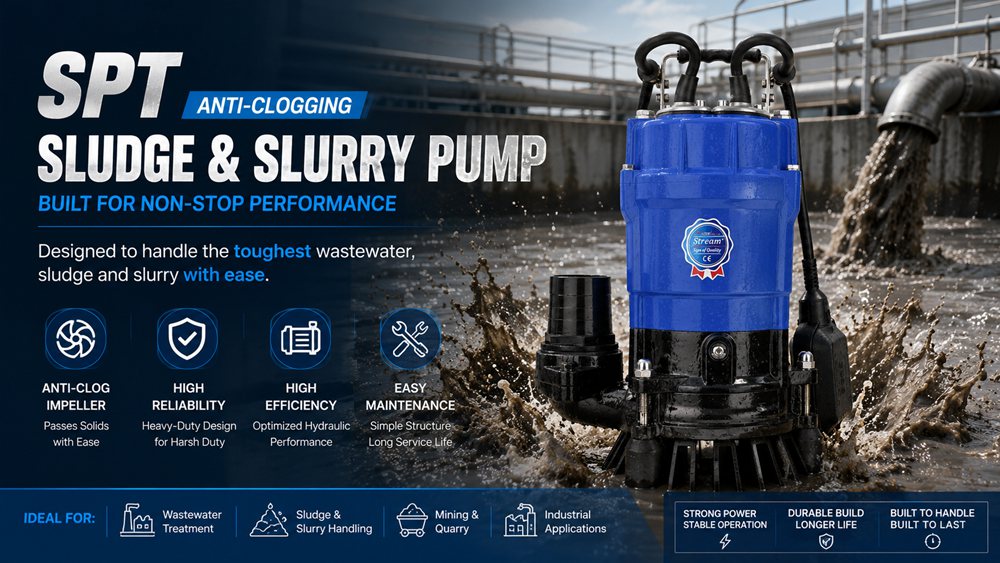
Standard submersible pumps fail in settled sand and thick sludge because they can only handle suspended solids. The SPT Series Submersible Agitator Pump by Stream Pumps solves this with a high-speed agitator that fluidizes compacted material at the inlet, enabling the pump to handle solid concentrations of 30% or more by weight without clogging.
Any engineer who has watched a standard submersible pump choke, cavitate, and grind to a halt in a sludge-filled pit knows exactly what's at stake. Downtime in heavy dewatering, dredging, or industrial wastewater applications doesn't just delay a project—it drives up labor costs, accelerates equipment wear, and puts timelines at serious risk.
The root problem is straightforward: most submersible pumps are designed to move water, not compacted solids. When sand, gravel, or dense sludge settles at the base of a sump or excavation pit, a standard pump simply cannot ingest it. The inlet clogs. The impeller struggles. The motor overloads.
Stream Pumps engineered the SPT Series Submersible Agitator Pump specifically to eliminate this failure point. By integrating a purpose-built agitation mechanism directly into the pump's design, the SPT Series transforms compacted, unpumpable material into a fluid mixture that flows freely into the impeller—without the constant intervention that plagues standard pump deployments.
The defining feature of the SPT Series is a specialized impeller extension called an agitator, positioned just outside the pump's suction inlet at the base of the unit.
When the motor activates, the agitator rotates synchronously with the main impeller at high speed. This rotation generates a powerful, localized vortex directly at the pump's intake zone. The vortex produces a shearing and turbulent force that acts on any compacted material—settled sand, mining tailings, slurry deposits—within its effective radius.
This process is known as fluidization. Compacted solids that would otherwise resist suction are violently agitated and suspended in the surrounding water, converting what was a dense, solid mass into a pumpable slurry mixture. Once suspended, the material flows freely into the main impeller, which draws it upward through the discharge line without blockage.
The result is a continuous, self-sustaining pumping action—even in conditions where settled solids would immediately disable a conventional unit.
Standard submersible pumps operate on the assumption that solids are already suspended in the fluid being pumped. Their impellers are designed to handle water with a relatively low concentration of fine particulates. When placed in an environment with settled, compacted material, several failure modes occur rapidly:
Inlet blockage: Dense solids block the suction port before the impeller can generate enough draw to move them.
Dry running: With the inlet restricted, the pump runs with insufficient fluid, causing the mechanical seals and motor to overheat.
Cavitation: Partial suction blockage creates vapor bubbles within the impeller housing, leading to pressure shocks that damage internal components over time.
The SPT Series sidesteps all three failure modes. The agitator ensures a consistent supply of fluidized material reaches the inlet, so the impeller always operates in a fluid-rich environment. Stream Pumps has engineered the SPT Series to handle solid concentrations significantly higher than standard pumps—up to 30% or more by weight—drastically cutting project time by eliminating repeated manual pump clearing.
Handling abrasive slurries at high concentrations places extreme mechanical stress on every component that contacts the fluid. Stream Pumps addressed this by specifying high-wear materials for the SPT Series' critical contact surfaces.
The agitator, impeller, and wear plate are all cast from High-Chrome Iron—a material class specifically selected for its exceptional resistance to abrasive wear. High-Chrome Iron maintains its surface integrity significantly longer than standard cast iron or bronze alternatives when exposed to silica sand, mineral tailings, or coarse aggregate slurries.
Beyond the hydraulic components, the SPT Series motor is built to sustain the elevated torque demands of continuous agitation in dense media. Advanced mechanical seals protect the motor chamber from slurry ingress—one of the most common causes of submersible pump failure in heavy-duty applications. The combination of abrasion-resistant hydraulics and a robust, well-sealed motor assembly gives the SPT Series an operational service life that standard pumps cannot match in these environments.
The SPT Series is engineered for B2B applications where high solid concentrations and abrasive materials are present. Primary use cases include:
Mining and Mineral Processing: Pumping abrasive tailings, mineral slurries, and process water containing high concentrations of fine particulates from processing circuits or tailings ponds.
Dredging and Civil Construction: Clearing accumulated sediment from deep foundation excavations, cofferdams, and riverbeds where settled silt and sand make standard dewatering equipment ineffective.
Industrial Wastewater Treatment: Removing dense sludge build-up from the base of sedimentation tanks, clarifiers, and holding lagoons where settled solids accumulate over time.
In each of these settings, the SPT Series delivers consistent performance where standard submersible pumps require frequent clearing, repair, or replacement.
The SPT Series Submersible Agitator Pump addresses a specific and well-defined engineering problem: the inability of standard submersible pumps to handle settled, compacted solids in demanding industrial environments. Its agitation-first design, High-Chrome Iron construction, and robust motor system combine to deliver reliable performance in conditions that would quickly disable conventional equipment.
Reduced downtime, fewer manual interventions, and a longer service life between maintenance cycles translate directly into lower operational costs over the life of a project.
That said, successful slurry pump selection requires more than identifying the right pump series. It requires precise application matching. The Stream Pumps engineering sales team invites project managers and procurement engineers to connect for a Preliminary Application Survey. During this assessment, the team will ask targeted questions about your fluid specific gravity, maximum solid particle size, and fluid pH levels—key variables that determine the correct pump configuration, impeller sizing, and seal specification for your exact site conditions.
What is a submersible agitator pump and how does it differ from a standard submersible pump?
A submersible agitator pump incorporates a rotating agitator at the suction inlet that fluidizes settled solids before they enter the impeller. Standard submersible pumps lack this mechanism and can only handle pre-suspended solids, making them prone to clogging in sludge and sand-heavy environments.
What solid concentrations can the SPT Series Agitator Pump handle?
The SPT Series is engineered to pump fluid mixtures with solid concentrations of up to 30% or more by weight—significantly higher than the capabilities of standard submersible pump designs.
Why is High-Chrome Iron used for the SPT Series impeller and agitator?
High-Chrome Iron offers superior abrasion resistance compared to standard cast iron or bronze, making it the appropriate material choice for components that continuously contact abrasive slurries, silica sand, and mineral tailings.
What information does Stream Pumps need to specify the correct SPT Series configuration?
The Stream Pumps engineering team conducts a Preliminary Application Survey that covers fluid specific gravity, maximum solid particle size, and pH levels. These parameters determine the correct pump model, impeller specification, and seal configuration for the application.
Which industries most commonly use the SPT Series Agitator Pump?
The SPT Series is widely used in mining and mineral processing, dredging and civil construction, and industrial wastewater treatment—any application where compacted solids must be extracted from sumps, pits, tanks, or riverbeds.
Address
No.17 XeDa Jimei Ind. Park, Xiqing Economic Development Area, Tianjin, China
Telephone
+86 13816508465
QUICK LINKS