+86 13816508465
Pump Introductions
Aug. 21, 2026
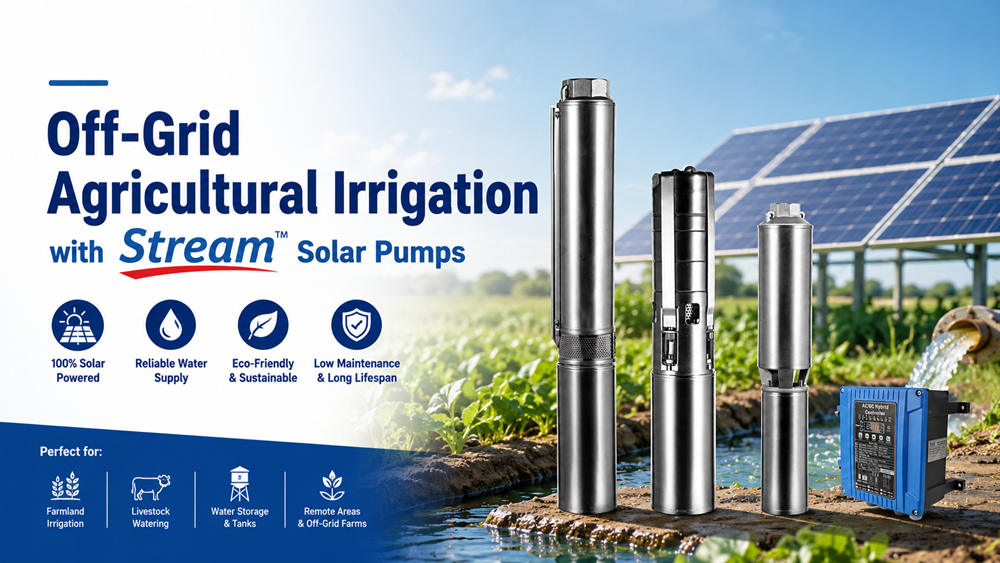
Stream Solar Pumps use photovoltaic panels, a solar controller/inverter, and a DC/AC pump motor to deliver water without grid power or diesel fuel. They are well-suited for farm irrigation, livestock watering, and remote community water supply—offering zero fuel costs and long-term ROI for agricultural and off-grid applications.
Diesel prices have climbed sharply across major agricultural markets over the past decade, and grid electricity—where it's even available—adds a recurring operational cost that compounds year after year. For farmers, ranchers, and rural communities, these costs directly erode profit margins and restrict access to reliable water.
Solar pumping offers a fundamentally different model. Once the system is installed, the sun provides the energy. There are no fuel invoices, no grid dependency, and no emissions. Stream Pumps, established in 1997 and supplying products to more than 150 countries, engineers solar pump systems specifically designed to meet these demands—from shallow agricultural wells to deep off-grid installations in arid regions.
This guide covers how Stream Solar Pumps work, why switching to solar pumping makes financial and environmental sense, how to size a system for your specific needs, and where these systems are already delivering results.
A Stream Solar Pump system operates through three integrated components working in sequence:
Photovoltaic (PV) panels capture sunlight and convert it into direct current (DC) electricity. Panel capacity is sized to match the pump's power requirements and the available solar irradiance at the installation site.
Solar controller/inverter manages the electrical output from the panels. It regulates voltage, converts DC to AC where required, protects the motor from power fluctuations, and optimizes pump performance throughout the day as sunlight intensity varies.
DC/AC pump motor drives the pump mechanism—either a submersible unit seated at the bottom of a well or a surface-mounted unit drawing from an open water source. Stream's AC/DC Solar Deep Well Pump with Water Filled Motor, for example, supports both AC grid power and DC solar input, providing operational flexibility across different site configurations.
The result is a self-contained pumping system. No generator. No fuel supply chain. No grid connection required.
The cost advantage is significant. Diesel-powered irrigation pumps carry three layers of ongoing expense: fuel purchase, fuel transport to remote sites, and maintenance on combustion engine components. Solar pumps eliminate all three.
After the initial capital investment, Stream Solar Pump systems operate with near-zero recurring costs. Most agricultural installations recover the capital outlay within three to five years, depending on prior fuel consumption and system scale—after which the water supply is effectively free.
Solar pumping produces zero carbon emissions at the point of operation. For agricultural buyers facing increasing regulatory scrutiny around carbon footprints, or organizations with sustainability mandates, this is a measurable compliance advantage. It also removes the risk of fuel spills near water sources, a concern for irrigation systems situated close to aquifers or waterways.
This is precisely where solar pumping outperforms conventional alternatives. Deep wells in arid or semi-arid agricultural zones are often located far from grid infrastructure. Extending grid power to these sites is prohibitively expensive. Diesel requires ongoing logistics. Solar requires neither.
Stream Solar Pumps are engineered for continuous operation in these conditions. The systems function throughout daylight hours and can be paired with water storage tanks to maintain supply during low-irradiance periods or at night—providing reliable water access without grid dependency.
Correct system sizing is critical. An undersized system will not meet water demand; an oversized one represents unnecessary capital expenditure. Three parameters drive the calculation:
Calculate total daily water volume in cubic meters or liters per day. This figure is derived from irrigated crop area, irrigation method (drip, sprinkler, flood), and crop water demand per hectare. Livestock watering systems require a separate calculation based on herd size and consumption per head.
Dynamic head combines two measurements:
Static head: The vertical distance from the water surface in the well to the discharge point
Friction losses: Resistance added by pipe length, diameter, and fittings
A system serving a well 40 meters deep with a further 10-meter vertical lift to a storage tank has a minimum dynamic head of 50 meters before friction losses are factored in. Stream's solar pump range covers a broad head spectrum to accommodate both shallow surface applications and deep well configurations.
Peak sun hours—the number of hours per day during which solar irradiance averages 1,000 W/m²—determine how long the pump can run at full capacity. Locations in North Africa, the Middle East, South Asia, and sub-Saharan Africa typically receive 5–7 peak sun hours daily, making them highly favorable for solar pumping. Lower-irradiance regions may require additional panel capacity to meet the same daily water output.
With these three inputs, Stream Pumps' engineering team can specify the correct pump model, panel array size, and controller configuration for your site.
Row crop and horticulture operations use Stream Solar Pumps to feed drip and sprinkler irrigation networks. The systems run during daylight hours—aligned with peak evapotranspiration periods—delivering water directly when crops need it most. Eliminating diesel costs in these applications produces measurable gains in per-hectare profitability.
Remote grazing operations require reliable water points for cattle, sheep, and other livestock across large land areas. Solar pumping stations, drawing from boreholes or surface water sources, provide consistent supply without the labor and cost of transporting diesel to dispersed locations.
In regions where communities have no grid access and groundwater lies deep below the surface, solar-powered deep well pumps represent the most practical long-term water infrastructure solution. The combination of high solar irradiance, deep well capability, and zero fuel dependency makes solar pumping the preferred choice for water supply projects in arid environments across Africa, the Middle East, and Central Asia.
Solar pumping converts a recurring operational cost into a fixed capital investment—one that continues delivering value for the operational life of the system. For procurement officers and agricultural managers evaluating water supply options, the financial case is straightforward: lower total cost of ownership, greater operational independence, and a clear sustainability profile.
Stream Pumps supports buyers at every stage of the project—from initial system specification through to delivery across more than 150 countries. To determine the right solar pump configuration for your site, contact Stream Pumps' solar experts for a free consultation.
Stream Solar Pumps operate on solar power during daylight hours. For continuous 24-hour supply, the system is typically paired with a ground-level or elevated storage tank that accumulates water during the day. Some models, including Stream's AC/DC Solar Deep Well Pump, also accept AC grid input as a backup power source where grid access is intermittently available.
Solar pump systems have significantly fewer moving parts than diesel-powered alternatives, reducing maintenance demands. Key tasks include periodic cleaning of PV panels to maintain energy output, inspection of electrical connections and controller settings, and pump motor servicing at intervals specified by the manufacturer. There are no fuel filters, injectors, or combustion components to service.
Quality solar pump systems are designed for long operational life. PV panels typically carry 20–25 year performance warranties. Pump and motor components vary by model and application conditions. Stream Pumps provides technical documentation and after-sales support to help operators maintain system performance over the long term.
Yes. Stream Solar Pumps are available across a range of flow rates and head capacities to suit applications from small-scale market gardens to large commercial irrigation schemes. System capacity scales with panel array size and pump model selection. Stream Pumps' engineering team can specify multi-pump configurations for high-demand sites.
Solar irradiance is the primary variable. Sites with high daily peak sun hours—typically equatorial and arid regions—generate more energy per panel and can run the pump longer each day. Sites at higher latitudes or with frequent cloud cover may require a larger panel array to achieve the same daily water output. Accurate irradiance data for the installation site is a required input for correct system sizing.
Address
No.17 XeDa Jimei Ind. Park, Xiqing Economic Development Area, Tianjin, China
Telephone
+86 13816508465
QUICK LINKS