+86 13816508465
Pump Troubleshooting
Mar. 18, 2026
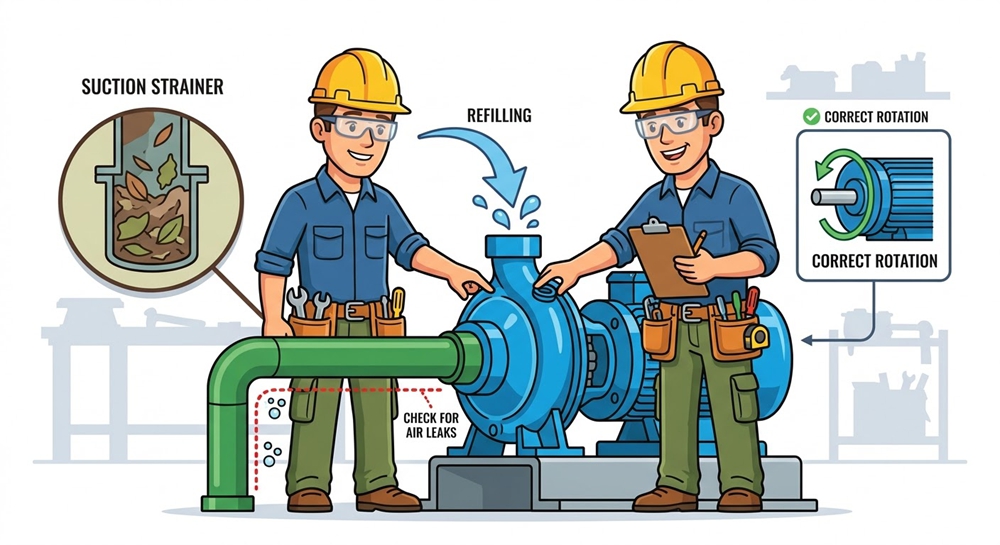
You activate the power switch, the motor hums to life, and the system appears to be operating normally. However, you quickly notice that nothing is coming out of the discharge pipe. Finding your water pump running but not pumping water is one of the most common and disruptive issues operators face in fluid management systems.
This situation requires immediate attention. Allowing a centrifugal pump to run dry for extended periods causes the internal temperature to rise rapidly. Without water to act as a lubricant and coolant, the mechanical seal will degrade, and internal components can sustain severe damage or melt entirely. The very first action you must take is to shut off the power supply to prevent catastrophic equipment failure.
Once the equipment is safely powered down, you can begin the diagnostic process. Centrifugal pump troubleshooting requires a logical, systematic approach to identify the specific mechanical or environmental failure preventing water flow.
The following sections provide a comprehensive guide by Stream Pumps to help facility maintenance teams, agricultural operators, and plumbers diagnose the root cause. By following these precise checkpoints, you can successfully resolve the problem and restore your fluid system to full operational capacity.
A loss of prime is the primary culprit for surface-mounted centrifugal pumps failing to move fluid. Centrifugal pumps rely on fluid dynamics to function. The pump casing must be completely filled with water to create the necessary pressure differential. When the impeller spins, it slings water outward, creating a low-pressure zone at the center that draws more water up the suction line. If the casing is filled with air instead of water, the impeller simply churns the air. Air is much lighter than water, meaning the pump cannot generate enough suction to lift the fluid from the source. This state is known as a pump airlock.
To correct a pump airlock, you must manually bleed the trapped air and refill the casing. Start by locating the priming plug at the top of the pump casing. Remove the plug and slowly pour clean water into the opening until the casing and the suction pipe are completely full. Allow a few moments for trapped air bubbles to rise to the surface, top off the water level, and tightly secure the plug. Turn the pump back on and monitor the discharge line.
Frequent priming issues require excessive stream pump maintenance and cause unnecessary downtime. Stream Pumps offers a variety of self-priming models designed to eliminate this recurring headache. These specialized pumps retain a reservoir of water in the casing even after the motor shuts off, allowing them to automatically evacuate air and re-prime the system upon the next startup.
If you have successfully primed the pump but it quickly loses prime again, you likely have an air leak on the suction side of the system. Because the pump operates by creating a vacuum, any opening in the suction pipe will draw in ambient air rather than pulling heavy water up from the well or tank.
Even a microscopic pinhole leak can introduce enough air to break the vacuum and cause your system to fail. Because the suction line is under negative pressure, water will not actively spray out of the leak, making these breaches difficult to locate visually.
You must conduct a thorough physical inspection of the entire suction line. Focus your attention on the following critical areas:
Pipe joints and threaded fittings: Ensure all connections are secure. Reapply thread seal tape or pipe joint compound to any suspect fittings.
PVC piping: Look for hairline cracks in the plastic, particularly near elbows and stress points.
O-rings and gaskets: Check the seals at the pump inlet housing. Rubber components can become brittle and degrade over time.
Stuffing box and mechanical seals: Inspect the area where the motor shaft enters the pump casing. If the seal is compromised, air can enter directly into the impeller chamber.
A physical blockage in the fluid pathway will absolutely prevent a pump from delivering water. Most systems feature a suction strainer or filter designed to keep solid objects out of the delicate internal machinery. Over time, mud, plastic, leaves, or algae can accumulate around the intake screen, creating an impenetrable barrier.
The procedure for clearing a blockage depends entirely on your equipment type. For a surface pump drawing from a tank or shallow well, you must extract the suction hose and manually scrub the strainer basket. For submersible configurations, you will need to carefully hoist the unit out of the fluid source to access the intake screen at the base. Use a stiff brush and clean water to remove all debris.
Occasionally, small debris bypasses the suction strainer and travels into the pump housing, resulting in a clogged impeller. When the vanes of the impeller become jammed, the motor will still run, but the hydrodynamic energy transfer ceases.
To clear a clogged impeller, you must disconnect the pump from the power supply and close the isolation valves. Remove the bolts securing the volute casing to expose the internal impeller. Carefully extract any foreign material lodged between the vanes. Verify that the impeller spins freely by hand before reassembling the casing and testing the unit.
A foot valve is a specific type of one-way check valve installed at the very bottom of the suction pipe. Its primary function is to trap water in the suction column when the pump motor is turned off. By holding the water in place, the foot valve ensures the pump remains primed for the next operational cycle.
If you discover a foot valve leaking, the water column will succumb to gravity and drain back into the well or reservoir. The next time the pump activates, the casing and suction line will be full of air, resulting in an immediate loss of prime.
Foot valves generally fail due to external contamination. A small pebble, a buildup of rust, or heavy sediment can wedge between the internal flapper and the valve seat, holding the mechanism open. Additionally, the internal spring or rubber seal can wear out after years of continuous service.
To test the valve, you must pull the suction line out of the water source. If the pipe is empty, or if you can see water actively draining out of the bottom fitting, the foot valve is severely compromised. In most cases, attempting to clean an old, corroded valve is inefficient. Replacing the faulty hardware with a new, high-quality brass or stainless steel foot valve is the most reliable long-term solution.
This diagnostic step applies specifically to industrial and agricultural users operating heavy-duty equipment on 3-phase electrical power. Unlike standard single-phase motors, a 3-phase motor can run in reverse if the electrical phases are not aligned correctly.
If two of the three power wires are swapped during installation or maintenance, the magnetic field inside the motor will spin in the opposite direction. Consequently, the pump shaft and impeller will also rotate backward.
A centrifugal pump running in reverse will not fail completely, which makes this issue highly deceptive. The backward-spinning impeller will still move a small amount of fluid, but the system will exhibit incredibly low flow rates and weak discharge pressure. It will sound abnormal and operate with terrible efficiency.
You can easily verify the rotation direction. Most centrifugal pump casings feature a cast-in arrow indicating the correct rotational path. Have a qualified technician briefly bump the motor power on and off while observing the cooling fan at the rear of the motor. If the fan spins opposite to the directional arrow on the casing, the rotation is reversed. A certified electrician can correct this by safely swapping any two of the three power leads at the motor terminal or control panel.
Physics imposes a strict limitation on how high a surface pump can pull water. Atmospheric pressure pushes down on the surface of the water source, forcing fluid up into the vacuum created by the pump. At sea level, standard atmospheric pressure can theoretically support a water column of roughly 10.3 meters.
Due to friction losses inside the pipe and the vapor pressure of water, the practical maximum suction lift for any surface-mounted centrifugal pump is restricted to around 7 to 8 meters (approximately 23 to 25 feet). If the vertical distance from the water surface to the center of the pump inlet exceeds this limit, the pump will run indefinitely but will never move water.
Environmental changes often trigger this problem. A system that functioned perfectly in the spring might fail in the late summer if a regional drought causes the local water table to drop. If the water level falls beyond the 8-meter threshold, the existing surface pump is no longer physically capable of lifting the fluid.
If you measure the vertical distance and find the lift is too high, lowering the pump closer to the water source might temporarily resolve the issue. If the water table is permanently lowered, you must abandon the surface-mounted setup. Upgrading to a deep well submersible pump is the required solution, as submersible units push water upward rather than relying on suction, effectively bypassing the limitations of atmospheric pressure.
Resolving a dry-running pump requires patience, technical awareness, and a commitment to methodical troubleshooting. Implementing routine maintenance checks on your suction lines, foot valves, and strainer baskets will successfully prevent the vast majority of these frustrating emergencies. Keeping your equipment clean and properly sealed guarantees that the hydraulic forces remain balanced and operational.
Is your old pump beyond repair, or are you consistently battling the same performance issues? Do not let unexpected downtime interrupt your facility or agricultural operations. Browse the Stream Pumps catalog for reliable, high-efficiency replacements, or contact our technical team for a fast quote today. Your partner for professional water pumps and pumping solutions is ready to assist.
Address
No.17 XeDa Jimei Ind. Park, Xiqing Economic Development Area, Tianjin, China
Telephone
+86 13816508465
QUICK LINKS