+86 13816508465
Pump Knowledge
Feb. 10, 2026
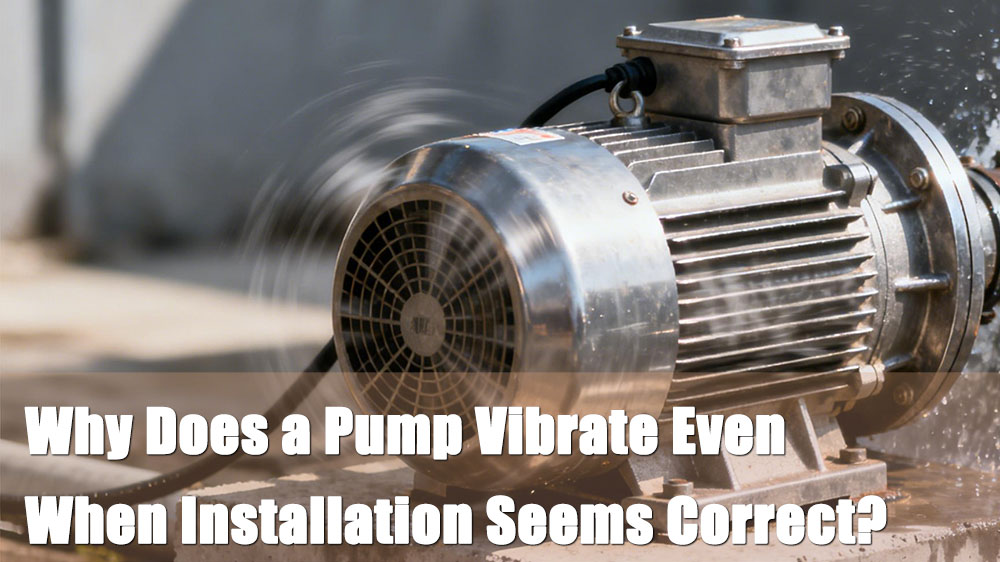
A common frustration in the field is a pump that vibrates despite a seemingly flawless installation. You've checked the alignment, secured the base, and confirmed the connections, yet an unsettling hum or shudder persists. This situation often points to hidden issues that go beyond the initial setup checklist. Vibration is more than just a nuisance; it's a critical symptom that can signal impending failure, efficiency loss, and safety risks.
Understanding the root cause is key to resolving the problem effectively. This article explores the various hydraulic, mechanical, and system-level factors that cause pump vibration. We will cover why a 【correct】 installation isn't always enough and provide a clear path for troubleshooting these complex issues.
First, it's important to establish that all rotating equipment, including pumps, will have some level of vibration. The goal is not to eliminate it entirely but to keep it within acceptable, specified limits. These limits are defined by standards from organizations like the Hydraulic Institute (HI).
Relying on a 【hand-feel】 test is not a reliable method for assessment. What feels minor could be a high-frequency vibration that indicates early-stage bearing failure. Continuous vibration during operation is a much greater concern than the brief shuddering that can occur during startup or shutdown. True health is determined by measuring vibration with calibrated instruments.
Hydraulic forces within the pump are a primary source of vibration. These forces are dynamic and change with the pump's operating conditions, making them invisible during a static installation check.
Every centrifugal pump has a Best Efficiency Point (BEP) on its performance curve where it operates most efficiently and stably. When a pump operates too far to the left (low flow) or right (high flow) of its BEP, the hydraulic forces inside the pump become unbalanced.
This off-BEP operation creates unstable flow patterns and increases radial thrust on the impeller and shaft. The result is higher vibration, increased wear on bearings and seals, and a noticeable drop in efficiency. Matching your system's requirements to the pump's BEP is fundamental to smooth operation.
Cavitation occurs when the pressure of the liquid drops below its vapor pressure, causing tiny vapor bubbles to form. As these bubbles travel to a higher-pressure area within the pump, they collapse violently. This collapse generates intense, localized shockwaves that can sound like gravel is passing through the pump.
This process is a major cause of vibration and can lead to severe damage to the impeller and casing. Cavitation can happen even if your Net Positive Suction Head (NPSH) calculations seem adequate. Partial or early-stage cavitation can still generate significant vibration long before you hear the classic 【gravel】 sound.
Mechanical problems can develop over time or exist as hidden flaws that are not apparent during installation.
Standard 【cold alignment】 is performed when the pump and motor are at ambient temperature. However, as the pump operates, thermal expansion causes the components to grow and shift. This can turn a perfectly aligned cold pump into a misaligned hot one.
This 【hot misalignment】 introduces significant stress and vibration that only appears after the pump has reached its normal operating temperature. It is a common cause of premature bearing and seal failure.
While manufacturers have tight tolerances, minor imbalances in the rotor or impeller can exist. Over time, this imbalance can be magnified by wear, corrosion, or even the buildup of solids from the pumped fluid. A partially clogged impeller will become dynamically unbalanced, leading to a sudden increase in vibration.
Often, the source of vibration isn't the pump at all but the system it's connected to.
A pump needs a rigid, solid foundation. A condition known as 【soft foot】, where one of the pump's mounting feet doesn't sit flush with the baseplate, can cause the frame to twist when bolted down, inducing stress and vibration.
Furthermore, if the natural frequency of the baseplate, foundation, or surrounding structure matches the pump's operating speed, it can create resonance. This amplifies even minor vibrations into major, destructive forces. This is why vibration may only appear at specific RPMs when using a variable frequency drive (VFD).
Piping connected to the pump should be independently supported. If the piping is not properly aligned or supported, it can exert significant force and moment on the pump nozzles. This pipe strain distorts the pump casing, causing internal misalignment and a host of related vibration problems.
Poor suction piping design, such as having an elbow directly on the pump's suction nozzle, can create turbulent, uneven flow into the impeller. This unbalanced flow is another common source of hydraulic vibration.
Troubleshooting pump vibration requires a systematic approach that looks beyond the initial installation checklist.
Analyze the Vibration: Use vibration analysis equipment to identify the frequency and amplitude of the vibration. Different frequencies point to different root causes (e.g., 1x running speed often indicates imbalance, while higher frequencies can suggest bearing issues).
Check the Operating Point: Verify where the pump is operating on its performance curve. Is it near its BEP? If not, investigate why. The issue could be a system design problem or a closed valve downstream.
Inspect for Hydraulic Issues: Check suction pressure to evaluate the NPSH margin and look for signs of cavitation. Listen for unusual noises and inspect the impeller for wear or blockages during the next shutdown.
Verify Mechanical and Structural Integrity: Perform hot alignment checks to account for thermal growth. Inspect the baseplate for soft foot and ensure the foundation is rigid and grout is intact. Check pipe supports to ensure no strain is being transferred to the pump.
Proper Pump Selection: Ensure the pump is correctly sized for the system's actual operating conditions, not just a theoretical maximum.
Improve Suction Conditions: Provide an adequate NPSH margin and design suction piping with long, straight runs before the pump inlet to ensure smooth, laminar flow.
Optimize the System: Match the system curve to the pump's BEP as closely as possible. Use control valves or VFDs to maintain operation within the preferred operating range.
Ensure Structural Rigidity: Invest in a robust baseplate and foundation. Eliminate pipe strain by using proper supports and flexible connectors where appropriate.
While a correct installation is a critical first step, it does not guarantee a vibration-free operation. Vibration is often a symptom of a deeper issue within the hydraulic system, the mechanical components, or the surrounding structure. It is a dynamic problem that reveals itself only when the pump is running.
By adopting a holistic, system-wide approach to troubleshooting, you can move beyond simple installation checks to identify and resolve the true root cause of pump vibration. This proactive stance is essential for ensuring the long-term reliability, efficiency, and safety of your pumping systems.
Address
No.17 XeDa Jimei Ind. Park, Xiqing Economic Development Area, Tianjin, China
Telephone
+86 13816508465
QUICK LINKS