+86 13816508465
Pump Knowledge
Feb. 10, 2026
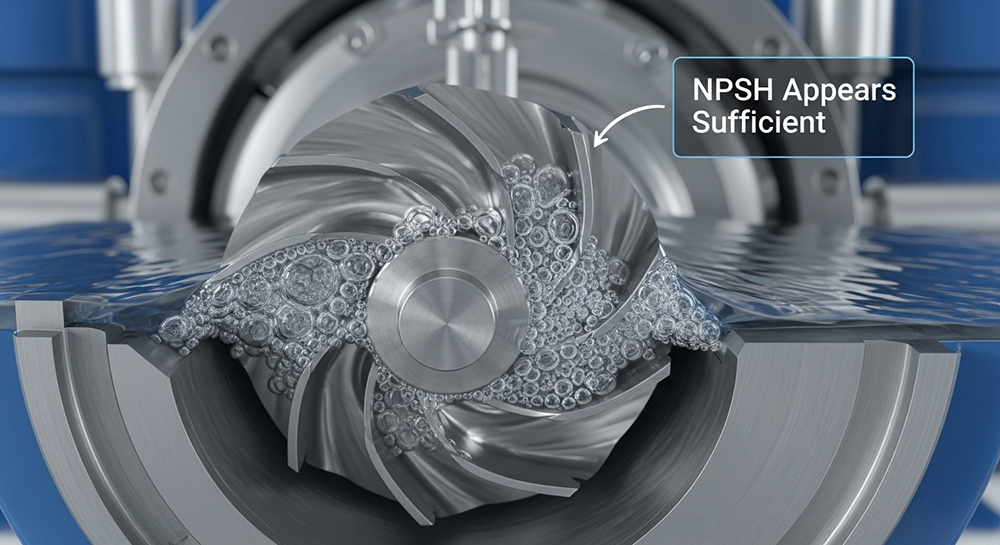
One of the most frustrating scenarios for a pump engineer or operator is hearing the distinct gravelly noise of cavitation from a pump that, by all calculations, should be running smoothly. You check the data sheets, revisit the system curves, and the numbers tell a clear story: your Net Positive Suction Head Available (NPSHa) is greater than the Net Positive Suction Head Required (NPSHr). Theoretically, cavitation should be impossible.
Yet, the pump vibrates, the flow fluctuates, and damage accumulates.
This confusion stems from a fundamental misunderstanding: treating NPSH as a static, single-point calculation rather than a dynamic system variable. This article explains why [sufficient] NPSH on paper often fails in the real world, exploring the hidden losses, dynamic conditions, and fluid behaviors that standard calculations miss.
Before diving into the [why,] let's briefly revisit the [what.] Cavitation in centrifugal pumps occurs when the pressure of the liquid at the impeller eye drops below its vapor pressure.
When this happens, the liquid flashes into vapor, forming small bubbles. As these bubbles move into regions of higher pressure within the impeller, they collapse violently. This isn't just a gentle pop; the collapse generates intense shockwaves that erode metal, cause significant vibration, and reduce hydraulic performance. Typical symptoms include a noise sounding like pumping marbles, erratic discharge pressure, and eventually, mechanical failure of seals and bearings.
To solve the mystery of unexpected cavitation, we must look at how NPSH is defined versus how it behaves.
NPSHa (Available): The absolute pressure at the suction port of the pump, minus the vapor pressure of the liquid. This is what your system provides.
NPSHr (Required): The minimum pressure required at the suction port to keep the pump from cavitating. This is what the manufacturer specifies.
The critical disconnect lies in how NPSHr is determined. It is a test-bench value, typically defined as the point where the pump has already lost 3% of its total head due to cavitation. This means that at the exact NPSHr value, the pump is already cavitating slightly. A steady-state calculation that merely matches NPSHa to NPSHr offers zero safety buffer against real-world fluctuations.
Simply having NPSHa > NPSHr is the bare minimum, not the gold standard.
Many system designers assume a 1-2 foot margin is enough. In stable, clean water applications, it might be. But in complex industrial systems, this razor-thin margin vanishes quickly. Real systems require a robust safety margin—often a ratio of 1.1 to 1.3 times the NPSHr—to account for unforeseen variables.
NPSHr is not a flat line; it curves upward drastically as flow increases. If your pump operates to the right of its Best Efficiency Point (BEP), the required suction pressure increases significantly, potentially eating up your calculated margin.
Flow rate is the variable that changes most often, yet calculations often assume a static design point.
Higher Flow Increases NPSHr: As flow velocity increases, friction losses in the suction line rise (reducing NPSHa), while the velocity inside the pump increases (raising NPSHr). These two curves can cross unexpectedly if the pump runs at a higher flow rate than intended.
Operating Away from BEP: Pumps are designed to accept fluid smoothly at their BEP. At low flows (recirculation cavitation) or high flows, the angle of incidence between the fluid and the impeller blades becomes inefficient, creating localized low-pressure zones that trigger cavitation, regardless of the suction gauge reading.
Standard calculations use textbook friction coefficients for new, clean pipes. Reality is rarely so ideal.
Pipe Friction: Older pipes develop scale and roughness, increasing friction far beyond theoretical values.
Component Losses: Every valve, elbow, reducer, and strainer adds pressure drop. If a strainer is even partially clogged, the pressure drop across it can skyrocket, starving the pump of the necessary head.
Filters: A clean filter might pass the NPSH check, but a filter at 50% capacity might cause the system to fail.
Fluid properties are not constant. In many processes, the liquid temperature rises during operation.
As temperature increases, vapor pressure rises exponentially. If your calculation used water at 68°F (20°C) but the process water hits 100°F (38°C), the vapor pressure increases, drastically reducing the NPSHa. Cavitation often appears after the system has been running for a few hours because the fluid has warmed up, changing the thermodynamic balance.
NPSH calculations assume a perfect, uniform velocity profile entering the pump.
If an elbow is placed directly onto the suction flange, or if the straight pipe length is insufficient (less than 5-10 pipe diameters), the fluid enters the impeller with swirl and turbulence. This non-uniform loading means one side of the impeller eye may see sufficient pressure while the other sees a vacuum, causing localized cavitation that a single suction gauge reading won't detect.
Static calculations cannot predict transient events.
Start-up/Shutdown: Rapid changes in flow can momentarily drop suction pressure.
VFDs: Rapid speed ramps with Variable Frequency Drives can accelerate the pump faster than the fluid column can respond, creating a momentary vacuum at the suction eye.
System Fluctuations: A valve opening elsewhere in the loop can cause a pressure wave or drop that pushes the pump into a cavitation zone for seconds or minutes at a time.
Sometimes, what looks like cavitation is actually air entrainment, or a mix of both.
Small leaks on the suction side (which is often under vacuum) can pull air into the line. Alternatively, dissolved gases may release from the liquid as pressure drops. The presence of air bubbles acts as nucleation sites, accelerating the formation of vapor cavities and worsening the effects of cavitation, even if the liquid pressure itself seems marginally sufficient.
Ignoring [minor] cavitation because the pump is still moving fluid is a mistake. The consequences escalate quickly:
Loss of Head and Efficiency: The pump has to work harder to move less fluid.
Vibration and Noise: This leads to premature bearing and seal failures.
Physical Damage: The impeller becomes pitted and eroded, looking like it has been attacked by termites. Eventually, the casing itself can be breached.
Let's debunk a few myths that lead engineers astray:
Myth: NPSHa greater than NPSHr means cavitation is impossible.
Reality: It only means steady-state, uniform flow cavitation is unlikely. It doesn't account for turbulence, recirculation, or thermal shock.
Myth: Cavitation only occurs at high speed.
Reality: Cavitation can occur at low speeds if the suction line is restricted or if the pump operates far to the left of its curve (recirculation).
Myth: Noise is always required to identify cavitation.
Reality: While common, some forms of cavitation (like incipient cavitation) are relatively quiet but still damage the impeller over time.
If you suspect cavitation despite good calculations:
Check the Operating Point: Are you running near the BEP, or far to the right/left?
Monitor Vibration: Look for high-frequency random vibration, which is a signature of bubble collapse.
Inspect Suction: Check strainers for debris and measure temperature in real-time.
Listen: A crackling sound usually indicates suction cavitation; a deep rumbling often indicates discharge recirculation.
Solving the problem often requires physical changes to the system:
Increase Suction Diameter: Increasing pipe size reduces friction losses significantly.
Improve Layout: Remove elbows from the immediate suction of the pump; install flow straighteners if necessary.
Reduce Speed: Slowing the pump down (if process allows) drastically reduces NPSHr.
Select Better Pumps: Choose a pump with a lower NPSHr or a larger suction eye design.
Raise the Source Tank: Increasing the static head (elevation of the liquid) is the most direct way to increase NPSHa.
Cavitation is a system-level and dynamic phenomenon, not just a line item on a spreadsheet. While NPSH calculations are the necessary foundation for pump selection, they are rarely sufficient on their own to guarantee reliability.
True prevention requires a conservative design approach that accounts for suction losses, thermal changes, and flow dynamics. By looking beyond the basic math and understanding the fluid behavior, you can design systems that run smoothly, quietly, and reliably for years.
How much NPSH margin is recommended?
A general rule of thumb is to have NPSHa be at least 1.1 to 1.3 times the NPSHr. For critical applications or high-energy pumps, a margin of 3 to 5 feet (approx. 1 to 1.5 meters) absolute head is often recommended.
Can cavitation occur intermittently?
Yes. Variations in tank levels, fluid temperature, or system demand can cause a pump to drift in and out of the cavitation zone throughout the day.
Is cavitation more common in high-speed pumps?
generally, yes. Higher rotational speeds require fluid to enter the impeller faster, which increases the required suction energy (NPSHr). High-speed pumps are therefore more sensitive to suction restrictions.
Address
No.17 XeDa Jimei Ind. Park, Xiqing Economic Development Area, Tianjin, China
Telephone
+86 13816508465
QUICK LINKS