+86 13816508465
Pump Knowledge
Jun. 25, 2026
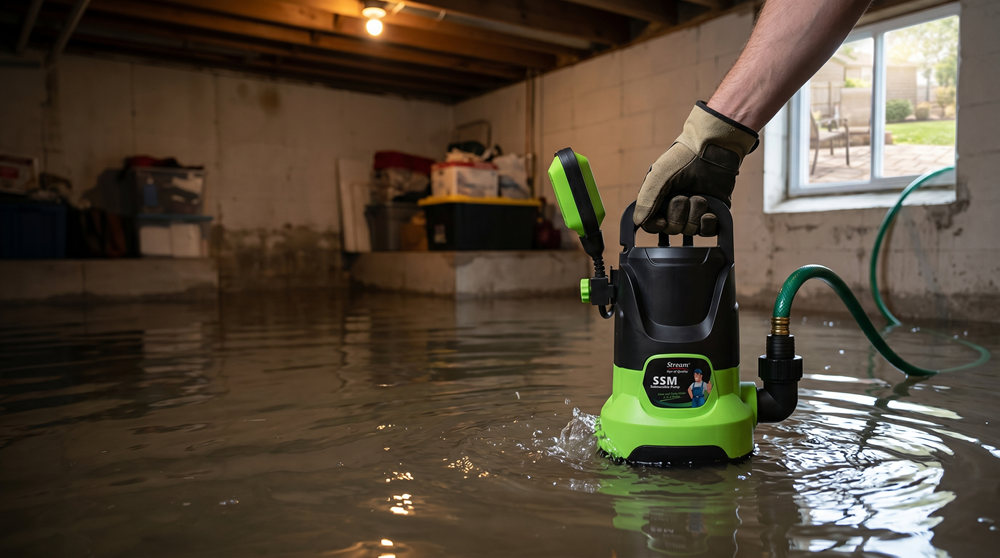
A portable submersible pump is the fastest, most reliable way to remove standing water from a flooded basement, garage, or any low-lying space. Because mold can take hold within 24 to 48 hours and water weakens building foundations fast, keeping a lightweight, automatic drainage pump like the Stream Pumps domestic submersible series on standby lets you start cleanup in minutes—not days—and avoid thousands in repairs.
A heavy spring storm rolls through overnight. Or a pipe in the wall gives way without warning. You head downstairs in the morning and find several inches of water covering your basement floor, your stored boxes floating, and that sinking feeling settling in your stomach.
It happens to homeowners every single day. And the worst part isn't the water itself—it's how fast that water turns into a much bigger, more expensive problem. Drywall soaks it up. Subfloors swell. Mold spores wake up and start spreading. The clock starts ticking the moment the flooding begins.
A mop and bucket won't save you here. Neither will a shop vacuum once the water rises past a few inches. What actually solves the problem is a portable submersible pump—a compact, drop-in tool that moves hundreds of gallons of water per hour straight out a window or door.
This article breaks down the real dangers of standing water, why most household tools fall short, and the exact features that make an emergency pump dependable when you need it most. You'll also see why the Stream Pumps domestic submersible range is built specifically for fast, stress-free deployment.
People underestimate water. It looks calm sitting on the floor, but it's quietly working its way into everything it touches. Here's what that timeline really looks like.
Water seeks the lowest point and then sinks even lower. It seeps into concrete foundations, slips behind walls, and saturates wooden subfloors and joists. Over time, that moisture weakens the structural integrity of the materials holding your house up. Hardwood floors warp and cup. Drywall crumbles. Even concrete can crack as trapped moisture freezes and expands during cold months. The longer water sits, the deeper the damage runs.
This is the danger most homeowners don't see coming. Mold begins to grow within 24 to 48 hours in damp, dark, poorly ventilated spaces—and a flooded basement is the perfect breeding ground. Once mold takes hold, it spreads through porous materials and releases spores that can trigger allergies, asthma, and other respiratory problems. Removing established mold often means professional remediation, which is far more expensive than the flood cleanup itself.
Rising water and electricity are a deadly combination. When floodwater reaches outlets, extension cords, furnaces, water heaters, or other appliances, it creates a serious risk of electric shock and fire. This is exactly why speed matters so much. The faster you can lower the water level, the sooner you reduce the danger to your home and your family.
Plenty of homeowners reach for a wet/dry vacuum when water shows up. For a small spill, that's fine. For a genuine flood, it's a losing battle.
A typical shop vacuum holds somewhere between 5 and 16 gallons. During a real flood, you'll fill that tank in seconds, then spend the next several hours hauling it to a drain, emptying it, and lugging it back—over and over. It's slow, it's exhausting, and while you're emptying buckets, the water keeps doing damage. You simply can't keep up with the volume.
A submersible drainage pump—often called a puddle pump—works on a completely different scale. Instead of collecting water in a tank, it pushes water continuously through a standard garden hose and out a window, door, or into a drain. A good unit can move hundreds of gallons per hour without ever stopping to empty. You drop it in, run the hose outside, and let it work while you focus on protecting your belongings. That's the difference between bailing and actually beating the flood.
Not all pumps are built for emergencies. When water is rising, these are the features that separate a tool you can trust from one that lets you down.
Most pumps stop working once the water drops too low, leaving a frustrating layer of standing water behind. A true emergency pump has low-suction (puddle pumping) capability, meaning it can draw water down to just a few millimeters. Stream Pumps offers a 5mm low water level submersible pump in its garden range, designed to pull water right down to the floor surface—so you're left with a nearly dry space instead of a wet mess to mop up.
In an emergency, you don't have time to read a manual or assemble parts. You need a pump you can grab, drop into the water, connect to a hose, and plug in. Simple, fast, and foolproof. The harder a pump is to set up, the more precious time you lose while the water keeps rising.
A built-in float switch is one of the most valuable features an emergency pump can have. As the water rises, the float lifts and switches the pump on. As the water drops, the float falls and switches it off—preventing the motor from running dry and burning out. This means you can deploy the pump and walk away to handle other priorities, trusting it to manage the job on its own.
Stream Pumps has manufactured water pumps since 1997 and now supplies more than 110 countries worldwide. Its domestic submersible series is designed specifically for the kind of quick deployment a household emergency demands. Here's what sets it apart.
When water is rising, you can't afford to wrestle with heavy equipment. Stream Pumps' domestic submersible pumps feature an ergonomic carry handle and high-impact plastic and stainless steel housing, keeping them light enough for anyone in the household to grab and deploy in seconds. No special strength or training required.
The hardest test for an emergency pump isn't the flood—it's the years of sitting unused in a garage beforehand. Stream Pumps uses corrosion-resistant plastic and stainless steel materials, so the pump won't rust or seize while it waits. Store it for years, and it will still spring to life the moment you need it.
Clearing a large flood pushes a pump hard. To protect the motor, Stream Pumps domestic submersible pumps include thermal overload protection that automatically guards against overheating. If the pump runs hot during heavy use, this safeguard prevents the motor from burning out—so your investment keeps working through the whole job.
With integrated float switch operation, you can place a Stream Pumps unit in the flooded area, head upstairs to safety, and let it do its work. The pump shuts itself off automatically once the water is cleared, giving you genuine peace of mind during a stressful situation.
Choose a portable submersible pump as standby equipment if any of these describe your home:
You have a basement or below-grade space. Gravity pulls water straight into the lowest part of your house, making basements the number one flood risk.
You live in a region with heavy rain or seasonal storms. Spring thaws, hurricane seasons, and sudden downpours overwhelm drains fast.
Your home has aging plumbing. Older pipes are more likely to burst without warning, and a pump turns that emergency into a cleanup.
You store valuables in low-lying areas. Garages, crawl spaces, and finished basements often hold belongings that water destroys quickly.
If even one of these applies, a standby pump is far cheaper than a single water-damage repair bill.
Floods rarely announce themselves in advance. By the time you know you need a pump, it's often too late to buy one and start cleanup before the damage sets in. That's what makes a portable submersible pump such a smart purchase: it's a small, one-time investment that delivers massive peace of mind every time the skies open up or a pipe gives way.
Standing water destroys homes fast, but it doesn't have to destroy yours. With a reliable, lightweight drainage pump waiting in your garage, a potential disaster becomes a manageable cleanup you can handle in an afternoon.
Be ready before the next storm hits. Visit www.streampumps.com/garden-pump/ to find the right emergency pump for your household and protect your property from water damage.
Most domestic submersible drainage pumps move several hundred gallons per hour, depending on the model and the height the water needs to be lifted. That's dramatically faster than a wet/dry vacuum, which has to be emptied every few gallons. For a flooded basement, this continuous flow is what lets you lower the water level quickly enough to limit damage.
Yes—if it has low-suction capability. Stream Pumps offers a 5mm low water level submersible pump that draws water down to roughly 5 millimeters from the floor surface, leaving the space nearly dry. Standard pumps usually stop higher than this, leaving a layer of water you'll need to mop up by hand.
Mold can begin growing within 24 to 48 hours in damp, dark, poorly ventilated spaces like basements. This short window is exactly why fast water removal matters so much. Clearing standing water quickly with a submersible pump is one of the best ways to reduce the risk of mold taking hold.
A pump with an automatic float switch is designed for this. The float turns the pump on when water rises and off when it drops, preventing the motor from running dry. Stream Pumps domestic submersible units also include thermal overload protection, adding a second layer of safety against overheating during long jobs.
Store your pump in a dry, accessible spot like a garage or utility room where you can reach it fast. Because Stream Pumps uses rust-proof plastic and stainless steel housings, the pump resists corrosion even after long periods in storage—so it's ready to perform the moment you need it.
For most homeowners, yes. A single water-damage repair, including structural drying and mold remediation, can run into the thousands of dollars. A portable submersible pump is a small one-time cost that helps you avoid that expense—making it one of the most affordable forms of home flood protection available.
Address
No.17 XeDa Jimei Ind. Park, Xiqing Economic Development Area, Tianjin, China
Telephone
+86 13816508465
QUICK LINKS