+86 13816508465
Pump Knowledge
Jan. 26, 2026
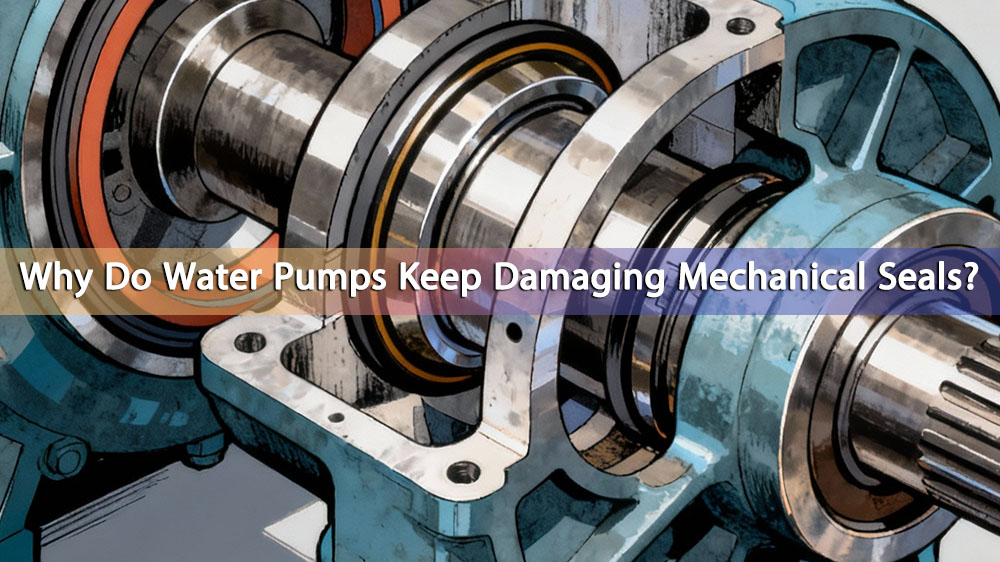
Mechanical seal failure is one of the most common complaints in centrifugal pump applications.
Many users simply replace the seal again and again, assuming it is a consumable part.In reality, repeated seal wear is a symptom, not the root cause.This article explains why pump seals keep getting damaged, including hydraulic imbalance, axial thrust, installation issues, and operating condition mismatches — and how to fix them permanently.
1. What Does a Mechanical Seal Actually Do?
A mechanical seal prevents fluid from leaking along the pump shaft while allowing rotation.It relies on:
· Two extremely flat seal faces
· Stable axial load
· A thin lubricating fluid film between the facesOnce this balance is disturbed, rapid wear is inevitable.
2. Excessive Axial Thrust — One of the Most Overlooked Causes
Why axial thrust matters
In centrifugal pumps, pressure on the front and back of the impeller is not equal.
This pressure difference creates axial thrust, pushing the impeller and shaft in one direction.If axial thrust is too high:
· The shaft moves axially.
· Seal faces lose proper contact.
· One side of the seal overheats and wears rapidly.
Typical reasons for excessive axial thrust
· No balance holes in the impeller
· Clogged or undersized balance holes
· High-head operation without thrust compensation
· Single-suction impeller designResult:
Seal faces are overloaded, leading to premature failure.
3. Impeller Rubbing Caused by Pressure Imbalance
When axial thrust is not properly controlled:
· The impeller may shift toward the casing or rear cover.
· Micro-contact occurs between metal surfaces.
· Vibration and shaft deflection increaseThis mechanical instability is directly transmitted to the seal, accelerating wear.
4. Pump Operating Far from Its Design Point (BEP)
Operating away from the Best Efficiency Point (BEP) is a major seal killer.
Common scenarios:
· Oversized pump running at low head → excessive flow
· Throttled discharge causing internal recirculation
· Frequent start-stop operation
Consequences:
· Increased vibration
· Shaft deflection
· Unstable hydraulic forces on the seal facesEven a high-quality seal cannot survive long under unstable operating conditions.
5. Solid Particles and Poor Fluid Quality
Mechanical seals are designed to work with clean or mildly contaminated fluids.Problems occur when:
· Sand, silt, or debris enters the seal chamber.
· Abrasive particles scratch seal faces
· Particles disrupt the lubricating film.Typical applications at risk:
· Construction dewatering
· Mining
· Sewage and slurry handlingWithout proper flushing or seal selection, abrasive wear becomes unavoidable.
6. Dry Running and Insufficient Cooling
Mechanical seals depend on fluid for:
· Lubrication
· CoolingSeal damage occurs when:
· Pump runs dry during priming.
· Suction is blocked
· Air enters the system.
· Cooling flow to the seal chamber is insufficient.Even a few seconds of dry running can permanently damage seal faces.
7. Misalignment and Installation Errors
Seal failure is not always a hydraulic issue.Common installation-related causes include:
· Pump and motor misalignment
· Bent shaft
· Excessive pipe stress is pulling the pump casing.
· Incorrect seal installation or preloadThese conditions cause:
· Uneven seal face contact
· Localized overheating
· Rapid face cracking or chipping.
8. Inappropriate Seal Selection
Not all seals are suitable for all conditions.Frequent mistakes:
· Using standard seals for high-temperature fluids
· Incompatible seal materials with pumped media
· Single seals are used where double seals are requiredA correct seal must match:
· Fluid type
· Temperature
· Pressure
· Presence of solids
9. Why Balance Holes Help Protect Mechanical Seals
Balance holes in the impeller:
· Reduce pressure behind the impeller.
· Lower axial thrust
· Stabilise the shaft positionAlthough they cause a small efficiency loss (typically 2–5%), they:
· Significantly reduce seal loading.
· Improve long-term reliability
· Extend seal and bearing life.This is a deliberate engineering trade-off, not a design flaw.
10. How to Diagnose the Real Cause of Seal Wear
Instead of just replacing the seal, ask:
· Is the pump operating near its BEP?
· Is axial thrust properly controlled?
· Are the balance holes blocked?
· Is vibration within acceptable limits?
· Is the fluid suitable for the seal type?Seal wear patterns often reveal the true problem.
Conclusion
Mechanical seals do not fail randomly.
They fail because hydraulic, mechanical, or operational conditions exceed their limits.Key takeaways:
· Repeated seal damage is a system problem, not a seal problem.
· Axial thrust and operating point mismatch are major hidden causes.
· Small design features, such as balance holes, play a critical role.
· Correct pump selection and operation are the best seal protection.Understanding these factors can dramatically reduce maintenance costs and unplanned downtime.
Address
No.17 XeDa Jimei Ind. Park, Xiqing Economic Development Area, Tianjin, China
Telephone
+86 13816508465
QUICK LINKS