+86 13816508465
Pump Knowledge
Jan. 25, 2026
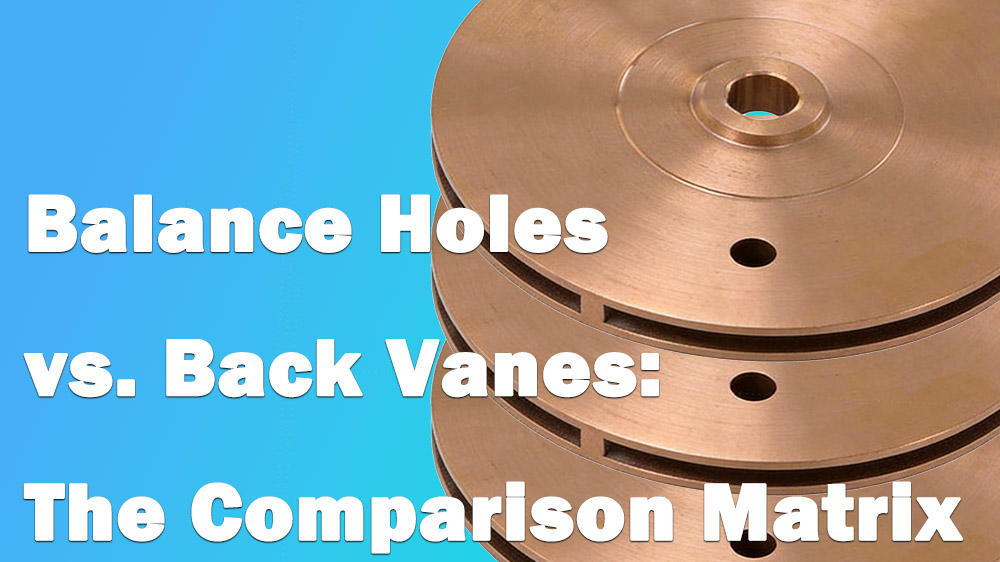
When selecting a centrifugal pump, managing the high axial thrust loads generated by the impeller is a critical design consideration. Two common engineering solutions to counteract this force and reduce pressure in the seal chamber are balance holes and back vanes. While both aim to improve reliability, they function differently and are suited for distinct applications. Understanding their trade-offs is essential for selecting the right pump for your service.
Efficiency
The primary goal of any pumping system is to move fluid with the least amount of energy. In this regard, balance holes typically provide a slight advantage in overall pump efficiency. Balance holes work by allowing high-pressure liquid from the discharge side of the impeller to leak back to the suction side through the impeller itself. This equalizes pressure and reduces axial thrust without consuming significant power.Back vanes, on the other hand, function as a small, secondary impeller on the reverse side of the primary one. They actively pump fluid out from behind the impeller, which lowers the pressure in the seal chamber. This pumping action, however, creates additional [disk friction] that consumes extra horsepower. While the effect may be minor on a single pump, the cumulative energy cost can become notable over the equipment's lifespan, especially in continuous-duty applications.
Solids Handling
The performance of these two methods diverges sharply when solids or slurries are introduced into the process fluid. Back vanes are unequivocally superior for applications involving dirty water or liquids with suspended solids. Their dynamic pumping action actively expels debris and prevents it from migrating toward the shaft seal and stuffing box area. This clearing effect is crucial for protecting the mechanical seal from abrasive wear and ensuring its longevity.Balance holes, in contrast, present a significant reliability risk in solids-laden services. The small holes drilled through the impeller are highly susceptible to becoming clogged with debris. When this happens, their ability to balance pressure is lost, resulting in a sudden increase in axial thrust on the bearings. This can lead to rapid bearing failure and damage to the mechanical seal.
Maintenance
From a maintenance perspective, the two designs have different dependencies. The effectiveness of a balance hole design is directly tied to the condition of the front wear ring clearance. As the wear ring clearance increases over time due to normal wear, more fluid bypasses the holes, reducing their ability to balance thrust effectively. Maintaining tight wear ring clearances is therefore essential for the system to function as designed.Pumps equipped with back vanes do not rely on a rear wear ring for their operation. The vanes create a dynamic [expeller] effect that is less sensitive to wear over time. This design can offer a more robust and forgiving solution, reducing the need for maintenance interventions focused on maintaining tight internal clearances to manage axial loads.
Conclusion: The Right Tool for the Job
The choice between balance holes and back vanes is a classic engineering trade-off between peak efficiency and rugged reliability. Neither method is universally superior; the correct choice depends entirely on the application.
· Balance Holes are the preferred choice for Clean & Efficient applications. In systems pumping clean liquids where maximizing wire-to-water efficiency is a primary driver, balance holes offer a reliable way to manage axial thrust with minimal energy penalty.
· Back Vanes are designed for Rugged & Reliable seal protection. In services with solids, abrasives, or slurries, the self-clearing action of back vanes provides essential protection for the mechanical seal, making them the far more durable and dependable option, even at the cost of a slight reduction in efficiency.
Address
No.17 XeDa Jimei Ind. Park, Xiqing Economic Development Area, Tianjin, China
Telephone
+86 13816508465
QUICK LINKS