+86 13816508465
Pump Knowledge
Jan. 26, 2026
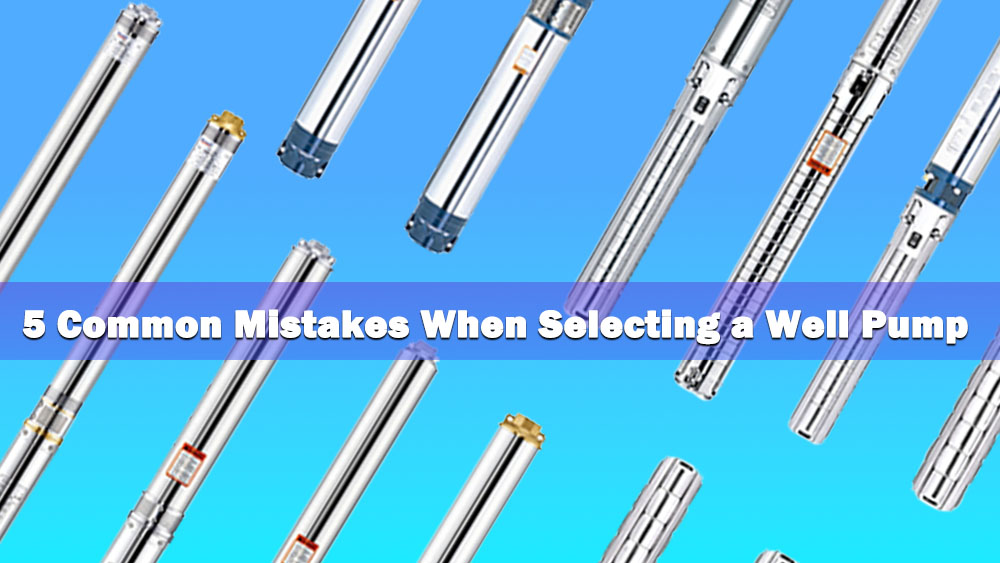
You turn the faucet, expecting a strong stream of fresh water, but instead, you get a trickle—or worse, nothing at all. For many property owners, this frustrating scenario is the direct result of a poor decision made months or years prior.Selecting the right well pump is often treated as an afterthought or a simple purchase based on horsepower alone. However, well pump selection mistakes are surprisingly common and can lead to inefficient systems, skyrocketing energy bills, and premature equipment failure. The long-term cost of choosing the wrong unit far outweighs the time it takes to research the right specifications.In this guide, we will break down the five most critical errors people make when deciding how to choose a well pump. You will learn why factors like total head, well diameter, friction loss, and water quality are just as important as the motor's power rating.
Mistake #1 – Focusing Only on Motor Power and Ignoring Pump Head
The most frequent error buyers make is assuming that more horsepower (HP) equals better performance. It is easy to look at a 2HP pump and assume it is superior to a 1HP model, but in hydraulic engineering, power is only half the story.
Why Power (kW / HP) Is Not the Whole Story
Motor power defines how much energy the pump consumes and the potential work it can do, but it does not tell you how that work is applied. Hydraulic performance is a balance between flow (gallons per minute) and head (vertical lift).A high-horsepower pump might be designed to move massive amounts of water at a low pressure, or a small amount of water at extremely high pressure. If you need to lift water 300 feet, a high-flow, low-head pump will fail, regardless of how much horsepower it has. A higher power rating does not guarantee the lift you need.
Understanding Total Head in Well Pump Selection
To avoid common well pump problems, you must understand [head.] This refers to the height a pump can raise water.
· Static Head: The vertical distance from the water level in the well to the highest point of discharge (like a storage tank or an upper-floor shower).
· Dynamic Head: The additional pressure required to overcome friction in the pipes and maintain pressure at the tap.If your pump cannot generate enough head to overcome both gravity and friction, you will experience low flow or no water delivery at all.
How to Avoid This Mistake
Never buy based on HP alone. Instead, calculate the Total Dynamic Head (TDH) required for your system. Once you have this number, look at the manufacturer's [pump curve.] This chart shows exactly how much water a pump can move at a specific head height. You want a pump where your required flow and head intersect near the middle of the curve—the [Best Efficiency Point.]
Mistake #2 – Ignoring Well Diameter and Installation Space
When discussing deep well pump sizing, physical dimensions are critical. A pump that is mathematically perfect for your water needs is useless if it doesn't fit inside your well casing.
Why Well Diameter Matters
Submersible pumps are generally categorized by their diameter (e.g., 3-inch, 4-inch, 6-inch). However, the pump's outer diameter is not the only measurement that matters. You must also consider the clearance required for the electrical cable and the safety rope.Furthermore, submersible motors require water to flow past them to dissipate heat. If the space between the pump and the casing is too wide, water might bypass the motor, leading to overheating. If it is too tight, you risk getting the pump stuck during installation.
Risks of Choosing the Wrong Pump Size
Choosing the wrong physical size leads to immediate and long-term risks:
· Installation Failure: A pump that is too tight can get wedged in the casing, turning a simple installation into an expensive retrieval operation.
· Poor Motor Cooling: Without adequate flow velocity around the motor, the internal temperature rises, frying the windings.
· Vibration and Wear: An improper fit can cause the pump to rattle against the casing walls during startup torque, damaging both the unit and the well.
How to Avoid This Mistake
Measure your well casing’s internal diameter accurately before shopping. Most residential wells use 4-inch or 6-inch casings. Standard practice for submersible well pump selection is to leave adequate clearance for wires while ensuring the pump is shrouded or sized correctly to induce flow over the motor. If your well is wide (e.g., a dug well), you may need a flow induction sleeve to force water past the motor for cooling.
Mistake #3 – Not Accounting for Pipe Length and Friction Loss
You have calculated the vertical lift, but have you considered the journey the water takes to get to your house? Ignoring pipe friction is a silent killer of water pressure.
What Is Pipe Friction Loss?
As water moves through a pipe, it drags against the inner walls. This creates resistance, known as friction loss. The faster the water moves and the narrower the pipe, the more pressure is lost.Imagine trying to drink a thick milkshake through a tiny coffee stirrer versus a wide straw. The coffee stirrer requires much more lung power (pressure) to get the liquid moving. The same physics apply to your well system.
How Friction Loss Reduces Pump Performance
If you run a powerful pump through a narrow, long pipe, a significant portion of the pump's energy is wasted just pushing water through the line.
This results in:
· Lower Flow at Outlet: You might lose 10-15 PSI just in the pipe run, leading to weak showers.
· Increased Energy Consumption: Your pump runs longer to build up pressure, driving up electricity costs.
How to Avoid This Mistake
Perform a well pump head calculation that includes friction loss. There are standard friction loss charts available that tell you how much pressure is lost per 100 feet of pipe for a given flow rate and pipe diameter.If you have a long run from the well to the house, consider upsizing your pipe diameter. Moving from a 1-inch pipe to a 1.25-inch pipe can significantly reduce friction and improve performance without changing the pump.
Mistake #4 – Choosing the Wrong Pump Material for Water Quality
Groundwater is rarely pure H2O. It contains minerals, sediments, and chemical properties that can destroy a standard pump.
How Water Quality Affects Pump Lifespan
If your water has a low pH (acidic) or high salinity, it becomes aggressive. Standard cast iron components can rust and corrode rapidly in these conditions. On the other hand, if your water contains sand or abrasive sediment, plastic impellers might wear down, reducing the pump's ability to build pressure.
Material Selection: Cast Iron vs Stainless Steel vs Thermoplastic
· Cast Iron: Durable and heavy, but prone to rust in aggressive water.
· Stainless Steel (304 or 316 grade): The gold standard for pump material for groundwater. It offers excellent corrosion resistance and durability but comes at a higher price point.
· Thermoplastic: often used for impellers in cheaper pumps. While resistant to corrosion, they are less durable against sand abrasion than stainless steel.
How to Avoid This Mistake
Test your water quality before selection. If your report shows high salinity, acidity, or iron bacteria, invest in a stainless steel pump. If you have sandy water, look for pumps with [floating stack] impellers designed to handle small solids without locking up. Matching materials to your actual water conditions is the best insurance policy for your investment.
Mistake #5 – Not Considering Continuous Operation and Duty Cycle
Are you filling a small pressure tank for a cottage, or running sprinklers for six hours straight? The intended use drastically changes the requirements.
What Is Duty Cycle in Well Pump Applications?
Duty cycle refers to how long a pump can run without needing a break. Some residential pumps are designed for intermittent duty—they run for a few minutes to fill a tank and then shut off. Others are rated for continuous duty, capable of running for hours to support irrigation or heat pump systems.
Risks of Overworking a Light-Duty Pump
Using a standard residential pump for heavy agricultural or continuous irrigation needs can lead to:
· Overheating: The motor windings degrade under constant heat.
· Shortened Motor Life: Frequent start/stop cycles or prolonged running beyond design limits causes premature burnout.
· Frequent Breakdowns: You will find yourself replacing the pump or control box far more often than necessary.
How to Avoid This Mistake
Define your usage profile clearly. If you plan to irrigate a large lawn or garden, ensure the pump is rated for continuous duty. Additionally, verify that the motor has built-in thermal protection that shuts the unit down if it gets too hot, saving it from catastrophic failure.
Additional Factors Often Overlooked
While the five mistakes above are the most common, a few other details can make or break your system:
· Power Supply Stability: Ensure you know whether you have single-phase or three-phase power. Three-phase motors are more efficient but require specific power supplies not available in most homes.
· Voltage Fluctuation Protection: If you live in a rural area with unstable grid power, voltage spikes or drops can destroy a pump motor.
· Control Boxes: Always use the control box recommended by the manufacturer. It contains the starting capacitor and relays specifically matched to that motor’s requirements.
Conclusion
Selecting a well pump is about more than just buying the most powerful unit on the shelf. It requires a system-based approach that considers the depth of your water, the width of your well, the pipes that carry the water, and the quality of the groundwater itself.By avoiding these common errors—ignoring head, misjudging diameter, neglecting friction loss, choosing poor materials, and overlooking duty cycle—you ensure a reliable water supply for years to come. The right choice now prevents the headache of common well pump problems later.Take the time to measure, calculate, and verify. A well-selected pump is one you install and then forget about because it simply works.
FAQ Section
Is higher horsepower always better for well pumps?
No. Higher horsepower does not automatically mean better performance. If the pump is not designed for the specific head (vertical lift) required by your well, a high-HP pump may still fail to deliver water. You must match the pump curve to your specific needs.
What happens if pump head is insufficient?
If the pump cannot generate enough head to overcome gravity and pipe friction, you will experience very low water pressure or zero flow at the faucet. The pump may run continuously without ever building enough pressure to shut off, leading to burnout.
How do I know if my well pump is oversized or undersized?
An undersized pump will struggle to build pressure and may provide weak flow. An oversized pump will [short cycle,] turning on and off rapidly because it fills the pressure tank too quickly. This rapid cycling damages the motor and increases electricity bills.
Can one well pump handle continuous irrigation?
Yes, but only if it is rated for continuous duty. Standard residential pumps are often designed for intermittent use. If you need to run sprinklers for hours, check the manufacturer’s specifications to ensure the motor can handle the thermal load of continuous operation.
Address
No.17 XeDa Jimei Ind. Park, Xiqing Economic Development Area, Tianjin, China
Telephone
+86 13816508465
QUICK LINKS