+86 13816508465
Pump Introductions
Aug. 21, 2026
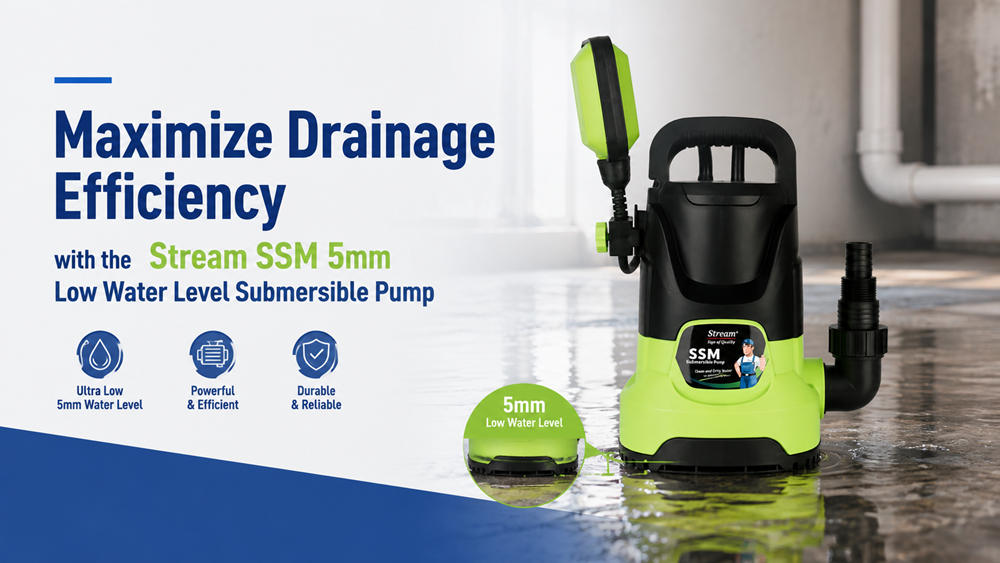
The Stream SSM is a heavy-duty submersible pump engineered to drain water to a residual depth of just 5mm. Built with cast iron construction and a flat-suction design, the SSM is a reliable drainage solution for construction dewatering, basement flooding, and industrial floor drainage—where standard submersible pumps fall short.
Incomplete drainage is a costly problem. On active construction sites, standing water delays concrete pours, creates safety hazards, and drives up project timelines. In industrial facilities, pooled water on processing floors poses contamination risks and accelerates surface corrosion. Standard submersible pumps stop pumping when water levels drop below their intake port—often leaving 50mm to 100mm of water behind. That residual volume requires manual removal or additional equipment, adding labor cost and time to every drainage operation.
The Stream SSM 5mm Low Water Level Submersible Pump eliminates this limitation. Engineered with a flat-base intake design, the SSM continues operating until the water depth reaches just 5mm—delivering a level of drainage completion that conventional pumps cannot match. This article breaks down what makes the SSM the preferred choice for contractors and procurement officers who require reliable, high-performance dewatering across demanding job sites and industrial environments.
The SSM is built for environments where pump failure is not an option. Its construction reflects the demands of heavy-duty drainage applications.
Cast iron body: Provides structural rigidity and resistance to impact and abrasion—critical on construction sites where equipment is subject to rough handling and exposure to debris-laden water.
Stainless steel shaft: Resists corrosion from contact with chemically varied water sources, including groundwater with elevated mineral content.
Robust mechanical seal: Protects the motor from water ingress, extending operational life in continuous-duty dewatering scenarios.
Flat-suction base design: The core engineering advantage of the SSM. The intake is positioned at the base of the pump housing, allowing it to draw water from depths as shallow as 5mm—a capability that standard bottom-intake submersible pumps cannot replicate.
For procurement officers evaluating total cost of ownership, the SSM's construction quality translates directly into reduced replacement frequency and lower maintenance expenditure over the pump's service life.
Most submersible drainage pumps are limited by the position of their intake port. When water drops below the intake level, the pump draws air, loses prime, and stops—leaving the remaining water for manual removal. On a large construction site or industrial floor, this residual volume can amount to thousands of liters across the drainage area.
The Stream SSM addresses this with a purpose-built flat-base intake that keeps the suction point at ground level. The practical result:
Near-complete water removal: The SSM drains to 5mm, eliminating the need for secondary manual dewatering in most applications.
Reduced total job time: Fewer steps in the drainage process means faster site turnaround for contractors managing multiple dewatering operations.
Lower labor cost: Removing the manual mop-up stage reduces the hours required to complete drainage on each site.
Improved floor surface preparation: In construction and industrial settings, near-dry surfaces allow faster transition to subsequent work—concrete placement, floor coating application, or equipment reinstallation.
For facilities managers and site engineers who run recurring drainage cycles, the cumulative time and labor savings across multiple operations represent a measurable return on the capital investment.
Selecting the correct pump requires a clear understanding of the SSM's operating parameters and the conditions it is designed to handle.
Liquid Temperature Range
The SSM is designed for use with clean water and mildly contaminated water. Procurement officers should confirm that the liquid temperature at the installation site falls within the pump's specified operating range. Elevated temperatures—such as those present in industrial process drainage—may require a model with enhanced thermal tolerance.
Submersion Depth
The SSM operates as a fully submersible unit. Maximum submersion depth should be verified against the pump's rated specification for the intended application, particularly in deep excavation dewatering where the pump may be deployed at significant depth below the site surface.
Solid Passage
The SSM is designed for relatively clean water drainage applications. It is not a sewage or slurry pump. For applications involving suspended solids, sand, or construction slurry, a dedicated solids-handling submersible pump from the Stream range is the appropriate selection. Deploying the SSM in high-solids conditions risks impeller wear and premature seal failure.
Electrical Supply
The SSM operates on standard single-phase or three-phase power, depending on the motor variant. Confirm supply voltage and frequency against the specification sheet before deployment to ensure compatibility with site electrical infrastructure.
Continuous vs. Intermittent Duty
The SSM supports both continuous and intermittent operation. For high-volume construction dewatering with sustained inflow, confirm that the selected motor rating is appropriate for continuous-duty cycles.
The SSM's design supports straightforward maintenance, reducing downtime between drainage operations and extending the pump's service life.
Thermal Overload Protection
The SSM motor incorporates thermal overload protection that automatically shuts the unit down if operating temperature exceeds safe limits. This prevents motor burnout during extended drainage cycles or in situations where airflow around the motor housing is restricted. Once the motor cools, the pump can resume operation—avoiding the costly consequence of an unprotected motor failure mid-operation.
Mechanical Seal Inspection
The mechanical seal is the primary barrier between the pump cavity and the motor. Periodic inspection and replacement of the seal at manufacturer-recommended intervals is the most important maintenance task for extending pump service life. The SSM's construction allows seal access without full pump disassembly, reducing the time and skill required for routine servicing.
Impeller Condition
Regular inspection of the impeller for wear or debris accumulation maintains pump flow performance. In applications where the water source contains fine particulate, more frequent inspection intervals are advisable.
Storage Between Deployments
For rental fleets and contractors who deploy the SSM seasonally, proper storage—flushing with clean water, draining residual liquid, and storing in a dry environment—prevents corrosion and seal degradation between use cycles.
Availability of Spare Parts
Stream Pumps supports the SSM with a documented spare parts inventory. Procurement officers managing large equipment fleets should confirm spare part lead times with their Stream Pumps distributor to ensure critical components—seals, impellers, and motor components—are available when required.
The SSM is optimized for construction site dewatering, basement and underground car park drainage, industrial floor drainage, and water features or tank emptying where near-complete water removal is required. Its 5mm residual depth capability makes the SSM particularly effective in any application where leaving standing water behind creates operational, safety, or quality problems.
Standard submersible drainage pumps position their intake port above the pump base, typically leaving 50mm to 100mm of water when the pump stops drawing. The SSM's flat-base intake design draws water from ground level, reducing residual depth to just 5mm. This distinction is critical in applications requiring thorough drainage without manual follow-up.
The SSM is designed for clean to mildly contaminated water. It is not rated for sewage, slurry, or high-concentration suspended solids. For applications involving solid-laden water, Stream Pumps offers dedicated submersible sewage and solids-handling pump models that are engineered for those conditions.
The SSM is available in single-phase and three-phase motor configurations. Confirm the supply voltage and frequency at your installation site against the product specification sheet before ordering. Stream Pumps' technical team can assist with motor selection if the site power configuration is a constraint.
Technical documentation, including product datasheets and installation manuals, is available through Stream Pumps and authorized distributors. Spare parts—including mechanical seals and impellers—are stocked through the Stream Pumps distribution network. Contact your regional distributor or Stream Pumps directly to confirm parts availability and lead times for your location.
Address
No.17 XeDa Jimei Ind. Park, Xiqing Economic Development Area, Tianjin, China
Telephone
+86 13816508465
QUICK LINKS