+86 13816508465
Product Q&A
May. 22, 2026
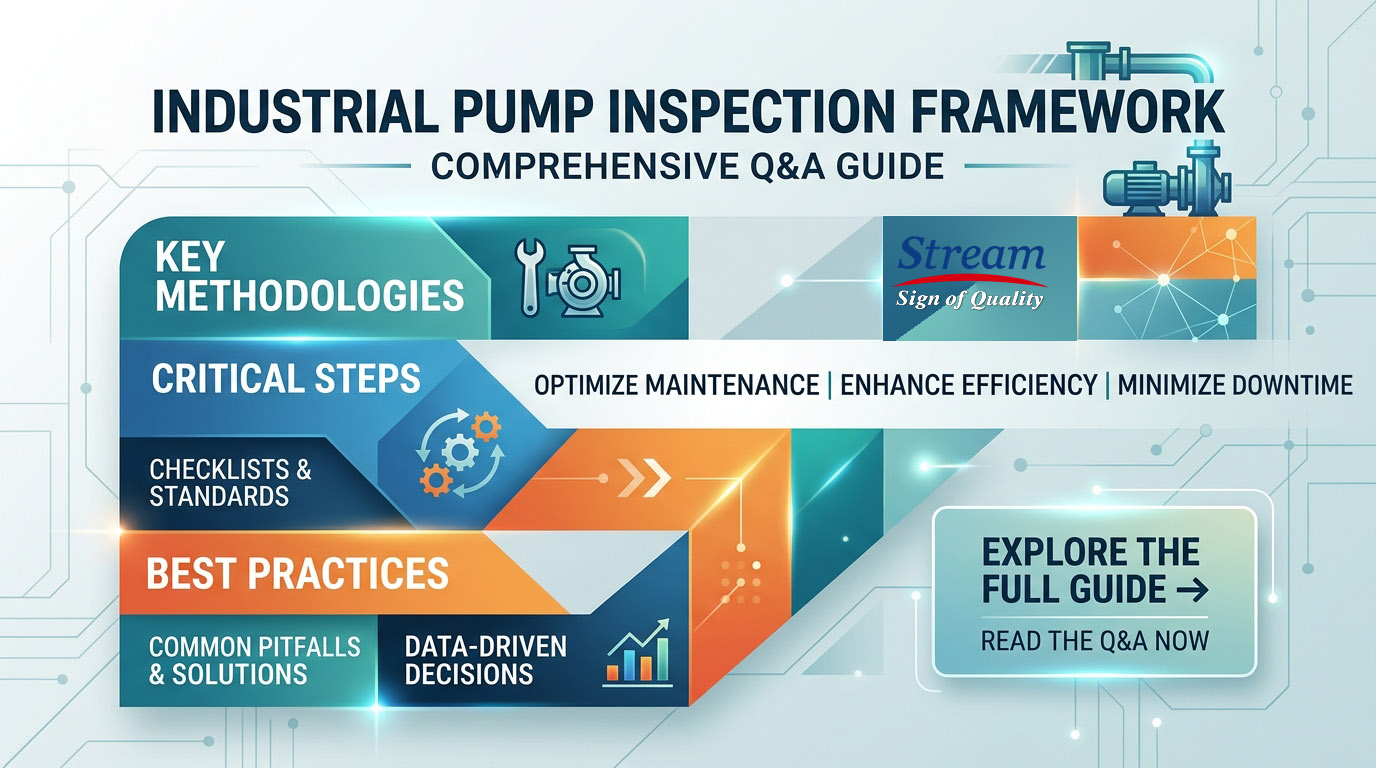
Mastering this industrial pump maintenance framework helps teams catch common failure signals early, reduce unplanned downtime, and control repair costs before minor issues escalate into major outages. It gives you a practical structure for setting inspection intervals, prioritizing maintenance actions, and understanding the service risks associated with different pump types. Use the linked sections throughout this guide to drill into detailed overhaul procedures, inspection standards, acceptance criteria, and pump-specific maintenance requirements.
Industrial facilities depend on the stable operation of pumping systems across production, utilities, water handling, HVAC, and process support applications. When maintenance is deferred until failure occurs, the result is typically increased downtime, unplanned parts replacement, collateral equipment damage, and higher operating cost. For this reason, a planned preventative maintenance strategy remains the standard basis for pump reliability management.
From a lifecycle perspective, pump ownership cost extends well beyond initial procurement. Energy use, routine servicing, wear-part replacement, efficiency loss, and emergency repair events all contribute to Total Cost of Ownership (TCO). A pump that operates outside its intended range, or one that continues in service with progressive wear, often consumes more power while moving closer to functional failure.
Mastering this inspection framework helps maintenance teams avoid most unexpected downtime traps, standardize preventive actions, and make faster repair decisions across end-suction pumps, multistage pumps, circulation pumps, and submersible pumps. It highlights the critical checks, failure points, and service priorities that have the biggest impact on reliability and operating cost. For detailed maintenance standards, disassembly steps, fault analysis, inspection tolerances, and model-specific repair procedures, use the linked guides throughout this article.[Internal Link Placeholder: Detailed guide to pump categories and applications]**[Internal Link Placeholder: Detailed guide to pump maintenance standards and inspection intervals]
Daily inspection forms the first layer of a preventative maintenance system. At this level, the objective is not major disassembly, but early identification of visible, audible, and operational abnormalities.
These routine checks apply broadly to both surface-installed and submerged units, although the specific inspection method may vary by equipment configuration.
A daily visual review should confirm general external condition, leakage status, and installation stability. On end-suction and circulation pumps, seals, packing areas, flange joints, drain points, and baseplates should be checked for leakage or residue. Some packed arrangements may permit slight leakage as part of normal operation, while mechanical seals should be evaluated against the manufacturer's allowable standard.
The presence of pooled liquid, staining, or residue around the pump base may indicate seal deterioration, gasket failure, or connection looseness. Early identification is important because leakage can migrate into bearing housings, couplings, or nearby structural areas.
[Internal Link Placeholder: Mechanical seal inspection and replacement standard]
[Internal Link Placeholder: Pump leakage diagnosis reference]
Routine listening and vibration awareness are basic but effective diagnostic practices. Operators should note unusual sounds such as cavitation noise, bearing roughness, grinding, intermittent rattling, or hydraulic instability. These symptoms do not by themselves provide full root-cause confirmation, but they often indicate the need for secondary inspection.
Where vibration monitoring instruments are available, readings should be logged according to site standard. Where formal instrumentation is not yet in use, operator observation still provides useful screening value.
[Internal Link Placeholder: Cavitation causes and corrective actions]
[Internal Link Placeholder: Bearing fault identification guide]
[Internal Link Placeholder: Pump vibration limits and evaluation criteria]
Daily operating data should be recorded as part of standard equipment history. Typical entries include suction pressure, discharge pressure, flow indication where available, motor current, operating temperature, and alarm status. These values should be compared against baseline operating conditions, equipment nameplate data, and the applicable performance curve.
The purpose of daily logging is trend recognition. A pump rarely moves from normal condition to complete failure without warning. In many cases, declining hydraulic performance, rising power draw, or increasing vibration develops gradually over time.
[Internal Link Placeholder: How to read a pump performance curve]
[Internal Link Placeholder: Best Efficiency Point (BEP) overview]
Monthly inspection should go beyond visual confirmation and focus on condition verification of key wear-related systems.
At this interval, attention is typically directed to lubrication quality, temperature behavior, alarm records, and developing mechanical or electrical risk indicators.
For centrifugal and end-suction pumps with rolling-element bearings, lubrication condition is a primary maintenance factor. Oil-lubricated housings should be checked for level, clarity, contamination, and evidence of water ingress. Grease-lubricated arrangements should be reviewed for over-greasing, contamination, and compatibility with the specified lubricant type.
This overview does not replace the manufacturer's lubrication schedule. Final service intervals, lubricant grades, and replenishment volumes must always be verified against the equipment manual and site standard.
[Internal Link Placeholder: Bearing lubrication standard for industrial pumps]
[Internal Link Placeholder: Common bearing housing failures]
Temperature review helps identify friction, overload, lubrication deficiency, or electrical stress. Monthly checks may include bearing housing temperature, motor surface temperature, and thermal comparison between similar assets. Infrared thermometers or thermal imaging tools are commonly used for this purpose.
Trend values are generally more useful than isolated readings. A temperature increase over time may justify inspection even if the equipment remains operational.
[Internal Link Placeholder: Thermal inspection procedure for pumps and motors]
Submersible pumps require a different diagnostic approach because many critical components are not directly visible during normal operation. Monthly review should therefore include control panel alarm history, seal leakage indication, moisture sensor status, insulation monitoring where fitted, and cable entry condition.
Many submersible units use conductive probes or moisture detection systems in the oil chamber. An alarm event may indicate outer seal degradation and should be treated as an early intervention point rather than a minor nuisance warning.
[Internal Link Placeholder: Submersible pump seal failure indicators]
[Internal Link Placeholder: Submersible pump control panel alarm reference]
Annual maintenance typically transitions from routine observation to planned intervention. Depending on criticality, operating hours, medium handled, and OEM requirements, this interval may include alignment verification, insulation testing, clearance inspection, internal cleaning, and selective teardown.
This section provides a framework only. Detailed procedures, tolerances, acceptance limits, and repair standards should be handled in dedicated equipment-specific articles.
Annual service for end-suction and general centrifugal pumps commonly includes alignment verification, coupling inspection, fastener review, seal assessment, bearing evaluation, and hydraulic component inspection as required. Laser alignment is often preferred where precision is necessary, especially after thermal movement, pipe strain, or base settling.
Where performance loss is observed, further inspection may include impeller wear, casing wear, shaft sleeve condition, and seal chamber review.
[Internal Link Placeholder: End-suction pump overhaul procedure]
[Internal Link Placeholder: Laser alignment standard for pump-motor sets]
Annual submersible pump maintenance often centers on electrical integrity, sealing condition, and cable system reliability. Insulation resistance testing, commonly performed with a Megger, is a standard method for assessing winding insulation health. Depending on the equipment and operating environment, additional checks may include cable jacket inspection, chamber oil condition review, sensor testing, and motor resistance comparison.
If insulation degradation is detected early, corrective planning may be possible before complete motor failure occurs.
[Internal Link Placeholder: Megger test procedure for submersible pumps]
[Internal Link Placeholder: Submersible motor inspection standards]
Multistage pumps depend on close internal clearances to maintain pressure and volumetric efficiency. Annual overhaul planning may include wear ring measurement, stage component inspection, shaft condition review, bushing examination, and internal recirculation analysis if efficiency decline has been reported.
Because allowable clearance limits vary by design and manufacturer, repair decisions should be checked against dedicated tolerance references and the applicable pump standard. For example, multistage pump wear ring and internal stage clearances are often controlled within tight limits, and API 610 applications typically follow strict tolerance requirements because excessive clearance can increase internal recirculation, reduce developed head, and lower efficiency. In submersible pump work, insulation resistance is also a practical screening value during maintenance; a 500V megger test is commonly used, and many technicians treat 100 megohms or higher as a strong indicator of dry, healthy insulation, subject to OEM and site criteria.[Internal Link Placeholder: Multistage pump wear ring clearance standards]**[Internal Link Placeholder: Multistage pump disassembly and inspection guide]
Circulation pumps used in HVAC or process loops should be reviewed as part of both pump maintenance and system maintenance. Annual work may include strainer cleaning, check-valve inspection, coupling review where applicable, motor verification, and loop cleanliness assessment. In systems with ongoing fouling, flushing and debris removal may be required to protect impellers and preserve flow.
In these applications, the pump cannot be evaluated in isolation. System-side restrictions, water quality, and loop contamination often influence service life and performance.
[Internal Link Placeholder: Circulation pump maintenance guide]
[Internal Link Placeholder: Closed-loop flushing and cleaning standard]
A pump maintenance program should include a centralized documentation method. This may take the form of a physical inspection record, a digital log sheet, or a Computerized Maintenance Management System (CMMS). The format may vary, but the purpose remains the same: preserve operating history, inspection findings, and maintenance actions in a way that supports trend analysis and planning.
Typical records may include:
· Asset identification and service location
· Pump type and duty classification
· Daily operating readings
· Monthly condition observations
· Alarm history
· Lubrication records
· Alignment records
· Electrical test values
· Parts replaced
· Planned follow-up actions
When records are maintained consistently, maintenance personnel can identify gradual deterioration patterns that may not be obvious during a single shift or isolated inspection.
[Internal Link Placeholder: Pump maintenance log template]
[Internal Link Placeholder: CMMS setup guide for rotating equipment]
This overview is intended to support a wider maintenance reference library. The following article types can be developed as standalone resources and linked from the sections above:
· End-suction pump inspection and overhaul standard
· Multistage pump clearance inspection standard
· Submersible pump electrical testing and seal inspection guide
· Circulation pump service checklist and system-side inspection guide
· Mechanical seal failure analysis reference
· Pump bearing lubrication and replacement standard
· Cavitation diagnosis and corrective action guide
· Pump alignment procedure and tolerances
· Pump maintenance log templates and recordkeeping standards
This structure allows the present article to remain a high-level reference while more technical procedures are documented separately.
[Internal Link Placeholder: Main pump maintenance knowledge hub]
Whether the equipment is a high-pressure multistage boiler feed pump, a general centrifugal process pump, a circulation pump in a closed loop, or a submersible wastewater unit, maintenance reliability depends on a structured approach. Daily checks, monthly diagnostics, and annual planned intervention together form the basic inspection framework.
This article should be used as an entry-point reference rather than a complete repair standard. As additional articles are developed, internal links can be added to each pump category, maintenance task, and inspection criterion referenced here. In that way, the document serves as a maintenance manual overview or encyclopedia index for broader pump service content.
Previous: None
Address
No.17 XeDa Jimei Ind. Park, Xiqing Economic Development Area, Tianjin, China
Telephone
+86 13816508465
QUICK LINKS