+86 13816508465
Pump Knowledge
Apr. 23, 2026
When examining industrial vertical pumps, the spotlight usually falls on the powerful motors that drive them or the highly engineered impellers that move the fluid. These components are highly visible and easy to understand. They generate the force and execute the physical movement required to transfer thousands of gallons of water, chemicals, or slurries every minute.
However, hidden deep within the casing of a vertical turbine pump lies a component that rarely gets the credit it deserves. Without this vital part, the massive power generated by the motor would quickly tear the entire system apart. This hidden protector is the guide bearing.
A pump is a finely tuned machine that relies on perfect alignment and stability to function over long periods. As industrial pump maintenance becomes increasingly focused on preventing catastrophic failures before they happen, understanding the internal mechanisms that keep a pump running smoothly is absolutely essential.
This article will explore what guide bearings are, how they function, and why they are absolutely critical for pump longevity. We will also review the different types of lubrication systems, common materials used in their construction, and how maintenance engineers can spot the early warning signs of bearing failure.
To understand the function of a guide bearing, you must first look at the physical reality of vertical long-shaft pumps and deep well turbine pumps. These massive industrial machines feature a unique design: the motor sits securely at the top of the assembly, well above the fluid level, while the pumping elements (the impellers) are submerged deep below.
Connecting the motor at the surface to the impellers at the bottom is a very long transmission shaft. Depending on the application, this shaft can extend tens or even hundreds of feet downward.
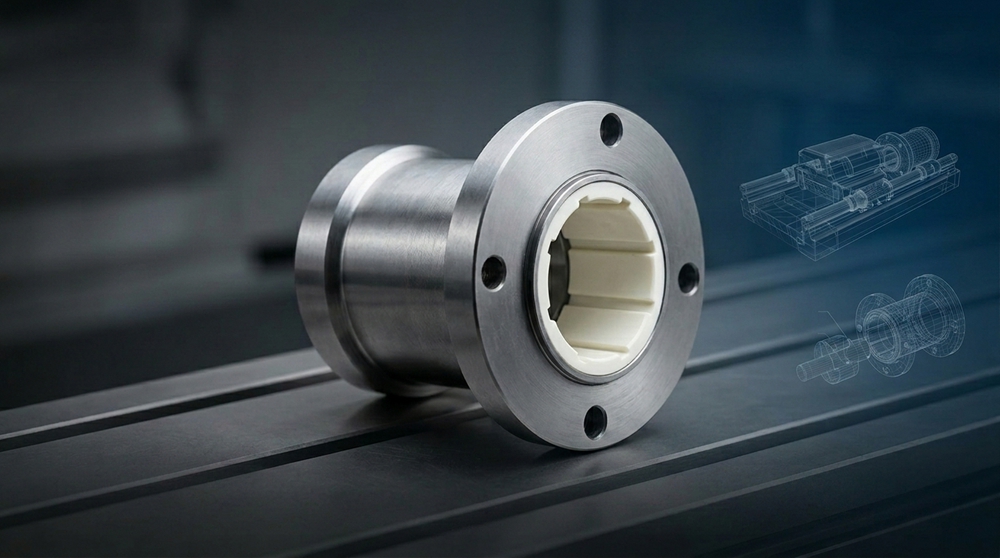
A guide bearing—frequently referred to as a line shaft bearing—is a specialized radial support mechanism. It is designed to surround this long transmission shaft at regular, calculated intervals along its entire length. Instead of supporting the weight of the shaft (which is the job of the thrust bearing at the top), the guide bearing restricts side-to-side movement.
By hugging the shaft at these crucial intervals, the guide bearing acts as a steadying hand. It keeps the rotating shaft perfectly plumb and centered within the stationary outer column pipe, ensuring smooth power transmission from the surface motor down to the submerged impellers.
Operating a vertical turbine pump involves tremendous kinetic energy. The central shaft spins at high speeds, often exceeding 1,500 to 3,000 revolutions per minute. To understand what happens to a long, rapidly spinning shaft without adequate support, think of a long bullwhip. If you spin a short, stiff rod, it stays straight. But if you try to spin a long, flexible whip from one end, the middle will bow outward, thrashing wildly.
This same physical phenomenon applies to industrial pump shafts. Guide bearings mitigate these extreme physical forces in three primary ways:
Without the support of line shaft bearings, the high-speed rotation causes the long metal shaft to bend, bow, and whip outward due to centrifugal force. This shaft deflection creates violent pump vibration that can quickly shatter couplings, snap the shaft, or destroy the surrounding casing. The bearings hold the shaft tight, breaking up its length into shorter, perfectly stable sections that cannot bow outward.
Clearances inside a high-efficiency pump are incredibly tight. The rotating impellers sit just fractions of an inch away from the stationary pump bowls. The guide bearing keeps the shaft perfectly centered, ensuring there is absolutely no metal-to-metal contact between the rotating and stationary components. If the shaft were allowed to drift even slightly off-center, the impeller would scrape against the casing, causing immediate and severe mechanical damage.
While pumping fluids, water pressure builds unevenly inside the casing, creating strong side-to-side forces known as radial loads. These loads push against the impellers and the shaft. Guide bearings absorb these lateral forces, distributing the stress evenly and protecting the main thrust bearings at the motor from taking on damaging side loads.
Because the guide bearing sits in direct contact with a shaft spinning at high speeds, it generates friction. To prevent the bearing and the shaft from melting or wearing down, they require constant lubrication. Vertical pumps generally utilize one of two main lubrication methods, depending entirely on the type of fluid being moved.
In a water-lubricated bearing system, the pump utilizes the very fluid it is pumping to cool and lubricate the bearings. The shaft and bearings are "open" to the water flowing up through the column pipe.
This method is highly eco-friendly because there is no risk of oil or grease leaking into the water supply. It is the standard choice for drinking water wells, municipal water supplies, and clean cooling tower applications. However, because it relies on the pumped fluid, the water must be relatively clean and free of abrasive particles that could chew up the bearing surfaces.
When a pump is tasked with moving abrasive fluids—such as sand-heavy well water, agricultural runoff, or industrial slurries—water lubrication is no longer viable. The grit in the water would quickly destroy the bearings.
To solve this, engineers use an enclosed line shaft design. The transmission shaft and the guide bearings are housed inside a protective inner tube. This inner tube isolates the spinning components from the abrasive pumped fluid outside. The tube is then filled with a continuous drip of oil or packed with grease, providing clean, reliable lubrication to the bearings regardless of how dirty the main fluid is.
The operational environment dictates the material construction of a line shaft bearing. Manufacturers select materials based on the lubrication method, the abrasiveness of the fluid, and the operating temperatures.
·Rubber: Rubber is the most common choice for water-lubricated, clean water applications. It is naturally slick when wet, highly cost-effective, and possesses excellent shock-absorbing qualities. Fluted rubber bearings do a fantastic job of dampening pump vibration and keeping the shaft running quietly.
·Bronze: Bronze is a tough, highly durable metal alloy. It is the go-to material for oil-lubricated systems. Bronze bearings can withstand heavy duty cycles and high lateral loads, making them ideal for deep agricultural wells and heavy industrial applications where the shaft is enclosed and constantly bathed in clean oil.
·Advanced Engineering Plastics: Materials like PTFE (Teflon) and proprietary composites like Thordon offer superior wear resistance and incredibly low friction coefficients. These advanced plastics are often used in specialized applications because they can handle dry starts (running for a few seconds before the water reaches them) and offer excellent resistance to harsh chemicals or mildly abrasive environments.
For maintenance engineers and pump operators, catching a failing guide bearing early is the difference between a routine repair and a catastrophic system failure. Because these components are hidden deep inside the pump column, you must rely on external symptoms to diagnose internal wear.
Excessive Pump Vibration: This is almost always the first indicator. As the bearing wears down, the internal clearance opens up, allowing the shaft to rattle back and forth. If you place a vibration analysis tool on the pump head and notice a sudden spike in horizontal velocity, a line shaft bearing is likely failing.
Loud Grinding or Rattling Noises: A healthy vertical turbine pump produces a smooth, consistent hum. If you begin to hear metallic rattling, rhythmic clanking, or harsh grinding noises echoing up through the column pipe, the shaft is likely deflecting and making contact with the bearing housings or the casing itself.
Decreased Efficiency and Increased Power Consumption: As the bearing fails and the shaft begins to wobble, the motor has to work significantly harder to keep the system spinning. If your amp draw increases unexpectedly while your flow rate or discharge pressure drops, the internal friction caused by a failing bearing could be the culprit.
While they may never be the most glamorous part of the system, guide bearings are undeniably the unsung heroes of industrial pumping. By preventing violent shaft deflection, maintaining precise alignment, and absorbing harsh radial loads, these simple support mechanisms prevent vertical pumps from destroying themselves from the inside out.
Choosing the right lubrication system and bearing material for your specific application is critical to maximizing the lifespan of your equipment and keeping industrial pump maintenance costs under control.
At Stream Pumps, we understand that reliability is everything. Stream Pumps designs high-performance vertical and multistage pumps using premium guide bearing materials tailored exactly to your operating environment. Whether you need water-lubricated systems for municipal water or heavy-duty enclosed line shafts for abrasive industrial fluids, we engineer our pumps to ensure maximum stability and minimal downtime. Contact Stream Pumps today to discuss custom industrial pumping solutions built to last.
Address
No.17 XeDa Jimei Ind. Park, Xiqing Economic Development Area, Tianjin, China
Telephone
+86 13816508465
QUICK LINKS