+86 13816508465
May. 20, 2026
Modern industrial submersible sewage pumps provide incredible versatility for complex municipal and industrial engineering projects. Gone are the days when a single mounting configuration had to be forced into every operational environment. Today, engineers can adapt pump placements to fit the precise hydraulic, spatial, and safety requirements of the site.
Selecting the correct submersible sewage pump installation method is a critical step in wastewater pump station design. The decision between a wet pit configuration and a dry pit setup directly impacts the long-term reliability of the system, the overall efficiency of the pump station, and the day-to-day safety of maintenance personnel. An incorrect installation choice can lead to premature motor failure, complex repair procedures, and severe safety hazards.
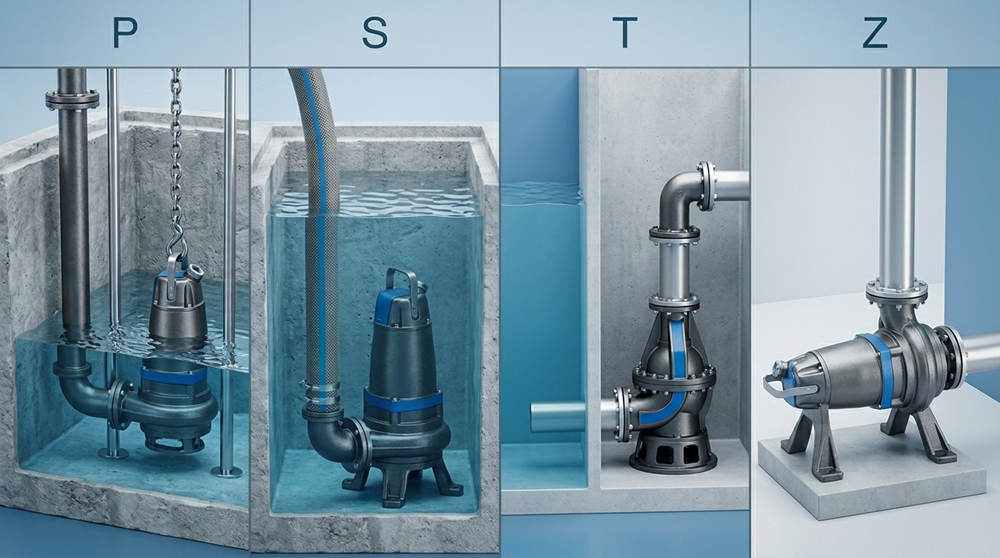
To help municipal wastewater engineers, pump station designers, and industrial contractors make informed decisions, we will break down the four primary installation methods: P, S, T, and Z. Understanding the specific mechanical requirements and operational advantages of each configuration ensures that your pumping system operates safely and efficiently for years to come.
The P-installation method is a semi-permanent, submerged configuration that has become the industry standard for traditional wastewater applications. In this setup, the pump operates entirely underwater within the sump or wet pit.
The defining feature of this method is the wet pit auto-coupling system. This mechanism relies on a twin guide bar configuration securely anchored to the bottom of the pit and attached to an upper bracket near the access hatch. The pump is fitted with a specialized sliding bracket that allows it to travel smoothly down the guide bars. Once it reaches the base, the weight of the pump automatically locks it into the discharge connection, creating a secure, leak-proof seal without the need for manual bolting.
The primary engineering advantage of the P-installation is maintenance safety. When routine inspections or repairs are required, maintenance crews can simply hoist the pump up the guide bars using a crane or lifting chain. Workers can extract, service, and reinstall the heavy machinery without ever entering the hazardous, toxic environment of the wet pit. This dramatically reduces the risk of exposure to dangerous gases and eliminates the need for complex confined-space entry protocols.
When operational agility is the priority, the S-installation method provides a freestanding, portable solution. Like the P-installation, this setup is fully submerged in wastewater. However, instead of utilizing a fixed auto-coupling base, the pump rests directly on the floor of the sump using a specialized stand or ring base to maintain stability and proper suction clearance.
Because it is not anchored to permanent infrastructure, the discharge connection is typically handled via a flexible hose coupling or a temporary rigid flange. This makes the portable installation highly adaptable to rapidly changing environments.
Industrial contractors frequently rely on the S-installation for temporary dewatering tasks, active construction sites, and emergency flood relief operations. Furthermore, it is the ideal configuration for facilities where pumps must be moved frequently between different sumps or temporary holding tanks. The ability to deploy a high-capacity pump at a moment's notice makes the portable setup an indispensable tool for emergency response and dynamic project sites.
The T-installation method shifts the equipment out of the wastewater entirely, functioning as a permanent, vertical installation within a dry pit. In this configuration, the pump is bolted directly to suction and discharge piping via rigid flanges, and the motor remains entirely separate from the fluid it is pumping.
Because the unit operates in the open air rather than being submerged in cold wastewater, engineers must account for motor heat dissipation. A standard submersible motor will quickly overheat if run continuously in a dry environment. Therefore, any dry pit submersible pump must be equipped with a closed-loop submersible pump cooling jacket. This system circulates a cooling medium—often the pumped fluid itself or a separate glycol mixture—around the motor housing, ensuring thermal stability during continuous heavy-duty operation.
The T-installation offers a significant operational advantage: easy dry access. Maintenance personnel can inspect flanges, check vibration levels, and perform routine servicing in a clean, dry, well-lit room. At the same time, because the motor retains its fully sealed, submersible housing, the system provides flood-proof reliability. If a pipe bursts or the dry pit accidentally floods, the pump will continue to operate flawlessly, preventing catastrophic station failure.
The Z-installation method shares the same fundamental engineering principles as the T-installation but orientates the equipment horizontally. The pump is permanently mounted on a robust metal support frame within a dry pit, connecting to horizontal suction and discharge pipes.
Just like the vertical dry setup, the Z-installation operates in ambient air and absolutely requires a submersible pump cooling jacket to manage the thermal load generated by the motor. The completely sealed submersible motor ensures that the pump remains fully operational even if the dry chamber experiences sudden inundation.
The specific engineering use case for the Z-installation revolves around spatial limitations. It is the perfect solution for dry pump stations with restricted vertical headroom. When a facility features low ceilings or existing overhead pipework that prevents the installation of a towering vertical pump, the horizontal footprint of the Z-installation delivers the necessary pumping power without requiring costly architectural modifications to the station itself.
Selecting the ideal pump installation method requires a thorough evaluation of your site's physical dimensions, safety protocols, and operational goals. The P and S methods provide exceptional solutions for wet applications, focusing on automated retrieval safety and portable flexibility. Conversely, the T and Z methods deliver the accessibility of dry-pit maintenance combined with the ultimate fail-safe of submersible motor technology.
Every wastewater facility presents unique engineering challenges. To ensure you select the correct installation type and the appropriate cooling jacket configuration for your next project, our engineering team is ready to assist. Contact the Stream Pumps technical department today to optimize your pump station design for maximum efficiency and long-term reliability.
Address
No.17 XeDa Jimei Ind. Park, Xiqing Economic Development Area, Tianjin, China
Telephone
+86 13816508465
QUICK LINKS