+86 13816508465
Pump Knowledge
Jan. 25, 2026
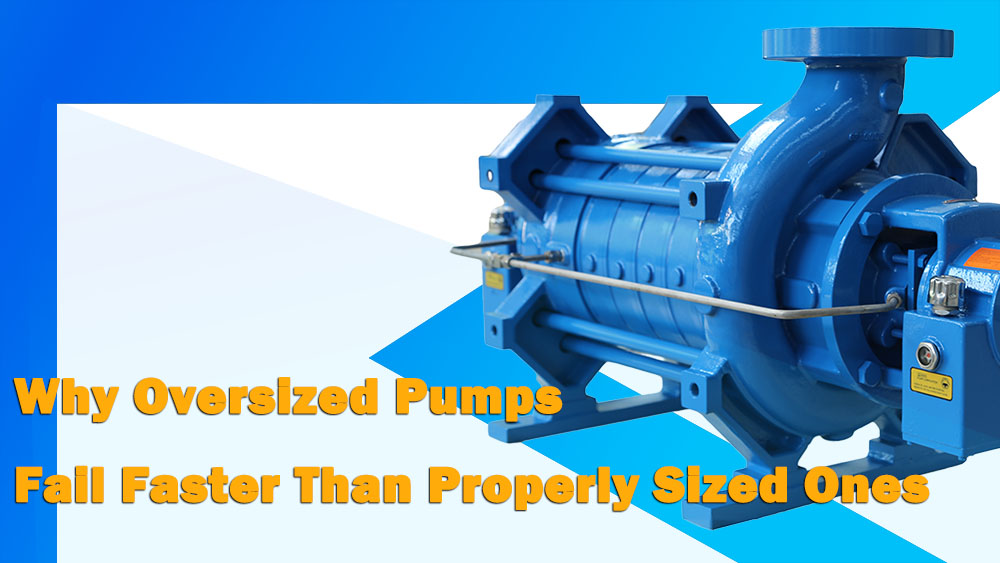
In the world of industrial equipment, there's a pervasive belief that [bigger is better.] It seems logical to build in a safety margin, especially with critical assets like pumps. Engineers, wanting to ensure they meet system head requirements under all conditions, often select a pump that exceeds the calculated need. This conservative approach, however, is a primary cause of poor pump reliability. An oversized pump is not a safety net; it is a liability that actively works against your operational goals.This article will explain the science behind why a precisely sized pump outperforms and outlasts an oversized one. We will explore the mechanical and hydraulic forces that turn a powerful, oversized pump into a constant source of maintenance headaches and financial strain.
The Science of the [Sweet Spot]: Understanding BEP
Every centrifugal pump has a [Best Efficiency Point,] or BEP. This is the single point on its performance curve where the pump operates at its highest efficiency, converting the most energy from the motor into fluid movement. Think of it like a custom-fitted suit; it's designed to perform perfectly under a specific set of conditions. When the pump operates at its BEP, it runs smoothly, quietly, and with minimal internal stress.Now, consider what happens when you drive a manual car in the wrong gear. If you're in fifth gear while trying to climb a steep hill slowly, the engine lugs, strains, and vibrates. The car is not operating efficiently. An oversized pump forced to run at a lower flow rate than it was designed for experiences a similar struggle. This condition is known as operating [to the left of the curve.] Instead of running in its sweet spot, the pump is throttled back, creating a mismatch between its design and the system's actual demand. This mismatch is the root cause of destructive internal forces.
The Mechanical Killer: Radial Loads and Shaft Deflection
When a pump operates away from its BEP, the pressure distribution inside the volute (the pump casing) becomes uneven. For an oversized pump running at low flow, this imbalance creates a powerful, sideways force on the impeller. This force is known as a high [Radial Load.]This immense radial load pushes the impeller and the attached shaft to one side, causing the shaft to bend. This bending, or [Shaft Deflection,] might only be a few thousandths of an inch, but it is a mechanical killer. It unleashes a domino effect of component failure, drastically reducing the pump's Mean Time Between Failure (MTBF).The components that suffer most from shaft deflection include:
· Mechanical Seals: As the shaft deflects, it causes the meticulously flat and parallel faces of the mechanical seal to open and close with every rotation. This allows contaminants in, lets product out, and quickly destroys the seal faces. This is the number one cause of pump failure and downtime in many facilities.
· Bearings: The high radial load is transferred directly to the pump's bearings. This force far exceeds the load the bearings were designed to handle, leading to rapid wear and premature failure.
· Wear Rings: Shaft deflection can cause the impeller's wear rings to make contact with the stationary casing wear rings. This rubbing generates heat, creates vibrations, and accelerates wear, reducing pump efficiency and requiring costly repairs.
Hydraulic Instability: Recirculation and Cavitation
Oversizing a pump doesn't just cause mechanical problems; it also creates severe hydraulic instability. When the pump's capacity is much greater than the system's flow rate, the fluid can't move through the pump smoothly. It begins to stall and churn within the impeller vanes, a phenomenon called [Recirculation.]There are two primary types: [Suction Recirculation,] which occurs at the impeller inlet, and [Discharge Recirculation,] which happens at the outlet. This internal turbulence is highly destructive. It can create intense, localized pressure drops that cause the liquid to vaporize, forming small bubbles. As these bubbles move to an area of higher pressure, they collapse violently.This process is known as [Low-Flow Cavitation.] The collapse of these vapor bubbles releases significant energy, which acts like a micro-jet, blasting away small pieces of the impeller material. Over time, this results in pitting and erosion, primarily on the pressure side of the impeller vanes. The audible signs of this damage are unmistakable: severe vibration and a noise often described as pumping gravel.
The Hidden Costs: Energy and Maintenance
The immediate impact of premature component failure is clear, but the long-term financial consequences are even more significant. An oversized pump's Life Cycle Cost (LCC) is substantially higher than that of a correctly sized one.First, there is the issue of energy consumption. Larger pumps require larger motors. When a large motor is forced to operate at a partial load to accommodate a throttled system, its efficiency drops significantly. A large portion of the electricity you pay for is wasted as heat instead of being used to move fluid. Over the lifetime of a pump, this energy waste can add up to a considerable sum.Second, the maintenance costs are relentless. The cycle of replacing mechanical seals, changing out bearings, and repairing impellers leads to high direct costs for parts and labor. More importantly, it results in frequent and unplanned downtime, which can halt production and lead to massive revenue losses. The expenses associated with repeated repairs and lost production often dwarf the initial cost of the pump itself.
Conclusion: Precision Over Power
The evidence is clear: oversizing a pump is a costly mistake. It creates a cascade of mechanical and hydraulic problems that lead to a shorter operational lifespan, higher energy bills, and constant maintenance headaches. True reliability comes from precision, not from brute force. A pump that is perfectly matched to its system's requirements will run efficiently and dependably for years.Stop guessing on your system requirements and settling for a pump that is [close enough.] Take the time to ensure you get the perfect fit for your application.Contact Stream Pumps today for a professional system curve analysis. Our experts will help you select a pump that operates at its Best Efficiency Point, maximizing reliability and minimizing your total cost of ownership.
Address
No.17 XeDa Jimei Ind. Park, Xiqing Economic Development Area, Tianjin, China
Telephone
+86 13816508465
QUICK LINKS