+86 13816508465
Pump Knowledge
May. 20, 2026
The initial purchase price of a sewage pump represents just a fraction of its total lifecycle cost. When a pump clogs, the true financial impact becomes painfully apparent. Facility managers and municipal engineers know that catastrophic failures lead to expensive unplanned downtime, emergency maintenance labor at premium rates, and the looming threat of environmental fines for sanitary sewer overflows.
Modern wastewater is highly unpredictable. The influx of synthetic fibers, plastics, and so-called [flushable] wipes creates an incredibly hostile environment for standard pumping equipment. To maintain operational efficiency and prevent sewage pump clogging, engineers must rethink their approach to solid handling. You cannot rely on outdated infrastructure to handle contemporary waste streams without facing severe financial penalties.
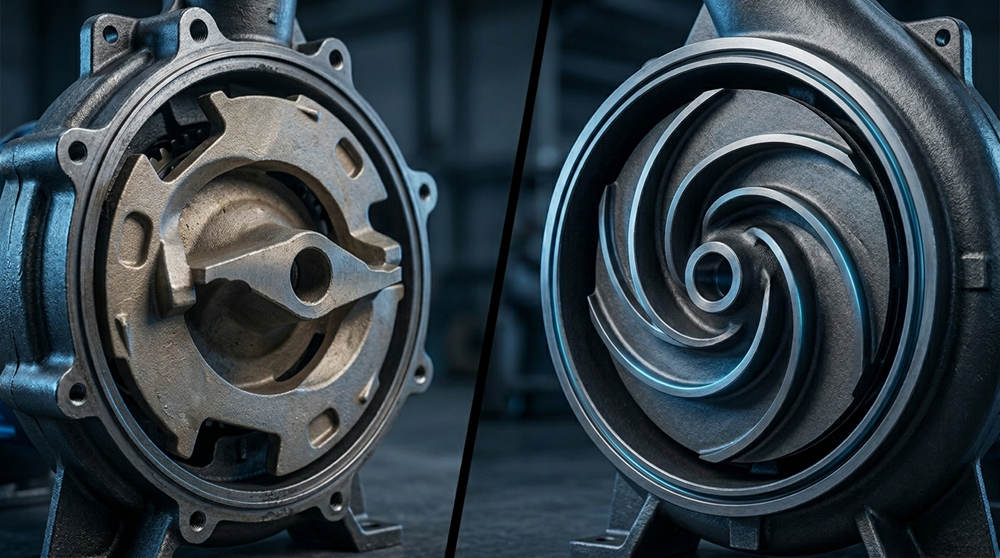
Solving this persistent issue comes down to choosing between two ultimate engineering solutions: passing the solids or destroying them. The debate of a grinder pump vs non-clog pump is central to modern wastewater management. Understanding the mechanical differences and strategic applications of each technology will dictate the long-term reliability and profitability of your entire system.
Engineering philosophies differ significantly when it comes to managing heavy solids. By examining the mechanics behind these two distinct pump categories, contractors and system designers can make highly informed, ROI-driven decisions.
The non-clog, or large solid passage submersible sewage pump, operates on a principle of unobstructed flow. Instead of fighting the debris, it allows the material to pass entirely unhindered. This is primarily achieved through a recessed vortex impeller design.
Because the impeller sits far back in the volute, a powerful whirlpool effect is generated. This vortex physically pulls the wastewater and its suspended solids through the casing and out the discharge pipe without the debris ever making direct contact with the impeller blades. Soft solids, heavy industrial debris, and large organic matter simply flow through the [highway.] By minimizing mechanical contact, this design dramatically reduces wear and tear on the pump's internal components, resulting in a significantly extended operational lifespan and lower long-term maintenance costs.
When debris is too tough or fibrous to pass through the system safely, you must destroy it. A cutter pump for wastewater takes an aggressive, proactive approach. Positioned directly at the suction inlet, a high-hardness cutting mechanism intercepts incoming solids before they can reach the impeller.
This mechanism acts as a heavy-duty shredder. It captures long synthetic fibers, durable plastics, and tightly woven wipes, macerating them into a fine, manageable slurry. Once the solids are reduced to this granular state, the pump easily pressurizes and moves the fluid through the discharge network. This prevents stringy materials from wrapping around the impeller shaft—a primary cause of motor burnout in standard pumps.
Selecting the correct pump requires matching the technology directly to the challenges of the project environment. Deploying the wrong solution will inevitably lead to systemic failure and compromised ROI.
Massive flow rates and large pipe diameters characterize municipal wastewater treatment plants and heavy industrial facilities. In these environments, the sheer volume of water is substantial, and the debris can be highly variable in size. A large solid passage submersible sewage pump is the optimal choice here. These facilities typically have the infrastructure, specifically wide-diameter piping, to transport large, unbroken solids safely. The vortex design handles the massive throughput with exceptional efficiency and minimal risk of blockage.
Commercial buildings, healthcare facilities, and hospitality venues face a very specific, aggressive threat: fibrous consumer waste. The volume of paper towels, synthetic sanitary products, and flushable wipes flushed down these drains is staggering. Standard pumps will choke on this fibrous mass within days. Therefore, grinder and cutter pumps are strongly recommended. By macerating this tough waste into a fine slurry at the source, facility managers can effectively prevent sewage pump clogging and avoid the nightmare of raw sewage backing up into guest rooms or sterile medical environments.
For infrastructure upgrades, particularly in expanding residential areas or retrofitting older systems, the financial math heavily favors grinder pumps. Pressure sewer systems rely on moving wastewater over long distances and varied elevations. By utilizing a grinder pump to reduce solids to a fine slurry, engineers can utilize much smaller-diameter discharge pipes. Laying smaller piping drastically reduces the heavy excavation, trenching, and material costs associated with traditional gravity sewer lines. The capital expenditure saved on infrastructure installation far outweighs the cost of the grinder pump units, delivering an immediate and highly attractive ROI.
Buying a commercial pump based solely on head and flow curves is a dangerous mistake. To guarantee reliability and protect your investment, your purchasing checklist must evaluate the specific engineering tolerances of the equipment.
A grinder pump is completely useless the moment its blade goes dull. When a cutter loses its edge, it stops shredding and starts pulling, which quickly jams the mechanism and burns out the motor. Demand premium materials for the cutting interface. High-hardness martensitic stainless steel or advanced tungsten carbide—like the materials utilized in Stream Pumps—are mandatory. These alloys maintain their sharp cutting edges even after thousands of hours of grinding abrasive, tough materials, ensuring uninterrupted service.
When specifying a non-clog pump, vague marketing terms like [heavy duty] are insufficient. You must specify the exact spherical solid diameter the pump is engineered to pass. Whether your system requires a 50mm, 80mm, or larger passage clearance, verify that the pump's internal geometry is rated for that precise diameter. This guarantees that any solid capable of entering the suction port will successfully exit the discharge port without bridging or jamming.
Reliable B2B pumps must be equipped with comprehensive internal diagnostics to prevent catastrophic failure. Demand thermal overload sensors, such as PT100 thermistors, embedded directly in the motor windings to shut down the unit before it overheats. Additionally, moisture and leakage probes within the oil chamber and motor housing are critical. These sensors provide an early warning system, alerting maintenance teams to a compromised mechanical seal before highly conductive wastewater can destroy the electrical stator.
Even the most robust engineering requires consistent, intelligent maintenance to deliver decades of peak performance. Adhering to a strict preventative maintenance schedule keeps OPEX low and efficiency high.
For grinder and cutter pumps, the most critical maintenance task is regularly checking the cutter clearance. The gap between the rotating blade and the stationary cutting ring must remain tight. If this clearance becomes too wide due to wear, the mechanism will attempt to drag and fold fibrous materials into the gap instead of cleanly slicing them. This will result in a hard jam. Calibrate and adjust this clearance according to the manufacturer's exact specifications.
For all submersible pumps, routine oil chamber inspections are non-negotiable. The oil acts as a barrier and lubricant for the mechanical seals. Maintenance technicians must regularly draw an oil sample to check for water emulsion. If the oil appears milky or discolored, it indicates that the primary mechanical seal is failing and allowing wastewater to ingress. Replacing a mechanical seal early is a minor maintenance task; ignoring it results in a flooded motor and a total pump replacement.
Ultimately, in the debate of the grinder pump vs non-clog pump, there is no inherently wrong pump—there is only the wrong application. Choosing the right engineering philosophy for your specific waste stream is the only way to guarantee a reliable, clog-free operation.
Stream Pumps provides an extensive, heavy-duty lineup featuring both advanced Vortex non-clog models and high-hardness grinder pumps. By focusing on rugged metallurgy and innovative fluid dynamics, Stream Pumps delivers the exact technology required to overcome your most challenging wastewater scenarios.
Do not leave your next infrastructure project to chance. Consult the Stream Pumps engineering team today to correctly size, specify, and select the ultimate anti-clogging solution for your facility.
Address
No.17 XeDa Jimei Ind. Park, Xiqing Economic Development Area, Tianjin, China
Telephone
+86 13816508465
QUICK LINKS